

Pests
Colorado potato beetle
Species – Leptinotarsa decemlineata
Symptoms
The Colorado potato beetle is a major pest of potatoes in our country. It is widespread throughout the country and has a decisive importance for potato production;
It also causes damage to tomatoes and eggplants;
Adults and larvae gnaw the leaves, leaving only the thick veins;
First-instar larvae gnaw the lower epidermis and parenchyma of the leaves;
After the second instar, the larvae destroy the fleshy part of the leaves, and later the veins and petioles;
In case of mass infestation, plants can be defoliated up to 100%. It attacks eggplants severely.
Life cycle
The pest overwinters as an adult insect in the soil;
It develops from 1 to 3 generations per year;
It emerges at a soil temperature of 14-150C, at a depth of 20-25 cm;
In a dry spring, the emergence of the beetles is delayed;
At a temperature of 15-200 C the beetles are not active;
The optimum temperature for egg development is 22-250C and relative humidity 70-75%;
The larvae pass through four larval instars;
Feeding, migration and reproduction of the pest depend on temperature.
Control
- Control of the pest starts with the emergence of overwintered adults;
- When population density is high, beetles can be collected manually and destroyed before they lay eggs on the leaves;
- Chemical control is carried out at the following thresholds:
- larvae 3-4 pcs / plant;
- adults 4-5 pcs/100 plants;
Registered insecticides for control: Biscaya 240 OD 20 ml/da; VAZTAC New 100 EC 10 ml/da; Decis 100 EC 12.5 ml/da; Calypso 480 SC 10-15 ml/da; Mageos 8 g/da; Oikos EC 100-150 ml/da;
Tomato leafminer moth
Species – Tuta absoluta
Symptoms
They prefer the leaves and stems of the plants, but also attack the fruits.
The damage consists of short and wide mines on the leaves, in which caterpillars and excrements can be seen.
Life cycle
The moths are active at night and hide during the day.
The damage is caused by the caterpillars.
Control
- Use of pheromone traps for monitoring and reducing population density;
- Placement of black sticky traps;
- At low population density in greenhouses, one of the biological agents Macrolophus pygmaeus or Nesidiocoris tenuis may be introduced;
- Treatment with plant protection products (PPP) upon appearance, economic threshold in greenhouses: caterpillars – 10% of leaves with mines; 4% of fruits damaged;
- Authorised PPP: Avant 150 EC 25 ml/da; Alverde 240 SC 100 ml/da; Altacor 35 WG 8-12 g/da; Ampligo 150 ZC 40 ml/da; Affirm 095 SG 150 g/da; Bermectin 50-100 ml/da; Voliam Targo 063 SC 0.08%; Confidor Energy OD 80 ml/da; Coragen 20 SC 14-20 ml/da; Exalt 200-240 ml/da; Lannate 20 SL 125 ml/da; Lannate 25 WP 100 g/da; Mospilan 20 SP 0.02%; NeemAzal T/S 0.3%; Picador 20 SL 0.05%; Rapax SBS 100-200 ml/da; Sineis 480 SC 10-25 ml/da; Warrant 20 SL 50 g/da.
Aphids
Species – Fam. Aphididae
Symptoms
Aphids cause damage by sucking sap from the underside of the leaves, which gradually become deformed and turn yellow.
Plants lag in their development, some of the flowers drop, and the fruits remain underdeveloped.
Life cycle
Due to their high reproductive capacity and multigenerational development, aphids can, in a short time, cover a large number of plants and form dense colonies. Aphids are vectors of dangerous viral diseases in vegetable crops (cucumber mosaic virus).
Control
- Regular inspections of areas under vegetables. When a density of 2-5% infested plants is established, treatment with PPP is carried out;
- Authorised aphicides: Ampligo 150 ZC 40 ml/da; Biscaya 240 OD 0.06%; Danadim Progress 400 EC/Rogor L40/ Bi-58 Top 0.05-0.075%; Deka EC/Desha EC/ Dena EC 50 ml/da; Deltagri 30-50 ml/da; Decis 100 EC 7.5-17.5 ml/da; Closer 120 SC 20 ml/da; Calypso 480 SC 0.02%; Confidor Energy OD 0.06%; Kohinor 200 SL 0.05%; Lannate 25 WP 90-100 g/da; Lannate 20 SL 125 ml/da; Mavrik 2 F 0.02%; Masai WP 15-25 g/da; Meteor 0.08-0.09%; Mospilan 20 SP 0.0125%; Mospilan 20 SG 25 g/da; Picador 20 SL 0.05%; Sivanto Prime 45 ml/da; Skato 30-50 ml/da; Teppeki 10 g/da; Trebon 0.065%.
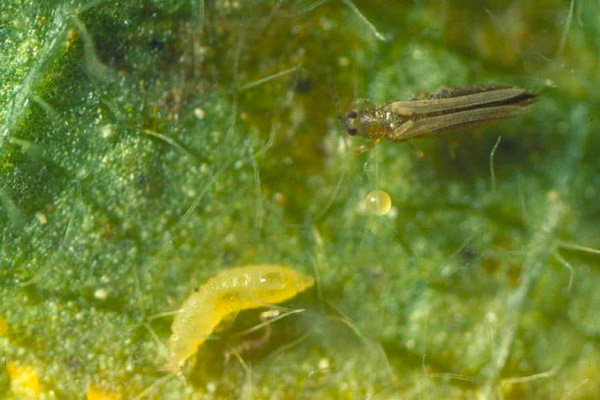
Thrips
Species – Tobacco thrips (Thrips tabaci) and Western flower thrips (Frankliniella occidentalis)
Symptoms
On the infested plant organs (leaves, petioles, flowers and fruits) small whitish spots are formed with dark dots, which are the pest’s excrements.
At higher population density, the spots merge and the leaves dry out.
The generative organs of plants (buds and ovaries) attacked in the early stages of development become deformed, dry up and fall off.
Life cycle
Favourable conditions for the development of tobacco thrips are high temperatures and low air humidity.
The western flower thrips prefers pepper flowers.
The pests are vectors of tomato spotted wilt virus in vegetable crops.
Control
- Regular inspection of the areas;
- Placement of blue sticky plates;
- Immediate treatment with PPP upon appearance;
- Economic injury thresholds:
- Tomatoes in greenhouses – western flower thrips adults 1 pc per flower; tobacco thrips adults and larvae – 3 pcs per leaf;
- Pepper – flowering: adults and larvae 2 pcs/flower; fruiting 3 pcs/fruit;
- Eggplant – flowering: adults and larvae 2 pcs/flower; fruiting 3 pcs/fruit;
- Authorised PPP: Exalt 200-240 ml/da; Deka EC/Desha EC/ Dena EC 30 ml/da; Dicarzol 10 SP 556 g/da; Lannate 25 WP 80-100 g/da; Meteor 0.06-0.07%; Naturalis 75-100 ml/da; Sineis 480 SC 10-37.5 ml/da; Oikos 100-150 ml/da; Requiem Prime 500-1000 ml/da.
Planthopper
Species – Hyalesthes obsoletus
Symptoms
They suck sap from the infested plants.
The damage has no economic significance.
Life cycle
The pest develops one generation.
The planthopper transmits stolbur phytoplasma.
It spreads the disease until the end of its life.
The symptoms of stolbur disease appear 30-35 days after the moment of infection.
Control
- Agrotechnical measures: sowing of shelter belts of maize; earlier planting of vegetable crops;
- Treatment with PPP: upon appearance of the first specimens or after a warning from forecasting services;
- Economic injury thresholds: tomatoes and peppers after transplanting at the beginning of the vegetation period, June-July – adults 2 pcs/10 sweeps with a net;
- Treatments should be carried out in the early hours of the day, when the pest is less mobile;
- Authorised PPP: Mospilan 20 SP 25 g/da; VAZTAC New 100 EC 10 ml /da; Mageos 8 g/da.
Cotton bollworm
Species – Helicoverpa armigera
Symptoms
The damage is caused by the caterpillars, which initially gnaw the leaves, buds and flowers.
Later they attack the fruits, bore into them and feed on their contents.
Damaged fruits stop growing, become deformed and rot due to various secondary pathogens.
Life cycle
It develops three generations per year and overwinters as a pupa in the soil.
Adult insects occur from May until the end of October.
Fecundity depends on air temperature and humidity, on the presence of nectar for sexual maturation of the moths and on the plants on which the caterpillars feed.
The greatest damage to vegetable crops is caused by caterpillars of the second generation.
Control
- Regular inspection of the areas;
- Use of pheromone traps for monitoring;
- Destruction of weed vegetation;
- Treatment with PPP is effective when directed against young caterpillars;
- It is necessary to carry out two treatments at an interval of 8-10 days, depending on meteorological conditions and the residual effect of the insecticide;
- The egg parasitoid Trichogramma spp. may be used for pest control;
- Authorised PPP: Coragen 20 SC 14-20 ml/da; Exalt 200-240 ml/da; Avant 150 EC 25 ml/da; Altacor 35 WG 8-12 g/da; Ampligo 150 ZC 40 ml/da; Lannate 25 WP 80-100 g/da; Affirm 095 SG 150 g/da; Decis 100 EC 7.5-12.5 ml/da, Cytrin Max 10 ml/da; Rapax 100-200 ml/da.