

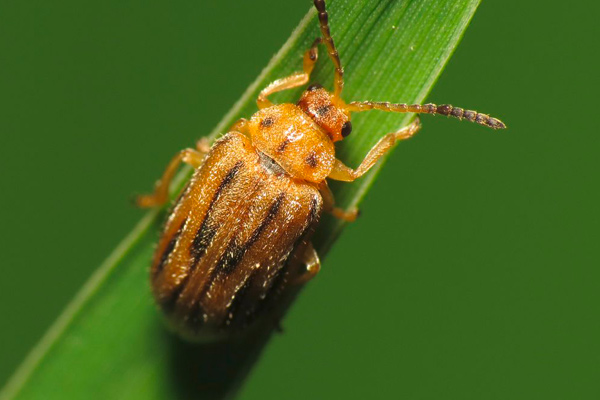
The small beetle "Ophraella communa" and Ambrosia artemisiifolia have one thing in common: They were introduced from North America to Europe, and thus are invasive and introduced species that can threaten the original flora and fauna of the Old Continent. However, Ophraella communa can also be a beneficial species, as its favourite food is ragweed, whose pollen causes mass allergic reactions in millions of people at the end of summer and in autumn.
The invasive species Common ragweed (Ambrosia artemisiifolia L., fam. Asteraceae) is not only a serious competitor to cultivated crops, but is also an extremely harmful weed for human health, as it causes numerous dangerous allergies affecting a vast part of the population.
Ragweed is not without reason considered a weed of globalization – its seeds are not only easily transportable, but also spread effortlessly over short and long distances. In addition, they are incredibly resilient and productive. They retain their germination capacity and can reproduce for as long as 40 years, and at a very rapid rate. This is a weed whose pollen is among the most aggressive allergens in the world. A minimal amount of it in one cubic metre of air is sufficient to trigger allergic reactions, both in people sensitive to allergens and in some animals, such as horses, for example.
The European research team, which includes Prof. Gerhard Karrer from the University of Natural Resources and Life Sciences in Vienna, has published in the latest issue of the renowned scientific journal “Nature Communications“ data on the real threat posed by the highly allergenic plant Ambrosia artemisiifolia L. to public health and biodiversity in Europe. The report emphasizes the fact that there is a new invasive beetle species, Opharaella communa, whose larvae prefer to feed on the leaves and flowers of Common ragweed, and this gives experts hope that they could reduce the harmful impact of ragweed by naturally limiting its invasion.
In 2013, the leaf beetle Ophraella comuna was detected in the area around Milan. The beetle larvae managed to almost completely destroy the ragweed populations in Northern Italy. Prof. Karrer and his Croatian colleagues were able to study the further spread of the beetle towards the Pannonian region in Eastern Central Europe, which is heavily infested with Common ragweed.
The data in the report indicate that before O. communa immigrated to Europe, about 13.5 million people suffered from ragweed-induced allergy, resulting in annual costs of 7.4 billion euro for medicines, medical examinations, sick leave, etc. Predictive models show that biological control of A. artemisiifolia by this leaf beetle will reduce the number of patients by around 2.3 million and healthcare costs by 1.1 billion euro per year.
The controlled spread of O. Communa must be carried out under strict phytosanitary measures, because it has been established that it can also attack cultivated crops such as sunflower. In Turin, after the destruction of a ragweed field, the small beetle massively attacked a neighbouring sunflower field. For the time being there are no precise studies on how the beneficial activity of Opharaella communa can be limited exclusively to the invasive species – Ambrosia artemisifolia L.
Opharaella communa is a beetle from the family of leaf beetles (Chrysomelidae), detected in Europe for the first time in 2013, originating from North America – just like ragweed (first observed in Europe in 1883), which is spreading rapidly due to the warmer climate of the European continent. The beetle species feeds only on a few plant species (oligophagous), but mainly on ragweed (Ambrosia artemisiifolia). The beetles are 3.4 to 4.1 millimetres long and 1.8 to 2.1 millimetres wide (males), while females are 3.9 to 4.3 millimetres long and 2.0 to 2.4 millimetres wide. Their head is yellowish and they have a large black spot on the back. The elytra of the beetle, as in all species of the genus Ophraella, have dark longitudinal stripes.
The natural range of Opharaella communa is the eastern parts of North America, where the species is distributed from Mexico to Canada. However, for several years now the species has been reproducing very rapidly in Southern Switzerland, Northern Italy, the Pannonian region, East Asia–China and Japan. To ensure the survival of the Opharaella communa population, temperatures between 20 and 32 °C are required during its development, with optimal temperatures between 25 and 28 °C. It overwinters in the soil until the following year, when it begins to reproduce at suitable temperatures. The beetle is capable of flying 25 km within a single day.
According to data from the University of Natural Resources and Life Sciences, Vienna