

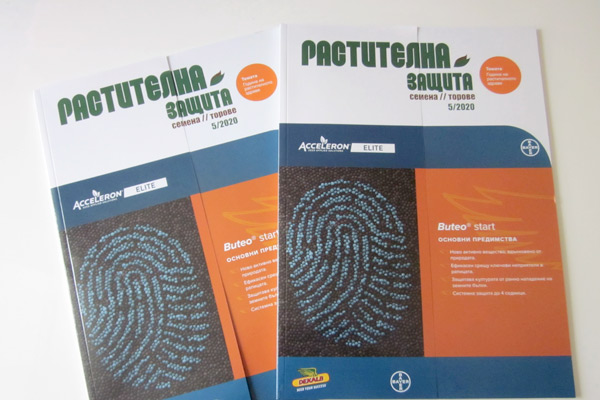
See which are the current topics in this issue.
We have dedicated the June issue of the magazine “Plant Protection” to the International Year of Plant Health 2020. Plants are at the basis of life and we owe to them 80% of the food we consume and 98% of the oxygen we breathe. Climate change and human activities deteriorate ecosystems and reduce biodiversity, while the increased free movement of people and goods provides a niche for the spread of pests worldwide, causing major damage to local plants and the environment. Priority pests for the territory of the European Union in 2020 are the pine wood nematode and the bacterium Xylella fastidiosa, declared extremely dangerous by the International Plant Protection Convention, due to their massive occurrence in European countries.
The key to successfully reducing the risk of infections and increasing the resilience of agricultural production in an uncertain abiotic environment is integrated plant protection. The way in which crops are protected has changed drastically over the last century. While at the beginning organized plant protection relied mainly on cultural and mechanical practices, using a few minerals and some active substances as pesticides, the revolution of synthetic chemical products in the 1950s–1960s contributed to an increase in yields in developed countries by up to 2.5 times. Along with this agricultural boom, in recent years we have also been observing the harmful impact on the environment and human health from the excessive use of plant protection products (PPPs).
Do we need change? How can we determine the appropriate crop protection strategy? What is the plant protection of the future? Is it possible to grow crops without the use of PPPs?
All these questions are part of the strategy in which plant protection must be considered as an important component of plant health, and plant health as an important objective of sustainable agriculture. The pyramid of Integrated Pest Management (IPM) needs to be reconsidered in a new light. Instead of being the basis of pest control, PPPs must be the last resort. This is possible through the application of modern systems for forecasting, warning, monitoring, agroecology and resistant varieties, both through classical breeding methods and through new techniques such as gene editing (CRISPR-Gas) or genetic transformation. Precision agriculture, including remote sensing with drones and the combination of digital tools and technologies, can also reduce and optimize the use of PPPs. In the future, the role of chemicals in agriculture will change, as their action will become increasingly harmless to the environment and their task will be to manipulate pests so that they do not cause serious economic damage. High-tech biopesticides will be based on knowledge derived from understanding the molecular mechanisms underlying the associations between plants, pests and pathogens, imitating the natural antagonistic strategies of bioagents and/or weakening the defensive barriers of pests.
Enjoy your reading!
Here is what else we will present to you in this issue:
Topic
*** – Protect plants – protect life
V. Harizanova – A look at the future of plant protection
A. Harizanov – Natural factors limiting mass multiplication of insects and mites in agrocenoses
V. Harizanova – Integrated pest management – a key component of plant protection
V. Maneva, D. Atanasova – Status and problems of plant health in cereal crops under changing climate conditions
G. Pasev, V. Radeva-Ivanova – Viruses in vegetables – methods for diagnosis and identification
*** – A beetle saves those suffering from ragweed allergy
Diseases
P. Chavdarov – Do not underestimate sclerotinia rot in cucumbers
Orchard – Pear
A. Zhivondov et al. – The pear – an unjustifiably neglected fruit crop
D. Aleksandrova – Diseases
D. Stefanova – Pests
Traffic light
M. Borovinova – In the orchard in June
S. Masheva et al. – In the vegetable garden in June
Comment
E. Ivanov – Bulgarian agriculture can revive the textile industry
The magazine “Plant Protection & Seeds and Fertilizers“ has no involvement with the information presented in the published advertisements and PR materials. Responsibility for their content lies entirely with the advertisers. The authors of the publications bear responsibility for the information contained in the authored materials.