

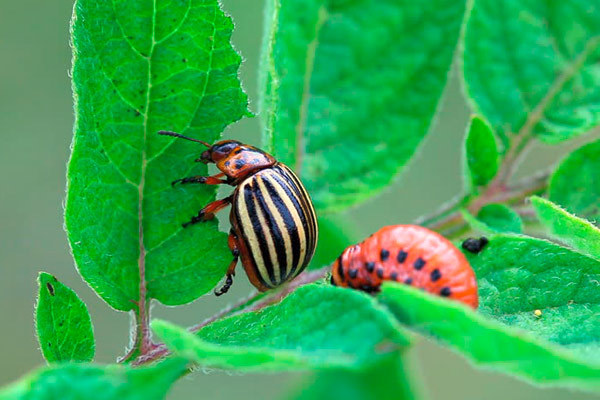
I. Pests
Colorado potato beetle
Species – Leptinotarsa decemlineata
Symptoms
The Colorado potato beetle is a major pest of potatoes in our country. It is distributed throughout the country and is of decisive importance in potato production;
It also causes damage to tomatoes and eggplant;
Damage is caused by the larvae and the beetles, which feed on the leaves of the plants and, in case of mass infestation, completely defoliate them. The amount of consumed food depends on the temperature and humidity of the environment and on the phenophase of the plants. The most dangerous for the plants are the injuries caused during flowering and tuber formation.
Life cycle
The pest overwinters as an adult insect in the soil;
It develops from 1 to 3 generations per year;
It emerges at a soil temperature of 14-150C, at a depth of 20-25 cm;
In a dry spring the emergence of the beetles is delayed;
At a temperature of 15-200C the beetles are not active;
The optimum temperature for egg development is 22-250C and relative humidity 70-75%;
The larvae pass through four larval instars;
Feeding of the pest, its migration and reproduction are dependent on temperature.
Control
- Control of the pest starts with the appearance of the overwintered adults;
- When the population density is high, the beetles can be collected by hand and destroyed before they have laid eggs on the leaves;
- Chemical control is carried out at the following thresholds:
- 10% infested hills, at plant height 10-15 cm;
- 5 adults/100 plants, at plant height 15-25 cm;
- 10 egg clusters/10 plants;
- 150 larvae/100 plants;
- 10% to 20% infested plants from the budding stage to flowering.
Registered insecticides for control: Alverde 240 SC 20 ml/da; Ampligo 150 ZC 30 ml/da; Ascot WG 40-80 g/da; Biscaya 240 OD 20 ml/da; Vaztak Nov 100 EC 10 ml/da; Decis 100 EC 12.5 ml/da; Estrela WG/Lamsha WG/Adalam WG/Indulam WG 40–80 g/da; Efcimetrin 10 EC/Tsaiper 10 EC 20 ml/da; Imidan 50 WG 100 g/da; Calypso 480 SC 10-15 ml/da; Karate Zeon 5 CS 15 ml/da; Coragen 20 SC 5-6 ml/da; Mageos 8 g/da; Mospilan 20 SP 6 g/da; Oikos EC 100-150 ml/da; Proteus 110 OD 45 ml/da; Sineis 480 SC 5 ml/da; Sumi Alpha 5 EC/Sumicidin 5 EC/Oasis 5 EC 15 ml/da; Fury 10 EC 10 ml/da; Cyclone 10 EC 20 ml/da; Sherpa 100 EW/Afikar 100/Cyperfor 100 EW/Cyclone 100 EW 20 ml/da; Sherpa 100 EC 20 ml/da
Potato tuber moth
Species – Phthorimaea operculella
Symptoms
Damage is caused by the larvae, which bore into the parenchyma near the main vein, where the formation of mines begins;
Initially the mines are small, but gradually expand into wider galleries;
They are transparent and the caterpillar and its excreta are visible inside them;
Heavily mined leaves gradually wilt and dry up;
The caterpillars leave the mines and penetrate the stem, where they make tunnels directed downwards;
Above the damaged area the stem wilts and dries up;
On the tubers, damage by the larvae starts from leaf wilting until potato harvest or during storage in potato stores;
On the tubers the larvae excavate galleries filled with excreta and webbing, and the tubers become unsuitable for consumption.
Life cycle
The moth overwinters as a mature caterpillar and pupa in the field or in potato stores;
It develops four generations in our country;
The butterflies fly mainly at dusk, and during the day and at night remain hidden on the underside of leaves, on the soil surface and on other plant residues;
They lay their eggs singly or in groups of several on the underside of leaves, along the veins, on stems, on soil clods and on exposed tubers.
Control
- The potato tuber moth causes greater damage to potatoes in the field and in potato stores on farms with poor agricultural practices;
- Effective control includes regular soil cultivation, maintenance of optimum moisture, and hilling of the tubers.
- Registered insecticides for control: Ampligo 150 ZC 30 ml/da; Coragen 20 SC 12.5-17.5 ml/da.
- Treatments carried out against the Colorado potato beetle are also effective against the potato tuber moth.
Aphids
Species – Fam. Aphididae (Macrosiphum euphorbiae, Myzus persicae, Aphis nasturtii, Aphis fabae, Aulacorthum solani)
Symptoms
Aphids occupy an important place in the structure of the aboveground harmful entomofauna on potatoes;
They are a limiting factor for seed production stands;
Aphids are vectors of a number of viral diseases – potato leaf roll virus, potato virus Y and others;
In potatoes for mass production aphids have more limited economic importance;
Infested plants have yellowed, deformed leaves with necrosis;
The plants lag in their development, some of the flowers fall off, and the tubers remain underdeveloped;
The damage can also affect yield if the timing and degree of infestation coincide with critical phenophases.
Life cycle
Due to their high reproductive capacity and multigenerational development, aphids can in a short time colonise a large number of plants and form dense colonies.
Control
- Regular inspections of potato fields are necessary and, when a density of 2-5% infested plants in crops for consumption and single individuals in seed production fields is established, spraying should be carried out.
- Registered insecticides for control: Ascot WG 40-80 g/da; Biscaya 240 OD 0.06%; Deka EC/Desha EC/Dena EC/Poleci/Decision 50 ml/da; Estrela WG/Lamsha WG/Adalam WG/Indulam WG 40–80 g/da; Calypso 480 SC 20 ml/da; Proteus 110 OD 75 ml/da.
II. Diseases
Late blight of potato
Pathogen – Phytophthora infestans
Symptoms
The first symptoms are observed on the lowest leaves, which are in contact with the soil surface, as water-soaked, chlorotic spots covered on the underside, at the boundary with healthy tissue, with a sparse whitish mould;
Later, the spots enlarge and scorch and change colour from grey-brown to black;
The spots on the stems are grey-brown. From them the pathogen passes into the tubers.
The spots on the tubers become visible only when they are lifted. They are slightly sunken, sharply delineated and grey.
Life cycle
The pathogen overwinters as mycelium in the tubers;
Favourable conditions for infection are the occurrence of “critical periods“:
Rainfall over two consecutive days with a total amount of at least 10 l/sq. m;
Minimum temperature in the range 10-120C, maximum – 18-250C;
Relative air humidity above 80%;
Persistence of water droplets on the plants.
Control
- Removal of plant residues from the previous vegetation;
- Destruction of volunteer plants;
- To protect potatoes from infestation, preventive spraying should be carried out when conditions are favourable, using contact plant protection products.
- Upon detection of the first symptoms of late blight, plant protection products with local-systemic and systemic action should be used
- Registered plant protection products for control: Acrobat Plus WG 200 g/da; Armetil M 250 g/da; Valbon 160 g/da; Vitene Triplo R 400-450 g/da; Vitra 50 WP/Kuprohay 50 WP 150 g/da; Despina 200 g/da; Dimix 500 SC 30-36 ml/da; Dithane DG 200 g/da; Dithane M-45 200 g/da; Equation Pro 40 g/da; Infinito SC 120-160 ml/da; Cuper Key 180-240 g/da; Cuper Key Flow 180-240 g/da; Cuper Lainco 180-240 g/da; Karial Star 60 ml/da; Katanga Man 300-500 g/da; Kodimur 38 FLO 240-320 ml/da; Kodimur M 240-600 g/da; Kodimur 50 WP 180-240 g/da; Corzate 60 WG 15-20 g/da; Quantum Rock 250 g/da; Cupra 180-240 g/da; Cuproxat FL/Tribase Flowable 300 ml/da; Laincobre M 240-600 ml/da; Leymay 50 ml/da; Lieto 45 g/da; Manfil 80 WP 200 g/da; Manfil 75 WG 210 g/da; Moximate 505 WG 240-300 g/da; Pencozeb 80 WP 200 g/da; Pencozeb 75 WG 210 g/da; Polyram DF 180-200 g/da; Presidium Uno 100 ml/da; Proxanil/Axidor 200 ml/da; Profilux 200 g/da; Ranman Pack 20 ml/da + 15 ml Activator; Ranman Top 50 ml/da; Revus 250 SC 50 ml/da; Rival Duo 250 ml/da; Ridomil Gold MC 68 WG 250 g/da; Ridomil Gold R WG 500 g/da; Sankozeb 80 WP 200 g/da; Simbal Flow 50 ml/da; Simbal 45 WG 25 g/da; Taegro WP 18.5-37 g/da; Funguran OH 50 WP 150 g/da; Champion WP/Champ 50 WP/Macc 50 WP 150 g/da.
Early blight (brown leaf spots)
Pathogen – Alternaria solani
Symptoms
On the lowest leaves brown, rounded, enlarging spots with a concentric structure appear;
Gradually the leaves become deformed, yellow and dry, and the pathogen moves to the upper layers of the canopy;
The spots on the stems and petioles are elongated, brown and dry.
Life cycle
The pathogen survives in plant residues in the soil;
Development of the pathogen is favoured at temperatures of 22-260C and in the presence of heavy dews or frequent showers.
Control
- To protect potatoes, preventive treatments should be carried out when favourable conditions for pathogen development are present;
- At the appearance of the first spots, crops should be treated with plant protection products with local-systemic and systemic action;
- Registered plant protection products for control: Acrobat Plus WG 200 g/da; Karial Star 60 ml/da; Cupertin M 400 g/da; Polyram DF 180-200 g/da; Ridomil Gold MC 68 WG 250 g/da; Sankozeb 80 WP 200 g/da; Score 250 EC 0.06%; Taegro 18.5-37 g/da.