

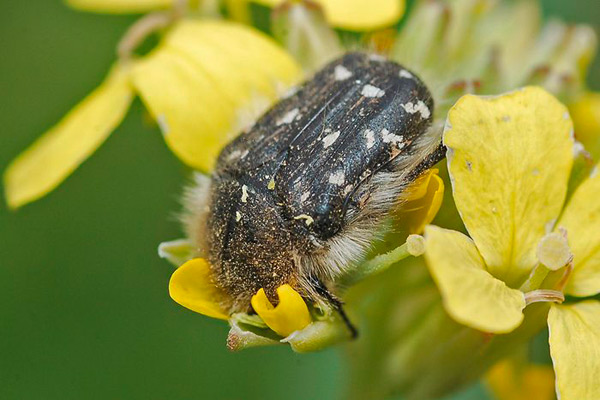
Description of the pest
The hairy beetle is a widely distributed pest of fruit crops in Bulgaria. It completely destroys the attacked flowers by gnawing all floral organs (petals, stamens, pistil). In addition, it gnaws at unopened flower buds, young shoots and young leaves. Among fruit crops, it most severely attacks and damages quince, pear, apple and, less frequently, plum, sour cherry, peach and strawberry. Besides these, it attacks small fruits, grapevine, cruciferous crops, cereals, legumes, some Chenopodiaceae and Apiaceae plants, etc.
Damage:
The pest develops one generation per year and overwinters as an adult insect in the soil. The beetles become active early in spring and cause damage during flowering, attacking all flowering fruit species. They are active in sunny weather, while in cool and cold weather they hide under soil clods or remain motionless on the plants.
In dry and warm springs, the damage caused by the beetle is significant. The adults feed on the flowers, gnawing the pistils, stamens and petals.
The flowers turn yellow and appear as if frost-damaged. The beetle also gnaws pits in the young fruits, especially in cherry, which become deformed.
Control:
The hairy beetle appears during the flowering period of fruit crops, and the use of plant protection products is highly restricted.
In small areas, manual collection in the morning hours and destruction of the beetles is applied, after shaking the branches or the whole trees.
Control measures are implemented at an economic injury threshold of 3–5 individuals/100 rosettes, or 5% damaged inflorescences. Chemical control of the hairy beetle is difficult, firstly because it is carried out during flowering and most plant protection products are harmful to bees, and secondly because the beetle’s body covering provides very good protection against pesticides.
Registered insecticides for control: Vaztak Nov 100 EC – 10 ml/da (in oilseed rape).