

The average monthly temperature in April for most fruit-growing regions of the country is between 10 and 14℃, and the monthly rainfall total is from 40 to 70 l/sq.m for the lowland areas and between 60-100 l/sq.m for the mountainous ones. Sudden weather changes during the month are a frequent phenomenon, and the risk of frost is high.
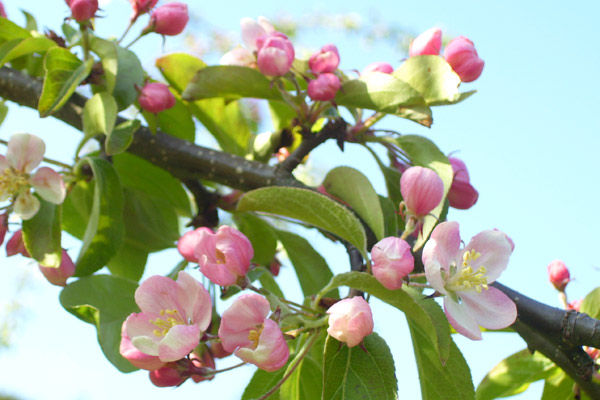
In April, fruit species in the different regions of the country are in various phenophases: mouse ear, white bud, flowering.
For the apple at mouse ear stage, the first pre-bloom spraying against apple scab and powdery mildew is carried out with one of the following fungicide mixtures: Bordeaux mixture 1% + Bayfidan 250 EC – 0.015%, Champion WP – 0.3% + Bayfidan 250 EC – 0.015%, Funguran OH 50 WP – 0.3% + Bayfidan 250 EC – 0.015%. Besides Bayfidan, Systhane Ecozome EW – 20-150 ml/da may also be used. Scab-resistant cultivars should be sprayed only with Bayfidan 250 EC – 0.015% or Systhane Ecozome EW – 20-150 ml/da. The indicated fungicide mixtures are preferable for pre-bloom treatments in order to prevent the development of resistance to the pathogen causing scab, Venturia inaequalis. Also suitable for pre-bloom treatments against scab are the fungicides Manfil 75 WP – 320 g/da, Captan 50 WP – 0.2%, Polyram DF – 0.2%, Sancozeb 80 WP – 200 g/da, Thiram 80 WG – 0.3%, Folpan 80 WDG – 0.15%. For simultaneous control of powdery mildew, these fungicides must be combined with Bayfidan 250 EC – 0.015% or Systhane Ecozome EW – 20-150 ml/da.
The cultivar Golden Delicious is susceptible to russeting of the fruits, and copper products enhance this manifestation, which necessitates the use of other fungicides. Captan 50 WP – 0.2% is suitable and can be successfully applied in pre-bloom treatments. The fungicide is also recommended for other cultivars that are susceptible to fruit russeting.
Cultivars resistant to scab – Prima, COOP-10, Florina, Liberty, Pioneer, McFree, Pilot, Topaz, Novamak, Sava, Rubinola, Jonafree, Jonathan, etc., should be sprayed only against powdery mildew with Bayfidan 250 EC – 0.015% or Systhane Ecozome – 60-185 ml/da.
The second pre-bloom spraying of apple is carried out at pink bud stage. The same fungicide mixtures and fungicides as for the first treatment are used. In orchards where there is a high density of apple sawfly – 2-3 adults per 100 shaken shoots, one of the following insecticides is added to the fungicide solution: Decis 2.5 EC – 0.03%, Deka EC – 30–50 ml/da, Meteor SC – 60-90 ml/100 l water. Growers who are not able to perform beating tests may orient themselves approximately by the damage observed on the fruits in the previous year or by noticing the drop of fruitlets damaged by the sawfly. The listed insecticides are also suitable for control of the hairy beetle in young apple orchards in the early fruiting period and at very high population density of the hairy beetle.
In April, blossom spraying is also carried out in apple, which is very important for protecting the blossoms from scab. In years with frequent rainfall and high air humidity, mass infections are observed in scab-susceptible cultivars, resulting in blossom drop. This damage often remains unnoticed and growers attribute it to other causes. Blossom spraying is also targeted against powdery mildew and brown rot.
For blossom treatment, one of the following fungicides is used: Luna Experience – 20-75 ml/da, Systhane Super 24 EC – 0.03%, Stroby DF – 0.02%, Flint Max 75 WP – 0.02%, Chorus 50 WP – 0.03%, Shavit 72.5 WDG – 0.2% or the combination Stroby DF – 0.02% + Delan 700 WDG – 0.035%, Faban SC – 120 ml/da, Indar 5 EW – 100 ml/da, Karathane 2.5 EW – 200 ml/da.
For the pear only one pre-bloom spraying is carried out. It is aimed at controlling scab, pear psyllids, pear lace bug and pear sawfly. For scab control, one of the following fungicides is used: Bordeaux mixture – 1%, Funguran OH 50 WP – 0.3%, Champion WP – 0.3%, Captan 80 WG – 0.2%, Dithane M-45 – 200 g/da, Bordo Mix 20 WP – 375-500 g/da. At high infestation levels – 2-3% rosettes with colonies of common pear psylla, one of the following insecticides is added to the fungicide solution: Vaztak New 100 EC – 0.02%, Decis 2.5 EC – 0.03%, Deka EC – 75 ml/da, Sumi Alpha 5 EC/Sumicidin 5 EC – 0.03%, Sineis 480 SC – 30-43.7 ml/da, Lamdex Extra – 80-100 g/da, Naturalis OD – 100-200 ml/da.
Blossom spraying of pear is aimed at controlling scab and brown rot, and the fungicides indicated for blossom spraying of apple are used.
During this period, quince is sprayed against fruitlet blight. The first treatment against this fungal disease is carried out at pink bud stage, and the second – during flowering. For the first treatment it is best to use Bordeaux mixture – 1% or Champion WP – 0.3%, and for the blossom treatment – one of the fungicides Chorus 50 WP – 0.03%, Luna Experience – 20-75 ml/da, Difcor 250 EC – 15 ml/da.
At pink bud stage, plum orchards are sprayed against plum sawfly at a density of 3-5 sawflies per tree on average, established by beating. One of the insecticides Decis 2.5 EC – 0.05%, Deka EC – 30-50 ml/da, Sumi Alpha 5 EC – 0.02% is used. If this spraying is missed, or in the case of very high sawfly density, control of the pest can also be carried out immediately after flowering, when 70% of the petals have turned brown but have not yet fallen. This treatment is conducted when 5% damaged fruitlets are established.
In young fruit-bearing stone fruit species, at pink bud stage, spraying is carried out against the hairy beetle, which at very high densities can completely destroy the blossoms. For its control in fruit crops there is no approved insecticide, but the following may be used: Decis 2.5 EC – 0.03%, Karate Zeon 5 CS – 0.02%, Deka EC – 30–50 ml/da.
In all stone fruit species, blossom spraying is usually carried out in April for control of brown rot. Effective fungicides against this disease are: Luna Experience – 20-75 ml/da, Chorus 50 WP – 0.045%, Signum WG – 30 g/da, Difcor 250 EC – 20 ml/da, Delan 700 WDG – 0.05%, Indar 5 EW – 100 ml/da, Prolectus 50 WG – 80 g/da, Thiram 80 WG – 0.3%.
Most of the apricot and sour cherry cultivars grown in our country are susceptible to brown rot, and in a wet spring and prolonged flowering of these two species, two blossom sprayings should be carried out. The first – at the beginning of flowering, and the second – 8-10 days after the first.
Blossom sprayings should be carried out in the morning, when there is no bee flight. The fungicides used are not toxic to bees, but they must be protected from the spray jet and from contamination with fungicides.
Strawberry plantations are sprayed before flowering with Bordeaux mixture – 1% or Champion WP – 0.3% in combination with Karate Zeon 5 CS – 0.02% or Calypso 480 SC – 0.02% for their protection against leaf spots (white and red) and weevils. The economic injury level for the strawberry-raspberry blossom weevil is 11% damaged buds per square metre or 15% damaged plants, and for the strawberry stem weevil it is 5 damaged flower stalks/leaf petioles per square metre. During flowering, strawberry plants must be treated against grey mould with one of the following fungicides: Switch 62.5 WG – 100 g/da, Luna Sensation SC – 60-80 ml/da, Prolectus 50 WP – 80-120 g/da, Signum WG – 75 g/da, Captan 80 WG – 150 g/da.
In raspberry, when the young shoots reach a height of 15-20 cm, spraying is carried out with Bordeaux mixture – 1% or Champion WP – 0.3% against bud blight (Didymella) and cane blight (Coniothyrium).