

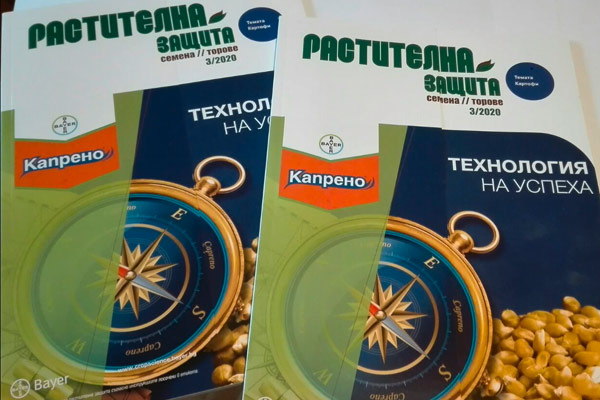
See which topics are current in this issue.
The third issue of the magazine „Plant Protection” in 2020 is dedicated to potatoes, which are one of the most widespread agricultural crops in the world. Between 1500 and 2000 different varieties are known, which vary in colour, size and nutrient content. The wide use of potatoes as food, fodder and raw material for industry determines their important economic significance.
Unlike the increase in global potato production, in our country over the last 10 years the cultivation of this agricultural crop has decreased 4 times, and the harvested areas – 3 times. In Bulgaria, potato production is the main livelihood of a significant part of the population in the semi-mountainous and mountainous regions of the country, but the yields are among the lowest in Europe. The reasons for this are several – a mismatch between the biological requirements of the crop and the soil and climatic conditions in the predominant part of the areas, non-observance of the main elements in the cultivation technology, use of low-quality seed material and not least – a high infectious background of viruses in the country.
In this issue you will learn what the main highlights in potato production are, how to choose a suitable region and soil, the specifics of planting, fertilisation, weed control, agrotechnical measures, which variety to choose and how potatoes fit into different crop rotation systems.
One of the serious threats to potato cultivation are viral and fungal diseases. Prof. Stoika Masheva, PhD, will acquaint you in detail with the diseases of potatoes during vegetation, the diseases during tuber storage, the control measures and the proper disinfection of seed material.
Anthracnose in potatoes is an extremely dangerous disease because it is difficult to diagnose and there are no effective plant protection products available. Preventive measures are leading in the control of anthracnose. You will learn what they are from the article of the Institute of Plant Physiology and Genetics.
Of course, not least are the pests of potatoes, which often compromise the yield because they can attack all parts of the plant – above-ground mass, roots and tubers. Some of them are narrowly specialised to the crop, while others damage other plant species as well. In this issue we will introduce you to the different potato pests and their successful control.
In our special supplement to the magazine, the Fruit Growing Institute in Plovdiv has prepared for you a full basket of apricots. Everything about apricots – from their specific biological characteristics, through the types of varieties distributed in Bulgaria, to the diseases and pests of this beautiful and useful fruit, presented in a concise, brief and clear manner, can be read in issue 3/2020 of the magazine „Plant Protection”.
Enjoy your reading!
Here is what else we will present to you in this issue:
Topic
S. Masheva – Potatoes – an important food for people, problems in their production
V. Blagoeva – Main highlights in potato production
S. Masheva – Viral and fungal diseases are a serious threat
R. Rodeva, Z. Stoyanova – Anthracnose in potatoes
V. Yankova et al. – Pests can compromise the yield
Fruit orchard – Apricot
V. Bozhkova et al. – A full basket of apricots
D. Aleksandrova – Diseases
D. Stefanova – Pests
Pests
A. Kharizanov, A. Kharizanova – Diapause in insects
Quarantine
B. Katinova – Pests from North America and Asia threaten the forests of Europe
Traffic light
M. Borovinova – In the fruit orchard in April
S. Masheva et al. – In the vegetable garden in April
Events
E. Ivanov – Corteva: Reliable solutions in an uncertain environment!
*** – Agrotaym – Isperih: We are determined to offer the best products
The magazine „Plant Protection & Seeds and Fertilisers“ has no involvement with the information presented in the published advertisements and PR materials. Responsibility for their content lies entirely with the advertisers. The authors of the publications are responsible for the information contained in the authored materials.