

In seedling facilities, seedlings are grown for unheated glass and polyethylene greenhouses and for low tunnels. Sowing of seeds for early field crops begins – tomatoes, pepper, eggplant, cabbage, and later for medium-early crops. The seedling facilities are cleaned of plant residues from the previous vegetation, weeds and volunteer plants. The seedling substrate is prepared. It is best for it to be a peat–perlite mixture, which is used to fill trays, flats and pots. If they are placed directly on the soil, the surface must be well levelled. A polyethylene film is placed on it, which insulates the seedling containers from the soil and does not allow the passage of pathogens and pests. Healthy or disinfected seeds are used for sowing. An optimal temperature and humidity regime is ensured in the seedling compartment.
II. Pests
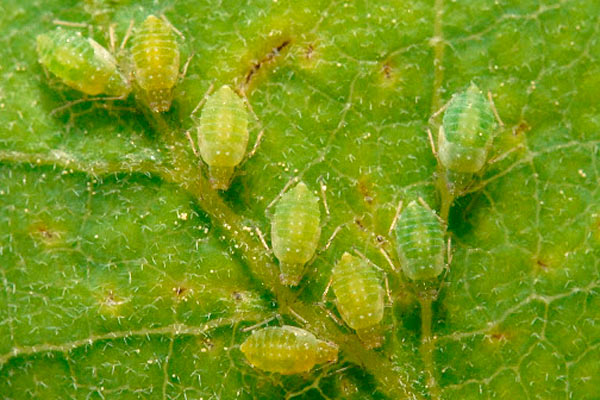
Aphids
Causal agent – fam. Aphididae
Symptoms/Damage:
As a result of feeding, they cause chlorotic spots and deformation of the leaves, stunting and wilting of the plants.
Contamination of the leaf surface by the “honeydew” secreted during feeding.
Development of sooty mould fungi on it and reduction of the photosynthetic surface.
Life cycle:
In addition to direct damage to plants, aphids also transmit certain dangerous viruses.
Control:
- Upon detection of the first specimens in the seedlings, treatment with plant protection products (PPP) should be carried out;
- The last treatment is carried out immediately before planting at the permanent site;
- Destruction of weed vegetation in and around the beds, which is a reservoir for preservation and a source of virus infection;
- Authorised aphicides: Aktara 25 WG 0.007%; Ampligo 150 SE 40 ml/ha; Bi-58 0.05–0.07%; Biscaya 240 OD 0.06%; Danadim Progress 400 EC/Rogor L40/Bi-58 Top 0.05–0.075%; Deka EC/Desha EC/Dena EC 50 ml/ha; Deltagri 30–50 ml/ha; Decis 100 EC 7.5–17.5 ml/ha; Calypso 480 SC 0.02%; Confidor Energy OD 0.06%; Closer 120 SC 20 ml/ha; Kohinor 200 SL 0.05%; Lannate 25 WP 90–100 g/ha; Lannate 20 SL 125 ml/ha; Mavrik 2 F 0.02%; Masai WP 15–25 g/ha; Meteor 0.08–0.09%; Mospilan 20 SP 0.0125%; Mospilan 20 SG 25 g/ha; Nexide 015 CS 0.02%; Picador 20 SL 0.05%; Sivanto Prime 45 ml/ha; Skato 30–50 ml/ha; Sumi Alpha 5 EC/Sumicidin 5 EC/Oasis 5 EC 0.02%; Tepekki 10 g/ha; Fury 10 EC 15–20 ml/ha.
Greenhouse whitefly
Causal agent – fam. Trialeurodes vaporariorum
Symptoms/Damage:
Larvae, nymphs and adults are harmful. They suck sap mainly on the lower side of the plant leaves.
During feeding they secrete “honeydew”, as a result of which the leaves become sticky.
Sooty mould fungi develop on them, which reduce the photosynthetic surface.
Life cycle:
Adult whiteflies are active at night, when they fly short distances.
In addition to direct damage, they also transmit some dangerous viruses in tomatoes.
Control:
- Yellow sticky traps should be used to monitor the occurrence and population density of the whitefly;
- At low population density in greenhouses, the biological control agent Encarsia formosa may be released;
- Upon appearance of the first specimens, treatment with PPP is carried out;
Authorised PPP: Admiral 10 EC – 0.05%; Aktara 25 WG – 0.03%; Bi-58 0.1%; Braid 50–112.5 ml/ha; Vaztak Nov 100 EC 0.03%; Deka EC/Desha EC/Dena EC 50 ml/ha; Confidor Energy OD 0.08%; Krisant EC 75 ml/ha; Closer 120 SC 20–40 ml/ha; Lannate 20 SL 125 ml/ha, Lannate 25 WP 80–100 g/ha; Meteor 0.08–0.09%; Mospilan 20 SP 0.02%; Mospilan 20 SG 35–40 g/ha; Mulligan 25–95 ml/ha; Naturalis 75–100 ml/ha; Natur Breaker 75 ml/ha; Pyrethro Natura 75 ml/ha; Proximo 50–80 ml/ha; Sivanto Prime 56 ml/ha.
Thrips: tobacco thrips and western flower thrips
Causal agent – Thrips tabaci; Franklinella occidentalis
Symptoms/Damage:
On the attacked plant organs (leaves, petioles, flowers and fruits) small whitish spots with dark dots are formed, which are the pest’s excrements. At higher population density, the spots merge. Generative organs of plants attacked in the early stages of their development dry up and fall off.
Life cycle:
Tobacco thrips is found mainly on the leaves, less often on the flowers. Favourable conditions for its development are high temperatures and low air humidity.
Western flower thrips attacks mainly the flowers.
Thrips are vectors of tomato spotted wilt virus (TSWV).
Control:
- For monitoring, blue sticky traps should be used, which, in greater numbers, reduce the pest population density;
- Upon appearance, treatment with PPP;
- Authorised PPP: Deka EC/Desha EC/Dena EC 30 ml/ha; Dicarzol 10 SP 556 g/ha; Lannate 25 WP 80–100 g/ha; Meteor 0.06–0.07%; Naturalis – 75–100 ml/ha; Sineis 480 SC – 10–37.5 ml/ha; Fury 10 EC 0.015%.
Tomato leaf miner moth
Causal agent – Tuta absoluta
Symptoms/Damage:
The moth forms short and wide mines on the leaves, in which caterpillars and excrements can be seen, located at one end.
Damage to the fruits provides opportunities for the development of diseases causing their rot.
Life cycle:
The adult moths are active at night and hide among the leaves during the day.
The damage is caused by the caterpillars. They prefer leaves the most, but also attack the fruits.
Control:
- Use of pheromone traps and black sticky plates for timely detection of the pest, for reducing its population density and for taking adequate control measures.
- At low population density, one of the biological control agents Macrolophus pygmaeus or Nesidiocoris tenuis may be released.
- Upon detection of the first specimens, treatment with PPP is carried out.
- Authorised PPP: Avant 150 EC 25 ml/ha; Alverde 240 SC 100 ml/ha; Altacor 35 WG 8–12 g/ha; Ampligo 150 SE 40 ml/ha; Affirm 095 SG 150 g/ha; Bermectin 50–100 ml/ha; Voliam Targo 063 SC 0.08%; Decis 2.5 EC 0.05%; Confidor Energy OD 80 ml/ha; Coragen 20 SC 14–20 ml/ha; Lannate 20 SL 125 ml/ha; Lannate 25 WP 100 g/ha; Mospilan 20 SP 0.02%; Neem Azal T/S 0.3%; Picador 20 SL 0.05%; Rapax SBS 100–200 ml/ha; Sineis 480 SC 10–25 ml/ha; Warrant 20 SL 50 g/ha.