

Fruit species are attacked by a number of insects, mites, viruses, phytoplasmas, bacteria and fungi which, under favourable conditions for their development, can completely destroy the fruit crop. Some of them also cause premature death of the trees. The production of high-quality fruit is impossible without protecting these species from pests.
Measures for protecting fruit trees from diseases and pests must begin as early as February. During this month a large part of the fruit species are in the phenophase of forced dormancy due to unfavourable temperatures. Warm periods during this month can lead to activation of vital processes both in the fruit species and in their pests. This necessitates that measures for the protection of fruit trees from diseases and pests start already at the end of winter.
During the warm days of February, ploughing can be carried out to bury the fallen leaves, if this has not been done in the autumn. This soil cultivation also destroys part of the pupae of the cherry fruit fly, the false caterpillars of the sawfly on stone fruits, the sour cherry sawfly, the black plum fruit sawfly, the overwintering forms of the cherry/sour cherry weevil, the apple blossom weevil and the apple blossom beetle.
Ploughing in the fallen leaves helps to reduce infection by scab in apple and pear, cylindrosporiosis in sweet cherry and sour cherry, red leaf spots in plum, etc. The listed diseases are caused by fungi that overwinter in the infected fallen leaves.
By ploughing in the leaves, the overwintering stock of leaf-mining moth species, which overwinter in the fallen leaves, is also reduced. When ploughing in the leaves, great care must be taken not to injure the root system, which leads to infections with bacterial canker or agents of root rot. The ploughing depth should be determined by the age of the plantation and the type of rootstock.
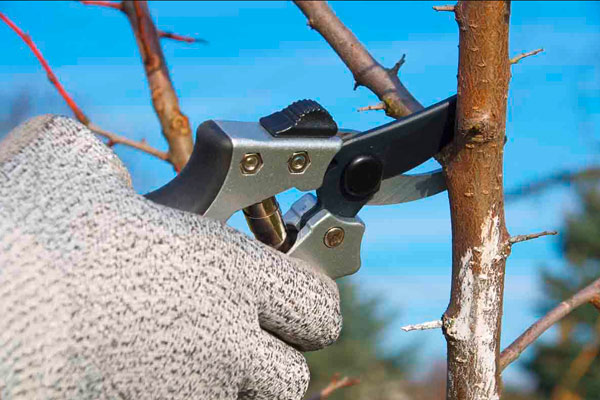
During this period, pruning is carried out for the training of fruit trees and, simultaneously with it, infected shoots are removed: powdery mildew in apple, scab in pear, black rot in fruit trees, cytospora canker, lead/silver/leaf in fruit trees, shot-hole disease in stone fruits. Infected shoots from fire blight in pome fruits and bacterial canker /Pseudomonas syringae/ in stone fruits are also cut out, if they have not been removed during the vegetation period, which is the most appropriate moment. Damaged branches from leopard moths, wood-boring insects, goat moth, apple clearwing moth, apple twig moth are also cut out.
After sanitary pruning, the wounds are coated with white latex paint to which Champion or Funguran is added. All cut branches and twigs are removed from the orchard and burned so that they do not serve as a source of infection.
One of the agrotechnical measures for limiting the development of apple scab is moisture-charging irrigation at the end of winter, by which the discharge/“shooting”/ of the overwintering scab spores can be accelerated and completed within a shorter period. This irrigation should be carried out before bud break.
During the warm days of February and the first half of March, fruit species are sprayed to reduce the overwintering stock of: eggs of European red mite, brown mite, green apple aphid, rosy apple aphid, apple-plantain aphid, pear aphid, pear leaf blister aphid (Psylla pyri – Reaumur’s pear psylla), black cherry aphid, mealy peach-cane aphid, greenhouse peach aphid, leaf-curling aphid, large peach aphid, small and large plum aphid, small winter moth, large winter moth, rose tortrix, hawthorn tortrix, brown-spotted tortrix; larvae of San Jose scale, yellow oyster scale, false San Jose scale, apple comma scale. Against these pests in apple, pear, sweet cherry, sour cherry, apricot, peach and plum, treatments are carried out with preparations based on paraffin oil – Ovipron Top EC – 2.5–3.5 l/da, Ovitex EC – 2 l/da, Ecstyoyl EC – 375–1500 ml/da, Insectoil Key – 375–1500 ml/da, Laincoil EC – 1500 ml/da.
For simultaneous control of peach leaf curl, scab in pear and peach, shot-hole and brown rot in stone fruits, bacterial canker (blight) in sweet cherry, sour cherry and apricot caused by Pseudomonas syringae, pockets (blisters) in plum, one of the copper-containing fungicides is added to the above-mentioned preparations – Bordeaux mixture 1%, Bordo Mix 20 WP – 500 g/da, Funguran OH 50 WP – 0.3%, Champion WP – 0.3%, Kocide 2000 WG – 0.3%.
In pear, the development of the pear psylla should be monitored, in particular the leaving of the winter shelters and the dispersal of the overwintered adults on the swelling buds, from where they begin to suck sap. At high pest density /1 adult per 10 spur shoots/ it is necessary to spray against the adults before egg-laying with one of the insecticides: Vaztak New 100 EC – 0.02%, Decis 2.5 EC – 0.03%, Deka EC – 75 ml/da, Lamdex Extra WG – 80–100 g/da, Meteor (15.7 g/l) SC – 0.09%, Sineis 480 SC – 30–43.7 ml/da, Sumi Alpha 5 EC – 0.02%.
In sweet cherry and sour cherry, during this period the trees are shaken in order to determine the density of the sour cherry/sweet cherry weevil – when 3–5 adults per tree are established, spraying is carried out with Meteor (15.7 g/l) SC – 0.06–0.09%.
Winter spraying should be carried out only when there is proven necessity, i.e. when the density of the overwintering forms of the pests exceeds the economic threshold of harmfulness. For individual pests these thresholds are: European red mite – 60–80 winter eggs per 10 cm shoot; aphids – 15–20 winter eggs per 1 m of one- to three-year-old shoot; winter moths – 2–5 eggs per 2 m of one- to three-year-old shoot; codling moth – 0.5 to 1 shield per 1 m of three-year-old shoots; tortrix moths – 3–5 egg clusters per tree; San Jose scale – presence; other scale insects – 20–30 individuals per 1 m shoot; pear psylla – 1 adult or 8–10 eggs per 10 spur shoots; black cherry aphid – 5–10 eggs per 10 cm shoot. This necessitates that growers seek advice from plant protection specialists, thereby avoiding unnecessary expenses and reducing the harmful impact of the pesticides used on the environment.
The amount of spray solution required for winter spraying is determined depending on the age of the trees and the formed crown. Usually, from 80 to 150 litres of spray solution per decare are used.
An important condition for the effectiveness of control against the overwintering forms of pests is the good wetting of all parts of the crown. Preparations based on paraffin oil act by forming a fine layer which deprives the covered pests of access to oxygen and thus suffocates them.