

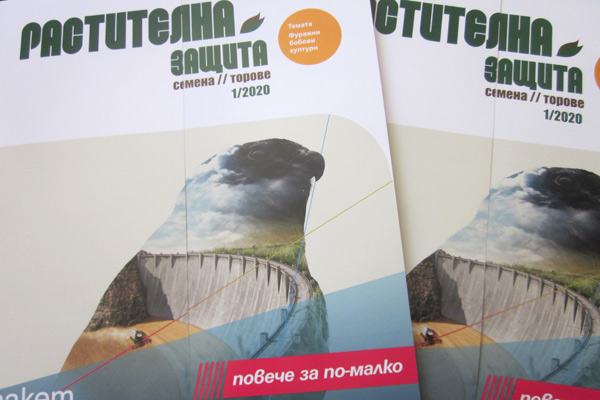
See which topics are current in this issue.
In the first issue of the magazine „Plant Protection” in 2020, we focus on a somewhat different topic, namely what exactly forage production represents, what the prospects and problems in the sector are, the breeding of forage crops, pests and weed control in alfalfa and some annual legume forage crops.
The range of forage crops grown in each country varies depending on the climate and the needs of livestock farming, but perennial alfalfa (Medicago sativa L.) is one of the most preferred and widespread high-protein forage crops. In addition to alfalfa, about 60 other legume crops are grown as a source of feed for different animal species, including forage pea (Pisum sativum L.), white clover (Trifolium repens L.), red clover (Trifolium pratense L.), soybean (Glycine max L.) and others.
The main trend in forage production is related to targeted influence on crop yield in the direction of its optimal increase, realization of the full plant potential and enhancement of the nutritional value and qualitative parameters of the forage.
Forage pea, among all legume crops, occupies the largest areas in our country and yields higher production compared to soybean, common bean and lentil, and its contribution to biological nitrogen in the system of organic farming is indisputable. What the climatic conditions in Bulgaria are for pea cultivation, what varieties exist and what the effectiveness of breeding work in our country is, you can read in the current issue of the magazine.
During the period 2006-2009 in the Pleven region, an investigation was conducted by agricultural scientists, which established that about 12 species of harmful insects occur annually in the areas from which forage is produced. These species, capable of completely compromising the crop in alfalfa forage production, belong mainly to the orders Coleoptera, Hemiptera and Thysanoptera. Prof. Dr. Ivelina Nikolova from the Institute of Forage Crops in Pleven describes in detail the scientific study, the pest species on alfalfa, the damage caused, the population dynamics of the pests related to the plant phenophase, as well as strategies to support the development of control of the dominant harmful species and the updating of crop management technologies. From her you will also learn about the new alfalfa pest – the stem weevil Catapion seniculus.
The Institute of Forage Crops in Pleven has also prepared a useful analysis of the types of weed infestation in forage crops. From the analysis you will learn about the preliminary control of perennial weed species, about weeds in the year of stand establishment, weed control in old stands (1st, 3rd and 4th year), as well as alternative and environmentally sound methods for regulating the degree and duration of weed infestation in alfalfa grass stands. And if you are interested in how to deal with the control of the invasive weed species curly dock (Rumex crispus L.), you will again find the answer in issue 1/2020 of the magazine „Plant Protection”.
Today, climatic and resource challenges raise the question of what constitutes a successful and sustainable forage production system and how it should be managed. The answer is complex and includes many and varied components, such as protection of the environment, landscape, natural resources and biological diversity of flora and fauna. In this issue we hope to provide a comprehensive response to the various aspects concerning forage production and its development in Bulgaria.
Enjoy your reading!
Here is what else we present in this issue:
The Topic
I. Nikolova – Forage production – essence and challenges
V. Kosev – Breeding of forage pea in Bulgaria – achievements and prospects
I. Nikolova – Major pests of alfalfa in the Pleven region
I. Nikolova – A new alfalfa pest
P. Serafimov et al. – Weed control in alfalfa and some annual legume forage crops
P. Serafimov, I. Golubinova – Segador – an alternative for control of curly dock in uncultivated areas
Orchard – Cherry
A. Zhivondov et al. – Growing interest in cherry production
D. Aleksandrova – Diseases of cherry and sour cherry
D. Stefanova – Pests of cherry and sour cherry
Traffic Light
M. Borovinova – In the orchard in February
S. Masheva et al. – In the vegetable garden in February
Interview
E. Ivanov – ARIB: „Green“ Deal in Bulgarian agriculture as well!
Events
*** – Protect plants – protect life!
The magazine „Plant Protection & Seeds and Fertilizers“ has no involvement with the information presented in the published advertisements and PR materials. Responsibility for their content lies entirely with the advertisers. The authors of the publications bear responsibility for the information in the authored materials.