

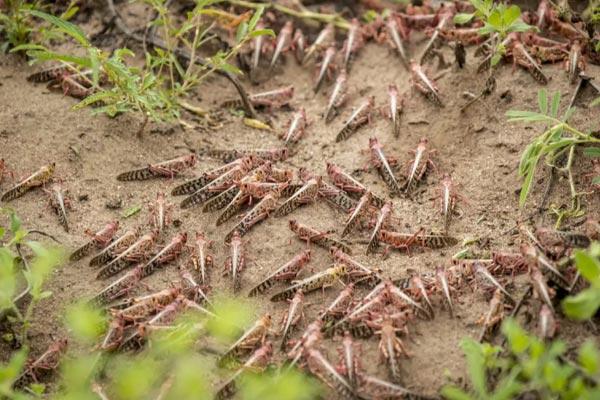
In Ethiopia, Kenya, and Somalia, months of extreme drought have been alternating with prolonged floods. To these climatic anomalies, the local population adds its unsuccessful struggle against the massive invasion of desert locusts, which have almost completely destroyed the crops. The scale of the damage, especially in a region such as East Africa, borders on a complete economic catastrophe. The authorities in Kenya have acknowledged that they have not seen such a disaster in 70 years. The locusts have already devastated vast areas and are causing serious concerns regarding the provision of food for the population.
According to specialists, the meteorological phenomenon known as the “dipole” in the Indian Ocean, known as the Indian Ocean Dipole (IOD), is considered responsible for the crisis situation. The index is derived from the current state of temperatures in two of its parts (hence the name “dipole”). The eastern pole is located around Sumatra, Indonesia, and the western pole is in the western Indian Ocean. While in the east the waters are colder and in the west warmer, this temperature imbalance in the ocean causes substantial changes in the climate over land. With the help of winds, the pattern of tropical convection also changes. It is favoured by the warmer waters, so we see lower pressure, more rain, and storms in the west (East Africa), where we have warmer waters, and we see the opposite in the eastern parts, where we have higher pressure, less rain and storms, and drier conditions in the region over Indonesia and Australia (extremely high temperatures and severe drought).
The meteorological phenomenon “dipole” is currently causing heavy rainfall in the area of Ethiopia, Kenya, and Somalia, which contributes to the mass reproduction of locusts. Their movement tens of kilometres inland is made possible by strong winds. Scientists believe that a swarm of locusts can travel up to 150 kilometres per day.
In March, strong and prolonged rainfall is once again expected, which will multiply the population of desert locusts. For now, the only measure, whose effectiveness in the current situation remains unclear, is the dispersal of enormous quantities of insecticides over the affected areas. According to the UN, the amount required for the purchase of pesticides for the entire region infested by locusts will amount to about 70 million US dollars. At present, local farmers are coping with the critical situation using various methods. In Kenya, for example, they use firearms and tear gas, while in Ethiopia they disperse pesticides with the help of small aircraft. In some places, hundreds of people chase the swarms with hand pumps and pesticide sprayers mounted on trucks.