

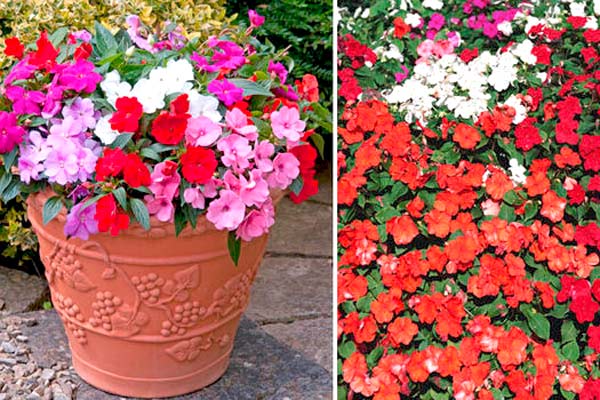
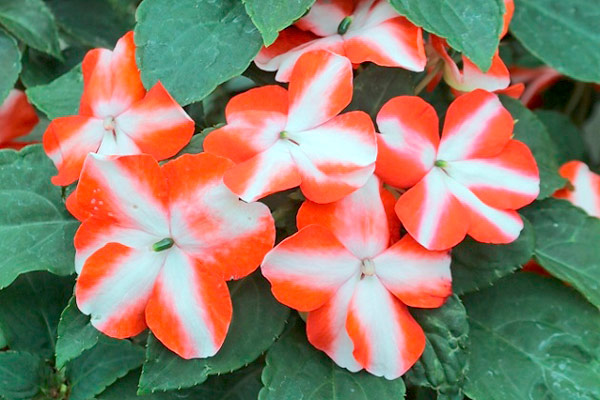
Busy Lizzie (called so in our country because of its cheerful and variegated colours) adorns most homes, balconies and gardens. The flower belongs to the family Balsaminacea. Its Latin name Impatiens means “not bearing pressure” and it owes this name to the fact that the seed pods of the busy lizzie burst very easily, even from a light breeze or slight touch. The most widespread species in our country are Impatiens walleriana and Impatiens balsamina, as well as, in recent times, the species Impatiens New Guinea.
The native land of the busy lizzie is East Africa, where it grows in its natural habitat along the riverbanks of Tanzania and Mozambique at altitudes up to 1700 metres.
Impatiens is a perennial, herbaceous plant with a succulent, strongly branched, creeping light green stem reaching a height of 35–40 cm. The leaves are light green or dark, sometimes with a purple or greyish hue, with an elliptic-lanceolate shape, slightly serrated at the edge. It blooms profusely from early spring to late autumn, and under suitable conditions throughout the winter as well, with bright white, orange, pink, red, purple flowers and their shades. There are single and double-flowered cultivars (resembling a small rose), as well as bicolour forms. The flowers have a diameter of up to 3–4 cm. Representatives of the New Guinea type are distinguished by very large and bright flowers and a darker colour of the leaves, which may also be bicoloured. It is the result of the long and persistent work of breeders. The pioneer company in the breeding of this colourful plant is considered to be Syngenta Flowers, which has nearly 140 years of experience in the flower market. Their new hybrid Imara (Impatiens walleriana) is not only even richer in diverse colour shades, but is also resistant to downy mildew, which is often the cause of the death of this colourful flower. Every year in the city of Essen, Germany, one of the largest international horticultural exhibitions is held (28–31 January 2020), offering innovations, solutions and products from plant production in nurseries to their sale in shops.