

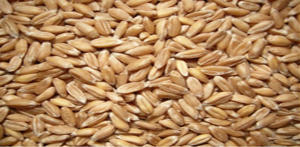
Spelt – Tr. spelta L. It possesses a very well-developed root system. The stem is sturdy and not prone to lodging. The ear is long with a quadrangular shape and a loose structure. The spikelets are separated from each other, but the grains are fully enclosed by the glumes.
The unanimous opinion of most researchers is that spelt tolerates cold well and is a winter-hardy plant. Given sufficient moisture, it germinates at 1-2 degrees C, and at 2-4 degrees C it is capable of development. The emerged young plants easily overwinter even at minus 15-20 degrees C. Spelt wheat is sensitive to powdery mildew, as well as to brown and yellow rust.
Compared to common winter wheat Tr. aestivum, spelt is more demanding of rainfall, as it tolerates drought with greater difficulty. With abundant rainfall and strong solar heating, it develops rapidly and becomes tillered. Before vegetation begins, it can withstand standing in water for a longer period, which determines its tolerance to waterlogging. Therefore, spelt wheat is particularly suitable for those regions of the country where waterlogging and the formation of water mirrors, in which plants die, are observed annually.
Spelt is not particularly demanding of different soil types. It is capable of adapting to poor mountainous soils and yields a harvest even on acidic and saline soils.
During the fertilization period, spelt actively reacts to the presence of copper (Cu) in the soil, respectively to its insufficient quantity, because it positively influences the course of biochemical processes in this developmental cycle. The reason for the bleached ears, which are observed annually in cereal crops, should be sought in the lack of Cu. If the soil contains 2-4 ppm, the amount of copper is insufficient. The amount of copper content in the soil should be at least 6 – 10 ppm.
For a period of 2 years, the "Danube" organic farm Ltd. – Vidin cultivated spelt wheat on about 2000 decares with the assistance of a German company. A yield of about 100 - 150 kg/decare was achieved without applying any fertilization. Herbicides, fungicides and insecticides were also not used.
In addition to common and durum wheat varieties, there are other cereal crops such as triticale, rye, barley, oats, which possess proven advantages over einkorn and spelt - crops of the past extensive agriculture. But considering the production results obtained in recent years and the great interest of a number of farmers and tenants in einkorn and spelt, these crops could be sown on limited areas. The domestic market for them is limited, but if international markets develop and demand for them increases, there is no reason not to expand the areas to 25–50 thousand decares.
It is wrong to think that with einkorn and spelt the problems of increasing production and improving the quality of bread and fodder grain will be solved. Their main and important role is primarily for breeding and genetic purposes. The advantage remains with winter common and durum wheat, with triticale, rye, barley. But farmers who show a certain interest in einkorn and spelt can turn to their cultivation, taking into account their economic interests and the need for the use of such grain in the country's food balance. And last but not least - with the inclusion of these crops in production, conditions are created for expanding the range of organic products.