

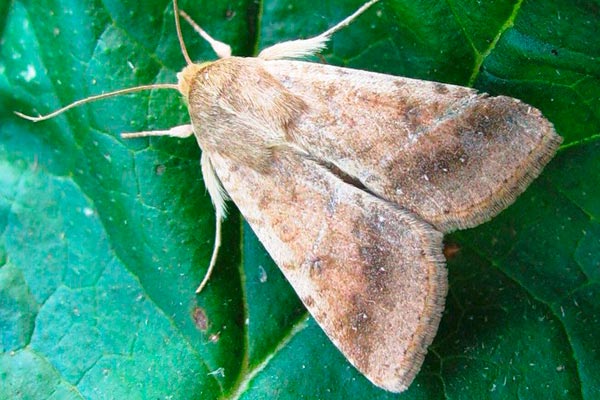
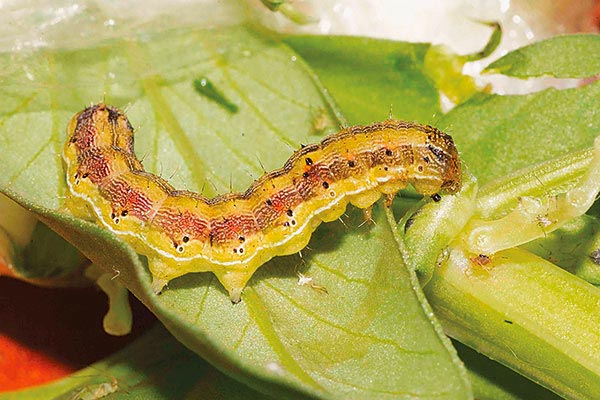
The cotton bollworm (Helicoverpa armigera L.) has shown increasing harmfulness in recent years. It is capable of attacking more than 120 species of cultivated and wild plants. In vegetable crops it causes worm damage to the fruits of pepper, tomato and eggplant.
The larvae are the damaging stage; they gnaw the leaves, buds and flowers, and at a later stage affect the green fruits, bore into them and feed on their contents. Control measures against the bollworm are effective when they are directed against the young larvae from the second to the third instar. In order to cover the generation, it is necessary to carry out two treatments at an interval of 8–10 days, depending on the meteorological conditions and the residual effect of the insecticide.
Strategy for pest control
Regular field inspections. Control of weed vegetation, where the adults feed, eggs are laid and young larvae are nourished before they move onto the cultivated plants.
Authorized plant protection products
Coragen 20 SC 14–20 ml/da; Avant 150 EC 25 ml/da; Altacor 35 WG 8–12 g/da; Ampligo 150 ZC 40 ml/da; Affirm 095 SG 150 g/da; Nurelle D / Sanba / Chlorsirin 550 EC 50 ml/da, etc.
In organic production of vegetable crops, Rapax (Bacillus thuringiensis subsp. kurstaki, strain EG 2348) may be used at a rate of 100–200 ml/da, registered for tomato, pepper and eggplant, and Cyneis 480 SC (Spinosad) 12.5–30 ml/da. Among the measures for limiting aboveground noctuid moths, the egg parasitoid Trichogramma can also be included; it is mass-reared in advance under laboratory conditions and released over the threatened areas.