

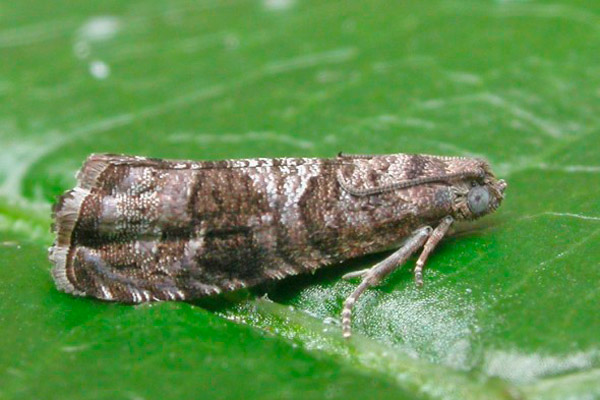
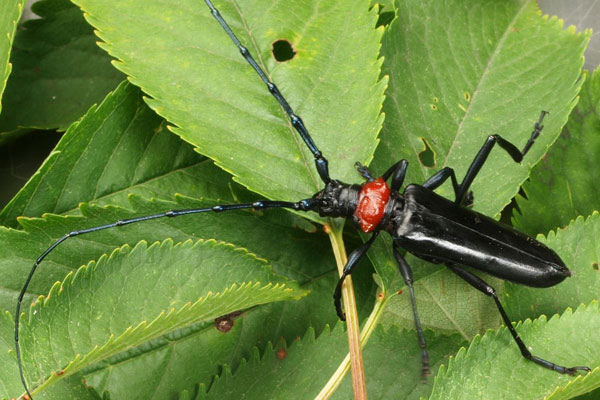
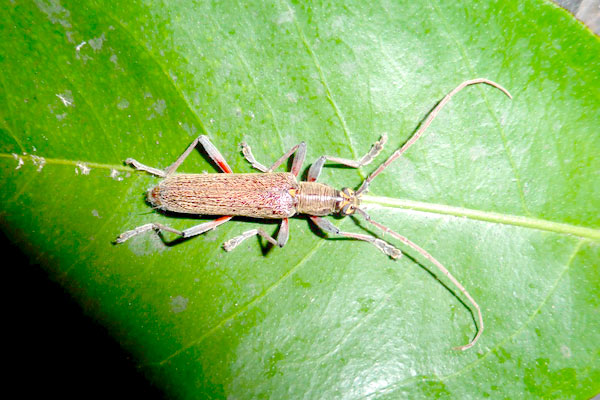
In 2018, the European Commission adopted a decision establishing measures to prevent the introduction and spread within the Union of Aromia bungii (Faldermann), which attacks various host plants of the genus Prunus. The decision was taken in connection with the occurrence of this pest in Italy and Germany. It has been established that it could have an unacceptable economic, environmental or social impact on certain cultivated species in the territory of the Union.
In 2019, the species was proposed for inclusion in Annex No 1, Part A; Chapter I of EU Directive 2000/29, and accordingly in Regulation No 8 on Phytosanitary Control. Together with it, two more species with potentially harmful impact on fruit plants in the territory of the European Community were proposed - Oemona hirta (Fabricus) and Grapholita packardi (Zeller).
Aromia bungii
Economic importance
In China, Aromia bungii is a pest of peach and apricot, but it has been proven that it also develops on poplar, olive, pomegranate and others. Species of the genus Populus and the genus Prunus are widely distributed in the countries of the European Union, in orchards, nurseries, parks, private gardens, roadside alleys and in the wild. The fruit-bearing species are of great economic importance and are highly valued for the unique aesthetic and organoleptic characteristics of their fruits.
The social and economic damage caused by the introduction of Aromia bungii may be significant for certain regions. This pest is capable of destroying extremely rapidly entire trees of apricot, peach and plum (Gressitt 1942). Some data indicate that under favourable conditions the species can multiply and lead to 30% losses in fruit production (Liu et al. (1997), which poses a risk of loss of local varieties and is a serious economic loss for orchard owners, since control involves cutting of infested branches and the destruction and removal of entire trees.
Geographical distribution
The species originates from Asia. It is distributed in Vietnam, China, Japan, Korea, Mongolia and Taiwan. In Europe it has been recorded in Germany, Italy and the United Kingdom. In the USA it has been detected in wooden packaging material.
Hosts
The main hosts are species of the genus Prunus, in particular peach (P. persica) and apricot (P. armeniaca), to a lesser extent plums (P. domestica) and sweet cherries (P. avium). Pomegranate (Punica granatum), white poplar (Populus alba), Chinese white poplar (P. tomentosa), olive (Olea europaea), persimmon (Diospyros virginian),etc.
Damage
According to Chinese sources, the development of these insects lasts 2–4 years, depending on climatic conditions. They overwinter in galleries under the bark of trees. Adults appear at the beginning of July and lay eggs until mid-month.
The larvae of A. bungii prefer old trees in poor condition or infested by bacteria or fungi, but can also attack healthy or slightly damaged trees. Adults start feeding at the beginning or middle of April, with a peak from May to June. They bore galleries (17–22 cm long) in the trunks and larger lateral branches. They prefer to feed under the bark and sapwood of trees, rarely in the heartwood, which leads to loss of fruit production and weakening of the trees. Very characteristic symptoms of the presence of larvae are necroses on the trunk and accumulations of frass around the tree, as well as large exit holes.
Morphology
Eggs are small, whitish, measuring 6–7 mm, located in cracks in the bark of trees. Females most often lay on the trunks of trees, 30 cm above the soil surface, but eggs have also been found in cracks and wounds on larger and smaller branches. Larvae are white to yellowish. In the more advanced stages of development they reach a size of 38–50 mm. Their body is whitish in colour, the mouthparts are black, the prothorax irregularly symmetrical with reddish tints – this specific feature makes it easily recognisable during identification. The pupa is whitish and is found in a “nest” in the heartwood of the tree. The last larval stages and the pupae can survive for months even in cut trees or plant parts until they reach full maturity (E Ucciero, pers. comm.).
Adults are black, 23–40 mm long, with glossy elytra and a red spot (although some forms may be completely black). The antennae are robust, black and significantly exceed the body length in males, while in females they reach the end of the elytra. The beetles emit a specific odour which protects them from predators.
Pathways of introduction
Over long distances the pest can be transported with planting material, whole bonsai-type plants, wood and wooden packaging material from countries where A. bungii has been detected. The import of plant material from Asia is the main reason for the spread of the species – it was precisely in this way that it was introduced into the USA and the United Kingdom.
It is considered that A.bungii can fly only short distances – on the order of 560 to 2 500 m, similar to Anoplophora glabripennis (Motschulsky 1853). However, since it is polyphagous, it cannot be excluded that it may fly much further. Nevertheless, for the time being there is no confirmed spread of the species by flight.
Control
The pest is difficult to detect during visual inspection of large numbers of plants for planting, although on some of them the laid eggs or cracks in the bark resulting from larval feeding may be observed. In addition, these plants are transported in refrigerated trucks, which makes the pest less active and even more difficult to detect.
In some countries, X-rays, acoustic methods and even trained dogs are used to detect pests in large consignments (Goldson et al., 2003; Haack et al., 2010). However, these are complex and are not sufficient to identify this pest.
Control of Aromia bungii is difficult, since the larvae penetrate quickly under the bark of the tree, where they cannot be affected by contact plant protection products and are protected from potential predators. Systemic insecticides and neonicotinoids can be applied.
Another method is thermal treatment of wood at 56 degrees for 30 minutes – but recent studies indicate that this measure is not 100% effective. Disinsection of wood using non-ionizing radiation is recommended (EPPO Standard PM 10/8 (1).
The most reliable way is not to allow plants and plant products of the genus Prunus and Populus into the countries of the European Union from places where this pest has been recorded. It is recommended that when it is detected, the trees be destroyed.
Natural enemies and entomopathogens or nematodes such as Steinernema carpocapsae (del Martinez de Altube et al., 2007).
Oemona hirta
Economic importance
The species is of great economic importance and has become an agricultural pest due to the feeding habits of the larvae, which attack a wide range of hosts.
Oemona hirta poses a threat both to fruit and ornamental crops and to forest vegetation. The larvae are capable of seriously damaging individual branches, reducing the overall growth of the species and affecting the yield and long-term productivity of the plants.
It is distributed in New Zealand and has been recorded once in the territory of the United Kingdom. It can be introduced into new territories through plants for planting and wood.
Host plants
The species is polyphagous and attacks over 200 species from 81 families of tree, shrub and herbaceous species in New Zealand. It mainly attacks species of Citrus spp., Prunus spp. and apple (Malus domestica), pear (Pyrus communis), acacia (Acacia sp.), maple (Acer sp.), walnut ( Juglans sp.), chestnut (Aesculus sp.), alder (Alnus sp.), birch (Betula sp.), hazel (Corylus sp.), poplar (Popolus sp.), oak (Qercus sp.), elm (Ulmus sp.), hawthorn (Crataegus sp.), pomegranate (Punica sp.) , fig (Ficus spp.), pine (Pinus sp.) and others.
Biology of the pest
One of the signs of the presence of live larvae are the cracks and the holes filled with frass made by the pest. Another sign of the presence of the larva is the wilting of small twigs and the dieback of foliage. Larger branches break under the weight of the fruits in stronger winds and adverse weather conditions.
In New Zealand the life cycle takes at least 2 years. Adults are active from the beginning of October to the first week of January. During this period they copulate and lay eggs. The eggs are laid singly in cracks in the bark or in fresh pruning wounds, with each female able to lay up to 50 eggs during her life cycle. The larvae feed under the bark of the tree and form long galleries with lateral branches to the surface through which frass is expelled, and they are active throughout the year. Pupation takes place from June to October in “chambers”. Adults live for about 2 months and are good fliers. They are most active early in the morning and in the evening between 19:00 and 21:00.
Morphology
Adults are brown. Females measure 14–31 mm in body length, are larger than males and have proportionally shorter antennae; the elytra are covered with pale yellow hairs. A distinctive feature is a series of transverse, parallel formations on the dorsal part of the thorax. Larvae are creamy white with dark brown to black mandibles, reaching 35 mm in length. They have three pairs of barely visible legs.
Control
Control of this pest is difficult because of its concealed way of life. The most reliable method is to destroy the infested plants once it is detected. Against adults, the use of insecticides is effective.
Grapholita packardi
Economic importance
The species belongs to the genus Grapholita, in which approximately 125 species of fruit moths with high destructive potential have been described. They cause significant economic damage to various fruit species – almonds, apricots, cherries, nectarines, peaches, pears, plums and others. The larvae closely resemble those of species of the genus Cydia.
Distribution
Grapholita packardi is widely distributed in the USA and has a limited distribution in Canada and Mexico.
A potential pathway for the introduction of the pest into the EU is through plants for planting, flowers and branches, and infested fruits. Given the climatic similarities between North America and Europe, and the fact that wild and cultivated hosts are widespread within the EU, G. packardi has the potential to establish within the Union. It can develop up to three generations per year.
Host plants
It attacks fruit plants such as apple (Malus domestica), wild cherry (Prunus avium), apricot (Prunus armeniaca), plum (Prunus domestica), pear (Pyrus communis), American cranberry (Vaccinium macrocarpon), quince (Cydonia oblonga), peach (Prunus persica), as well as wild roses (Rosa spp.). The damage caused by the larvae during their feeding impairs the quality of the fruits, reduces the yield and lowers their commercial value.
Biology of the pest
The larvae feed on the flesh around the stone of the fruits. Holes in the fruit and cracks, often filled with excrement, are observed. The damage pattern may be confused with that caused by the cherry fruit fly. Infested fruits become deformed and soften.
Grapholita packardi overwinters as a larva in cracks in the bark of host trees or in wounds on the trunk and branches 2.5–5 cm in size, enclosed in a silken cocoon. Adults appear from early June to mid-July. They are more active from late afternoon until dark. Eggs are laid singly on the fruit. Eggs hatch in about 7–10 days and the young larvae bore into the fruit and tunnel around the stone, where they develop over the next 3 weeks. From the end of July the fully fed larvae leave the fruit through an exit hole and seek a suitable place for overwintering on the tree. Many of them do not leave the fruit before harvest, especially if the weather is unusually cold. The pest develops one generation per year.
Morphology
Young larvae are white with a clearly defined black head; mature larvae are 7.5–9 mm long with a pale pink body and pale brown head and thoracic shield. The pupa is about 6 mm long and golden brown in colour, enclosed in a silken cocoon. Adults are small – 9–11 mm, with dark grey and black bands on the wings.
Control
Detection of this pest in the early stages of its development is difficult. Regular visual inspections of fruits during ripening are necessary. Pheromone traps are effective for monitoring Grapholita packardi. Preventive application of plant protection products with a broad spectrum of activity is possible.