

Preventive measures for the control of leafhopper vectors are a guarantee for the protection of vineyards from phytoplasma diseases
Dangerous phytoplasma diseases of wild and cultivated grapevines are the grapevine yellows (GY's), which are widespread throughout the world. The first of them to be studied and described in more detail is Flavescence dorée (FD), known as grapevine flavescence dorée. The disease first appeared in Europe in the southwestern part of France in 1954. Initially, due to the unknown etiology, the causal agent was regarded as an unidentified virus or physiological disorder, and subsequently as a virus-like or mycoplasma-like organism (MLO). With the accumulation of scientific information on the causal agent and especially with the development of molecular DNA methods for its identification, it has been classified as a phytoplasma from the grapevine yellows group.
Initially considered a physiological disorder, flavescence dorée (FD) showed the presence of an infectious disease process, transmitted through grapevine planting material and through the vector – the grapevine leafhopper Scaphoideus titanus Ball.
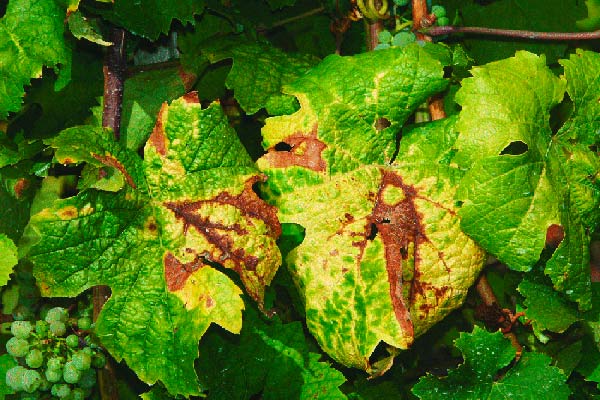
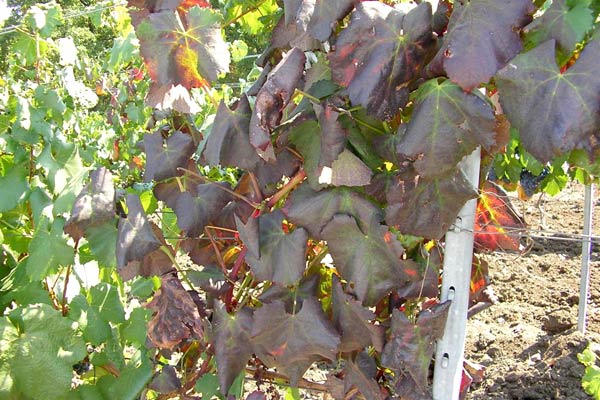
Grapevine flavescence dorée caused by the phytoplasma Grapevine Flavescence dorée (FD) is a quarantine disease for the EU and Bulgaria – up to the end of 2018 it had not been detected on the territory of our country. Its name is “derived” from the symptoms on the grapevine. The vector of this disease is the monophagous leafhopper Scaphoideus titanus. The specific methods for identification and classification could not determine its taxonomy; officially, FD phytoplasma belongs to the elm yellows group (Candidatus ‘Phytoplasma ulmi’), but it is also known under the name Candidatus ‘Phytoplasma vitis’, which has not been officially published and accepted. Infected vines have reduced vigour and produce poor yields. The leaves of red cultivars turn red, and those of white cultivars turn golden yellow; by the end of August, when the discoloration symptoms are most distinct, their margins curl downwards and take on a shape resembling a triangle, they become tougher, crackle when pressed, and are arranged like roof tiles when viewed from above. Many flowers in the inflorescence abort and the bunch remains loose; the berries that form later shrivel. The bunches are smaller than their usual size. They have a very high acid content and low sugar content, and the wine produced from them is of poor quality, with a distinctly bitter aftertaste and the smell of an uncleaned barrel. The infection does not spread evenly within the plant. Lignification of the plant parts is delayed and not fully completed in autumn; these infected canes droop downwards, and a cross-section reveals blackening of the vascular bundles. Numerous black warts appear on the shoots of infected vines which die during cold winters, and the vines quickly perish.
Laboratory analyses have shown that black wood (BN) of the grapevine is a widely distributed disease in our country, thanks to vector leafhoppers of the genera Hyalesthes, Reptalus, Neoaliturus, Dictyophara, Zyginidia and others. Grapevine yellows (GY’s), closely related to black wood, such as Vergilbungskrankheit (VK), belong to the stolbur group (Candidatus ‘Phytoplasma solani’). They are known to winegrowers in all countries of Europe with a temperate climate. Leafhopper species such as Hyalesthes obsoletus (Hemiptera, Cixiidae) are proven vectors for the transmission both of stolbur in vegetable crops (family Solanaceae) and of VK and BN. They prefer weed vegetation near vineyards and only exceptionally feed on the vines themselves. They overwinter in the nymph stage on the root systems of field bindweed, nettle and other weeds. Therefore, their destruction is important for limiting the population of the pest.
The symptoms of black wood (BN) in some grapevine cultivars and depending on climatic conditions completely overlap with those of flavescence dorée (FD). In white wine cultivars – Chardonnay and Traminer – partial yellowing of the leaf blades exposed to the sun is observed, which gives them a metallic sheen and causes the leaf blade to curl downwards, while in red wine cultivars the leaves are red-coloured. When the leaf blade curls, the leaves resemble a triangle. After making a cross-section, we observed an unusually strong development of the phloem and pith compared to the wood. In addition, on the shoots of the vines there are numerous black pustules arranged in rows. Non-lignified areas are located in the region of the nodes. The canes are thinner, they do not crack when bent, the plant tissue appears rubbery, and the internodes are shorter.
On the basis of the results obtained from the studies and in order to prevent the spread of black wood (BN) and flavescence dorée (FD) in vineyards, the following is recommended:
• Upon detection of symptomatic vines, the competent authorities of the Regional Directorates for Food Safety (ODBH) in each region on the territory of Bulgaria shall be notified.
• Preventive measures shall be implemented: upon the appearance of leafhoppers that are vectors of phytoplasmas, a signal shall be given for chemical control against them. There are good and highly effective plant protection products approved by the Bulgarian Food Safety Agency (BFSA) for use in vineyards.
• Ploughing between the rows and cultivation within the rows shall be carried out – in this way, through mechanical impact on the larvae, the population density is reduced.
• Control of field bindweed (Convolvulus arvensis), the main source of infection, and of other weeds that are reservoirs of the phytoplasma – chickweed, creeping thistle, nettle and others.
• The establishment of vegetable gardens near sites for the production of grapevine planting material and near vineyards shall be avoided.
• Severe pruning of vines showing disease symptoms and mandatory disinfection of tools.
• Uprooting of infected vines is not recommended, and should only be undertaken when necessary as a last resort under conditions of severe infection and ineffectiveness of all other control measures.
The use of healthy grapevine planting material for the establishment of vineyards, good agronomic practices in nursery plots and the correct and consistent implementation of chemical control against pests are the most important factors that prevent the spread of all grapevine diseases.