

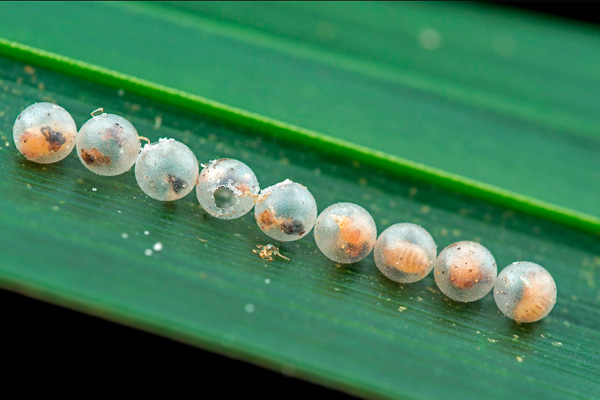
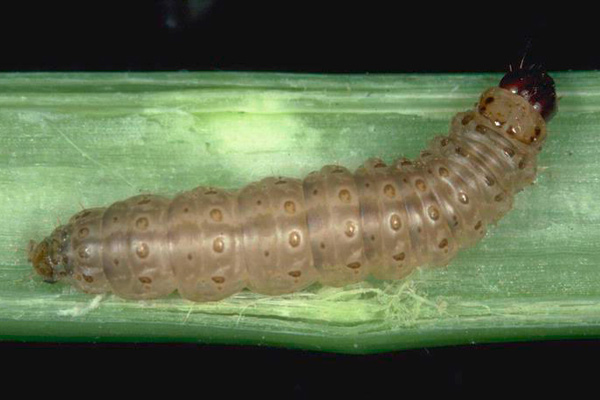
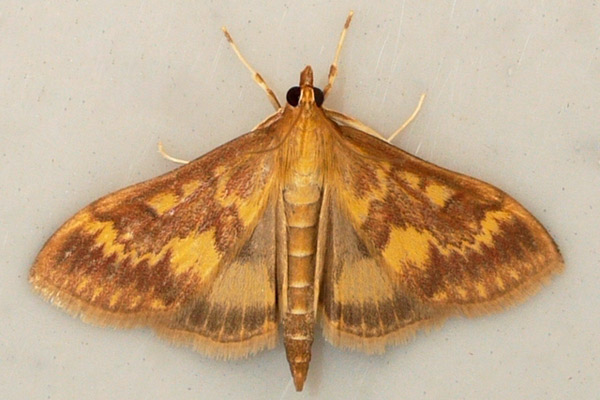
In June, a mass flight of first-generation moths of the pest is observed. The moths are active after sunset. They lay their eggs on the underside of the leaves. To monitor the dynamics of oviposition, it is necessary for observations on the maize plants to begin 2–3 days after the onset of the flight has been established. The flight of the moth is directly dependent on the accumulated temperature sum during the year – in most cases, the mass flight occurs in June and July, with the larvae being active from July.
Damage is caused by the young caterpillars, which immediately after hatching penetrate into the leaf sheath or the inflorescence. Initially, the young caterpillars feed in the leaf axils and gnaw the epidermis and parenchyma of the leaves. The already developed caterpillars make longitudinal galleries and feed out the interior of the stems, filling them with excreta and webbing. Plants with damaged stems lodge or break around the opening made by the caterpillar.
The biological agents regulating the population of the European corn borer are the egg parasitoids of the genus Trichogramma. They are widely distributed in maize-growing areas, but to be effective they require higher air humidity.
Chemical control in maize should begin at mass oviposition and the beginning of caterpillar hatching. Economic injury level:
- 10 egg masses /100 plants in grain maize;
- 3 egg masses /100 plants in seed production maize;
Authorized insecticides: Ampligo 150 SC – 30 ml/ha; Deka/Desha EC/Dena EC/Polythrin/Decis – 50 ml/ha; Decis 100 EC – 7.5–12.5 ml/ha; Coragen 20 SC – 10–15 ml/ha; Cyperkill 500 EC/Citrin Max/Cypert 500 EC/Poly 500 EC – 15 ml/ha; Meteor – 60–80 ml/ha.