

Pests of the vine – insects damaging winter buds, inflorescences and leaves of the vine
The vine looper was reported as a vine pest for the first time in Germany by Lustner in 1901, and in 1939 – in Switzerland – by Faes. Considerably later it was reported as a vine pest in other European countries. In Bulgaria, the first damage was observed in 1974 in the regions of Plovdiv, Stara Zagora, Burgas and Varna, and later also in other regions (Harizanov, 1978). It is now found in almost all vine-growing areas, but is little known to vine-growers and specialists.
Nature of damage and economic significance
The main damage is caused by the overwintering larvae, which become active as early as the end of March – beginning of April. They gnaw the buds on one-year-old canes and on other fruit-bearing wood, consuming the inflorescences inside them. Gnawing starts from the side of the bud and in this way they damage the dormant eyes. One larva damages from several up to 20 buds, depending on the cultivar and the air temperature in April. The damaged buds usually do not develop and the vines grow more weakly and bear less fruit. After the development of leaves and shoots, the larvae damage them by chewing holes in the leaf blade, and on young shoots – by injuring the bark. The species is polyphagous and also damages fruit and forest tree species and weeds, from where the moths can migrate into vine plantations.
Brief morphological characteristics
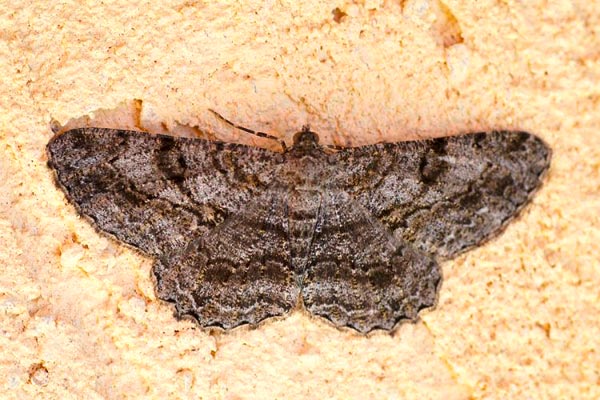
The moth has grey-brown wings with darker transverse stripes and spots. With wings spread it reaches 40-50 mm. The egg has fine ribs, is elongated-oval, 0.7 mm long and 0.4 mm wide. Its coloration varies from light green to dark pink, and before hatching – greyish. The larva is grey-brown to violet-brown. Along the back there is a narrow longitudinal stripe, darker on the first 3 and the last 3 segments. On the sides, longitudinally along the body, there is one darker stripe on each side. The thoracic legs are 3 pairs, and the abdominal – 2 pairs. The larva moves by arching its body in a way similar to measuring by a span, from which the family name – loopers – is derived. The coloration of the larva is close to that of one-year-old canes and other fruit-bearing wood in some cultivars, which makes it difficult to notice. When the vines are shaken, the larvae fall onto the soil surface. They are active after sunset and during the night, while during the day they remain on the vines motionless, with the body stretched, attached with the thoracic and abdominal legs to parts of the vine. Fully developed larvae reach 40-60 mm in length.
Biology, ecology and phenology
The species develops one complete and a second incomplete generation per year and overwinters as a larva, 10-20 mm long, under the bark of vines, on the supporting structure, in fallen leaves or in the soil. The overwintered larvae become active at the end of March – beginning of April, migrate to the buds and damage them in the manner described. After budburst and the growth of leaves and shoots, the larvae also damage them, and develop until the second half of May, then descend on a silken thread to the soil surface, bury themselves at a depth of 8-10 cm, prepare an earthen chamber and pupate in it. The flight of the first-generation moths begins at the end of May – beginning of June and ends during the first half of June. The moths are active at night. They lay eggs singly on the trunk in cracks, crevices and other protected places, and on the leaves, attaching them along the veins. The egg stage lasts 5-10 days depending on the temperature and the oviposition sites. Larval hatching begins in the second half of June and the beginning of July. The larvae feed on the leaves and shoots, but the damage has no economic significance. Part of the second- and third-instar larvae move under the old bark and to other places, spin a loose cocoon, enter diapause and remain there until the following spring. Another part develop fully, pupate and second-generation moths fly during the second half of August and the first half of September. They lay eggs in the same places as the first-generation moths. The larvae feed up to the second instar and then move to their overwintering sites.
Control
The economic injury levels are the same as for the European grapevine moth. The species usually occurs in low numbers and specific control is not necessary. The products used against the grape leafroller and grape berry moths are also toxic to it.