

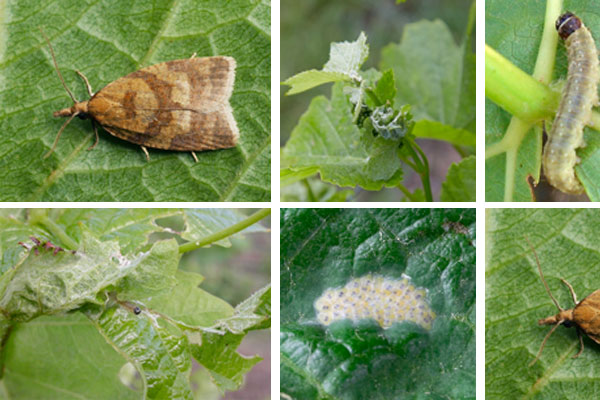
Pests of the vine – insects damaging winter buds, inflorescences and leaves of the vine
The first reports on the harmful activity of the European grapevine leafroller on vines were made by Lebeauf (1562), and Bask described it in 1786. Later Audouin conducted studies on harmful insects on the vine, devoting considerable attention to this species. The author summarized the results in a book published in 1842 – after his death.
Distribution
The species is distributed in all vine-growing countries of Europe, in South America, in other zones and regions, but has not been established in the USA. The leafroller is extremely harmful to vines in the northern viticultural regions of Austria, Hungary, Switzerland, France, Italy, Spain, Portugal and others, and in areas with high humidity during the summer period. The high harmfulness of the species necessitated the organization of scientific groups of specialists from different countries to develop projects related to its biology, ecology and possibilities for control. In Bulgaria it was observed in low numbers in 1936 and 1937 in vineyards near Pomorie, but by 1942 it appeared en masse in the Vidin region – in the villages of Novo Selo and Gămzovo, making it necessary to carry out chemical control (Popov V., 1962). At present the leafroller is widespread throughout the country, but the highest population densities have been recorded in plantings along the Danube River, along the Black Sea coast and in the interior of the country in areas close to large water bodies. During the period 1977-1980 it was observed at high density in the vineyards of the villages Gigen, Gigenska mahala, Brest, Milkovitsa and the town of Gulyantsi, Pleven region; during 1982-1986 – in the vineyards of Pomorie and the villages adjacent to it; the town of Veliki Preslav and the villages Imrenchovo, Blagoevo and Osmar; 1980-1991 – in the regions of Burgas, Sozopol, Sinemorets, Kraimorie and other places. From 1970 to 2003 – at lower densities in vineyards in the regions of Plovdiv, Pazardzhik, Haskovo, Stara Zagora, Sliven and Ruse. The larvae feed on 116 plant species from 38 families – annual and perennial cultivated and wild plants, but they prefer vines. The polyphagy of the species creates conditions for wide distribution and complicates control.
Nature of damage
During the first half of April (earlier or later depending on the area), at bud swell, the larvae begin to leave their overwintering sites (they are only about 2 mm long) and settle on the buds. Settlement continues for 10-15, up to 20-25 days, depending on the overwintering sites and the temperature in April and the first half of May. They bind the buds or young leaves abundantly with silken threads, gnaw small holes in them, perforate them or completely consume them. The buds and leaves dry out. After budburst, the larvae move to the developing leaves, also binding them with silken threads, skeletonizing them or gnawing them in the form of small holes. Usually many larvae feed on a single leaf. They successively change their feeding sites, damaging more and more new leaves and defoliating the vines. As the larvae grow, the damage increases significantly. When the inflorescences appear and start to grow, the larvae roughly bind them with silken threads and gnaw the flower buds and flowers, and then gnaw the branches of the inflorescences, which dry out. The damage to the inflorescences is more severe and coarser than the damage caused by grape moths. Later, depending on the development of the vines, the larvae also damage the young green berries, binding them with silken threads and gnawing them. The damage is most severe at the end of May – beginning of June, but continues until the second half of the month. The larvae prefer to develop inside the vines in the most shaded and humid parts. The European grapevine leafroller develops on and prefers cultivars with smooth and slightly hairy leaves and with red to dark blue berry skin.
Brief morphological characteristics
The moths are larger than the moths of grape berry moths. The forewings are ochre-brown in males and yellow-brown in females. They bear three darker-coloured bands, more pronounced in male moths. The coloration of the wings can often be darker or lighter, and the bands – wider or narrower, and sometimes they may be completely absent or only two in female moths. The egg is elongated-oval, 1–1.3 mm long, green after oviposition, later becoming yellow-green, yellow and brown. The eggs are laid on the upper side of the leaves in a tile-like pattern (overlapping) and are covered with a secretion from the accessory genital glands – forming the so-called “mirror”. The coloration of the larva varies. Green, yellow-green and grey-green larvae occur, with longitudinal darker and lighter stripes on the back and grey-whitish (relatively long) hairs standing upright. The head, prothoracic shield, thoracic legs and dorsal side of the pygidium are almost black and shiny. The larva is extremely sensitive to mechanical disturbance and reacts to shaking or touching by jumping or dropping to the soil surface on a silken thread. When fully developed it reaches a length of 25–30 mm, significantly larger than the larvae of grape moths.
Biology, ecology and phenology
The species develops one generation per year and overwinters as a young, unfed larva in a dense silken cocoon under the bark of the vine, in cracks, crevices and other similar shelters on the vine; in cracks or under soil clods in the ground; on the trellis construction; in dry vine leaves and on other plant residues in vineyards. Differences in overwintering sites are the reason why larvae settle on the buds and young leaves of the vine at different times – from mid-April to the first ten days of May. Under the conditions of Northern Bulgaria the first overwintered larvae settle on the swelling buds (sometimes even before bud swell) during the second half of April, and the last – at the end of the first ten days of May. After damaging the buds and young leaves, and after leafing out and shoot growth, the larvae move into the interior of the canopy. They moult 4 (rarely 5) times and pass through 5–6 instars. Before moulting they bind the attacked parts abundantly with silken threads. Pupation usually begins around the middle and in the second half of June and ends in the first half of July. The larvae pupate in a silken cocoon at the feeding sites, in dry leaves, often gnawing through the petiole of the leaves before pupation; the leaves wilt and pupation takes place in them. The pupal stage lasts 12–18 days, depending on the temperature and humidity at the pupation site. The flight of the moths begins in the first half of July and continues until mid-August. The moths are nocturnal insects. During the day they hide inside the vine canopy, and as soon as the sun sets and during the night they fly short distances from vine to vine. Copulation between moths begins after sunset, continues throughout the night, and sometimes into the following day. The moths do not feed, but drink water from dew drops. They live from 3–4 to 10–12 days, longer in humid weather. The moths lay eggs from sunset until 4:00–5:00 a.m., with a maximum between 21:00 and 24:00 hours. The eggs are laid on the upper side of the leaves inside the vine canopy in groups and are covered with a secretion from the accessory genital glands. A group usually contains 40–60, rarely up to 150–220 eggs. On one leaf eggs are laid in 1–2, and in many rows 4–5 and up to 10–12 groups. Unfertilized eggs are laid singly or several together and do not hatch. One female moth lays from 120 to 400 eggs. The egg stage lasts 10–15 days. The eggs and the other stages are demanding with respect to air humidity. After completion of embryonic development one larva gnaws an opening through the “egg mirror” and exits, the others follow it and one by one leave through the same opening. Larval hatching begins in the third ten days of July and continues until the second half of August. After hatching the larvae do not feed, they crawl over the vine canopy and beyond it and seek suitable overwintering sites, where they spin a dense cocoon and overwinter in it in large numbers together. During this period the larvae are about 2 mm long, hairy, light and can be blown by the wind far from the egg cluster.
Control
All canopy management operations are carried out against the European grapevine leafroller – shoot thinning, pinching, topping, lateral shoot removal and canopy thinning; soil cultivation during the vegetation period; balanced fertilization; monitoring to determine the phenology of the individual stages and, in particular, the period of migration of the overwintered larvae onto the buds and young shoots and the period of larval hatching and dispersal to overwintering sites, and, where necessary, insecticides are applied. They are applied in two periods – in the second half of April – beginning of May during the migration of overwintering larvae to feeding sites and in the third ten days of June and the first half of August during the period of larval hatching and movement to overwintering sites. One of the following insecticides is applied: Mageos WG – 7 g/da, pre-harvest interval 14 days; Meteor SC – 70 g/da, pre-harvest interval 3 days; Plinto 10 EC – 40–60 ml/da, pre-harvest interval 15 days; Avant 150 EC – 25 ml/da, pre-harvest interval 10 days; Cyperfor 100 EC – 50 ml/da, pre-harvest interval 7 days; Nurelle D – 60 ml/da, pre-harvest interval 21 days; Aficor 100 EC – 50 ml/da, pre-harvest interval 7 days; Daskor 440 SC – 50 ml/da, pre-harvest interval 21 days; Sherpa 100 EC – 50 ml/da, pre-harvest interval 7 days; Efcymentrin 10 EC – 50 ml/da, pre-harvest interval 7 days; Cyclone 10 EC – 50 ml/da, pre-harvest interval 7 days; Maltoato EC – 40–50 ml/da, pre-harvest interval 15 days; Karate Express WG – 100 g/da, pre-harvest interval 21 days, or other newly registered products.
The European grapevine leafroller has many natural enemies that limit its population density. The larvae and pupae are eaten by ground beetles – Carabus auratus L., Malachius aeneus Fabr. and others; by lacewings of the genera Chrysopa and Hemerobius; the earwig Forficula auricularia, the spider Theridium benignum Wal. and others, the slug Limax agrestis Lmk. and others. They are parasitized by Pimpla instigator Pauz., P. alternaus Grav., Pteromalus comunis Nees., P. cupreus Nees., P. larvarum Nees., Nemorilia florales Fall. and others, and they also suffer from fungal and other disease-causing agents.