

At the beginning of May, the development of agricultural crops will proceed under below-normal temperatures and with good soil moisture reserves, as a result of the above-normal precipitation in April.
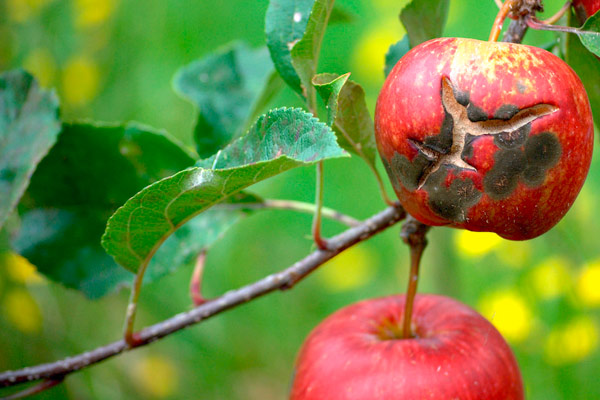
The frequent rainfall in May will create conditions for an increase in the infectious background of a number of fungal diseases: rusts (brown, yellow) and head fusarium in wheat; downy mildews in vegetable crops and grapevine; early brown rot and shot-hole in stone fruits, scab in pome fruit species, etc. During the month, more suitable conditions for carrying out plant protection spraying will occur in the middle of the first, in the first half of the second, and in the third ten-day periods.
In May an increased probability of hail is forecast. In case of partial hail damage, it is advisable to treat the affected crops at the first opportunity with copper-containing fungicides for faster callusing of the wounds and reducing the risk of secondary infections.
For effective plant protection it is necessary:
- Spraying to be carried out according to the warnings of the Regional Food Safety Directorates and the advice of plant protection agronomists.
- Only pesticides authorized for use to be applied, and spraying to be carried out only when pest density exceeds the accepted economic injury thresholds, which are as follows:
Codling moth – 0.8 – 1% fresh entries;
Oriental fruit moth – 1.5% damaged fruits;
Plum fruit moth – 1 – 1.5% fresh entries;
Anarsia – 3% damaged shoots;
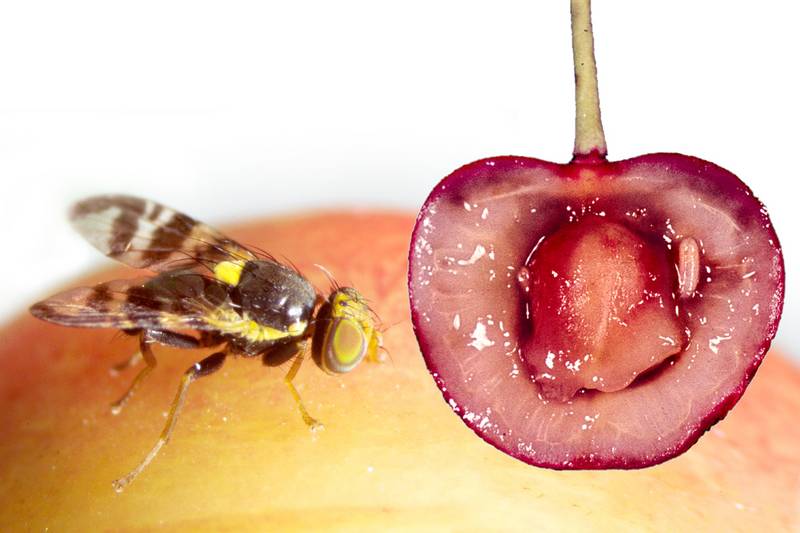
Cherry fruit fly – 10 flies/trap;
Aphids – 10 – 15% infested shoots;
Common plum scale – 5-7 individuals per leaf;
Leaf-mining moths – 1-2 fresh mines per leaf;
Fruit tree mites – 3-4 individuals per leaf;
Pear psylla – 4-6% shoots with colonies;
Strawberry blossom weevil and strawberry stem weevil – 15% infested plants.
In apple, usually 2 sprayings are carried out, aimed against scab, powdery mildew, codling moth, San Jose scale, leaf-mining moths, mites and aphids. For control of diseases, one of the following fungicides is used: Strobi DF – 0.02%, Flint Max 75WG – 0.02%, Score 250 EC – 0.02%, Strobi DF/Discus DF/ – 0.02%, Chorus 50WG – 0.03% – preventive and 0.05% – curative with 100 l/da spray solution, Shavit F 72WG – 0.2%, Difcor 250EC – 15 ml/da, Captan 80WG – 150-180 g/da, Manfil 75WG – 320 g/da, Merpan 80WG – 0.15%, Thiovit Jet 80WG – 600 g/da, Faban – 120 ml/da, Folpan 80WG – 0.15%, Fontelis SC – 75 ml/da, or fungicide mixtures Strobi DF – 0.02% plus Delan 700WG – 0.035%, Delan 700WG – 0.035% plus Bayfidan 250 EC – 0.015%, Dithane M-45 – 0.2% plus Bayfidan 250 EC – 0.015%.
Scab-resistant cultivars – Prima, COOP-10, Frolina, Liberty, Jonafree, Jonathan, Pioneer, McFree, Pilot, Topaz, Novamak, Sava, Rubinola, etc., are sprayed only against powdery mildew and for them one of the fungicides: Bayfidan 250 EC – 0.015%, Topsin M 70WG – 0.12%, Kumulus DF – 0.4% may also be used. At high temperatures, do not spray with a sulfur-containing fungicide, which may cause scorch on some cultivars.
During this period, green pruning must be carried out to remove the shoots infected with powdery mildew.
For control of codling moth, one of the following insecticides is added to the fungicide solution: Affirm 095WG – 0.3%, Afikar 100EC – 30 ml/da, Vaztak New 100EC – 0.0125%, Decis 2.5EC – 0.03%, Deca EC – 0.03%, Dursban 4E – 0.2%, Rexid 015SC – 0.03%, Sumi Alpha 5EC, Sumicidin 5 EC, Oasis 5 EC – 0.02%, Karate Zeon 5CS – 0.02%, Karate Express WG – 60-100 g/da, Calypso 480SC – 0.02%, Coragen 20SC – 0.016%, Lambda 5EC – 15 ml/da, Meteor SC – 60 ml/100 l water, Reldan 40EC – 0.12%, Proteus O–TEQ 0.05–0.06%, Runner 240 SC – 0.04%, Pirinex 48EC – 0.12%, Supersect Mega – 0.015%, Sineis 480SC – 20 – 37.5 ml/da, Sumi Alpha 5EC – 0.02%, Efcimetrin 10EC – 0.03%, Fury 10EC – 0.0125%, Cyclone 10EC – 30 ml/da, Cyperfor 100EC – 30 ml/da, Sherpa 100EC – 0.03%, of which Afikar 100EC – 30 ml/da, Vaztak New 100EC – 0.0125%, Deca 25EC – 0.03%, Dursban 4E – 0.2%, Karate Express WG – 60-100 g/da, Calypso 480SC – 0.02%, Nexid 015SC – 0.03%, Sumi Alpha 5EC – 0.02%, Supersect Mega – 0.015%, Cyclone 10EC – 30 ml/da, Efcimetrin 10EC – 0.03%, Cyperfor 100EC – 30 ml/da, Sherpa 100EC – 0.03% are effective also against the circular leaf-mining moth, as well as against leaf-feeding caterpillars and the apple blossom weevil. For control of San Jose scale, the following insecticides are registered: Bi-58 – 0.2%, Dursban 4E – 0.15%, Deca EC – 50-70 ml/da, Meteor SC – 90 ml/100 l water, Moligan – 30–50 ml/da and Pirinex 48EC – 0.15%.
For control of codling moth, Dimilin 25WP – 0.04% and Madex TOP – 10 ml/da and Madex TWIN – 10 ml/da may also be used; they are applied at mass flight and more precisely before egg hatching.
At high population density of red spider mite, spray with one of the acaricides: Valmec EC – 60-96 ml/da, Vertimec 018 – 100 ml/da, Voliam Targo 063 – 0.075%, Envidor 240SC – 40 ml/da, Zoom 11SC – 25-50 ml/da, Ortus 5SC – 0.05%, Sanmite 20WP – 0.05%, Masai WP – 25 g/da, Naturalis OD – 100-150 ml/da.
In pear during this period, sprayings are aimed against scab, leaf spots (white and brown), pear psylla, and codling, pear and oriental fruit moths. For control of diseases, one of the following fungicides is used: Dithane DG – 200 g/da, Dithane M-45 – 200 g/da, Difcor 250EC – 15 ml/da, Luna Experience – 20-75 ml/da, Captan 80WG – 150-180 g/da, Manfil 75WG – 320 g/da, Scab 80WG – 188 g/da, Polyram DF – 200 g/da, Sancozeb 80WP – 200 g/da, Thiovit Jet 80WG – 600 g/da, Faban SC – 120 ml/da. For control of pear psylla, one of the following insecticides is added to the fungicide solution: Vaztak New 100 EC – 0.02%, Decis 2.5 EC – 0.03%, Decis 100EC – 12.25 ml/da, Karate Express WG – 60-100 g/da, Masai WP – 25 g/da, Meteor SC – 90 ml/100 l, Movento 100SC – 0.12 – 0.15%, Naturalis OD – 100-200 ml/da, Proteus O – T 0.05 – 0.06%, Sumi Alpha 5EC/Sumicidin 5EC – 0.02%, Sineis 480SC – 30-43.7 ml/da.
To protect pear fruits from worm damage, one of the insecticides listed for control of pear psylla is used, except Masai WP, Movento 100SC and Naturalis OD. Quince is sprayed against brown rot and fruit moths. For control of brown rot, effective fungicides are: Chorus 50WP – 0.03%, Luna Experience – 20-75 ml/da, Difcor 250EC – 20 ml/da, Topsin M 70WG – 0.12%, and for control of fruit moths one of the insecticides indicated for control of codling moth.
In May, in most fruit-growing regions (under favourable conditions) symptoms of fire blight on pome fruit species appear en masse. It causes serious damage to pear, quince and apple. To limit the damage, pruning is carried out to remove the infected branches and shoots (cutting 30-40 centimetres below the site of infection), after which the wounds are covered with oil-based paint to which copper-containing products such as Bordeaux Mix 20WP, Bordeaux mixture, Funguran OH 50WP, Champion WP are added. Pruning tools are disinfected after each cut with denatured alcohol or bleach diluted with water at a ratio of 1:10. In addition to pruning, to protect the trees from infection, spraying is carried out with: Bordeaux mixture – 1%, Funguran OH 50WP – 0.15%, Champion WP – 0.15%. Under favourable conditions for disease development – susceptible cultivars, cool and humid weather, as well as the presence of inoculum from the previous year – preventive sprayings are carried out at intervals of 5-7 days.
Sweet and sour cherry during this period are sprayed twice against cylindrosporiosis (white leaf spot), brown rot and cherry fruit fly. Effective fungicides against cylindrosporiosis are: Signum WG – 30 g/da, Score 250EC – 0.03%, Syllit 40 SC – 0.15%, Delan 700WG – 0.05% and Flint Max WG – 30 g/da. At the first spraying against cylindrosporiosis, in case of high density of leaf-feeding caterpillars, cherry slug sawfly and weevils, one of the insecticides is added to the fungicide solution: Vaztak New 100EC – 0.015%, Dursban 4E – 0.1%, Karate Zeon 5CS – 15 ml/da, Sumi Alpha 5EC – 0.02%. Usually, spraying against cherry fruit fly coincides with the second spraying against cylindrosporiosis. For control of cherry fruit fly, one of the insecticides authorized for use against this pest is added to the fungicide solution: Vaztak 100 EC – 0.015%, Decis 2.5 EC – 0.03%, Decis 100EC – 10-17.5 ml/da, Calypso 480SC – 0.02%, Karate Zeon 5CS – 15 ml/da, Karate Express WG – 60-100 g/da, Naturalis OD – 100-200 ml/da, Nexid 015 SC – 0.03%, Fury 10 EC – 0.0125%, Eforia 045 ZC – 150 ml/da.
Only in late-ripening cherry cultivars and at very high population density of cherry fruit fly is it necessary to carry out a second spraying against it. It is done 10 – 14 days after the first one. Young non-bearing sweet and sour cherry trees are sprayed against aphids. Effective insecticides against them are: Mospilan 20SG – 25 g/da, Karate Express WG – 40-60 g/da, Calypso 480SC – 0.02%.
In case of frequent showers during the fruit ripening period and a strong infection of brown rot, it is necessary to carry out one or two sprayings against it. Effective fungicides against brown rot are: Signum WG – 30 g/da, Chorus 50WG – 0.045% and Luna Experience – 50 ml/da. The fungicide Signum WG is effective also against cylindrosporiosis and is best used for simultaneous control of both diseases at the second post-bloom spraying in sweet and sour cherry.
It is very important to observe the pre-harvest interval at the last spraying against brown rot.
In May, measures must also be taken against fruit cracking in sweet cherry, which is also a cause of attack by rot pathogens. Data from various countries where cracking is a problem indicate that spraying with CaCL2 reduces the percentage of cracked fruits. Usually, during the period of fruit ripening, three sprayings with 0.5% CaCL2 are recommended.
Foliar fertilizers containing calcium are also recommended – Vuxal Calcium – 500-600 ml/da, applied with 150 l spray solution. Three to four treatments are carried out, the first about 8 weeks before harvest. According to the manufacturer of Vuxal Calcium, this foliar fertilizer is compatible with the pesticides commonly used in sweet cherry.
In a number of European countries and in the USA, spraying is also carried out against cracking with:
RainGard – this product contains fatty acids, plant esters, emulsifiers and water. When sprayed, it forms a film on the fruit skin, which is a barrier to the penetration of rainwater and thus prevents cracking. Four to five sprayings are recommended, the first at fruit “colour break” or when they turn straw-yellow, and the others at intervals of 7-10 days. It has been established that this product reduces cracking by 50%.
SureSeal - a copolymer of stearic acid, cellulose and calcium, which forms a biofilm on cherry fruits and protects them from cracking. Two sprayings are recommended – 4 and 2 weeks before harvest.
In plum, during this period, sprayings are carried out against shot-hole, red leaf spot, rust, brown rot, plum fruit moth and common plum scale. Against shot-hole, Tiram 80WG – 0.3% is used, and against brown rot one of the fungicides: Difcor 250EC – 20 ml/da, Captan 80WG – 150-180 g/da, Systhane 20EW – 12.5 – 30 ml/da, Systhane Ecozome EW – 65-200 ml/da, Chorus 50WG – 0.045%. Against plum rust, Signum WG – 45 g/da is approved, which is also effective against brown rot. Effective insecticides against plum fruit moth are: Vaztak New 100EC – 0.0125%, Decis 2.5EC – 0.05%, Dursban 4E – 0.15%, Coragen 20SC – 16-30 ml/da, Eforia 045 ZC – 150 ml/da, Sumi Alpha 5EC – 0.02%, Pirinex 48EC – 0.15%, Runner 240SC – 0.03%. For control of common plum scale, Bi-58 – 0.1%, Vaztak New 100EC – 0.02%, Dursban 4E – 0.1%, and Pirinex 48EC – 0.15% are authorized.
In peach, sprayings are aimed against powdery mildew, shot-hole, brown rot, Anarsia, oriental fruit moth and aphids. For control of powdery mildew, one of the fungicides is used: Score 250EC – 0.02%, Systhane 20EW – 15-36 ml/da, Luna Experience – 50 ml/da, Topaz 100EC – 0.03%, Thiovit Jet 80WG – 600 g/da. For control of brown rot, spray with Delan 700WG – 0.05%, Chorus 50WG – 0.045% or Luna Experience – 63-75 ml/da. For control of oriental fruit moth, one of the insecticides is used: Avant 150EC – 33.3 ml/da, Karate Express WG – 100-120 g/da, Eforia 045 – 150 ml/da, Nexid 015SC – 0.03%, Decis 2.5EC – 0.04%, Dursban 4EC – 150-200 ml/da, Coragen 20SC – 16-30 ml/da, Luzido 40WG – 25 g/da, Rapax SC – 100-200 ml/da, Sumi Alpha 5EC – 0.02%. The listed insecticides, except Avant 150EC and Eforia 045 ZC, are also included in the list of those authorized for control of Anarsia.
At high aphid density, spray with: Bi-58 – 0.07%, Karate Express WG – 40-60 g/da, Calypso 480SC – 0.02%.
Apricot orchards are sprayed against brown rot, gnomonia, Anarsia and oriental fruit moth. For control of brown rot, one of the fungicides is used: Difcor 250SC – 20 ml/da, Captan 80WG – 150-180 g/da, Chorus 50WG – 0.045%, Delan 700WG – 0.05%, Topsin M 70WG – 0.12%, Luna Experience – 63-75 ml/da, Signum – 60-75 g/da, Systhane 20EW – 12.5-30 ml/da, Systhane Ecozome EW – 65-200 ml/da, Tiram 80WG – 0.3%, of which Delan 700WG and Signum are effective also against gnomonia. For control of Anarsia and oriental fruit moth, one of the insecticides listed for peach is used.
In organic production, the use of synthetic pesticides is not permitted. Copper-containing and sulfur-containing fungicides are used to control fungal diseases. For control of codling moth and oriental fruit moth, Madex Top and Madex Twin – 10 ml/da are approved, as well as dispensers – RAK 3+4 for codling moth and RAK 5+6 and FEROCON AM for oriental fruit moth. Naturalis OD is included in the list for control of cherry fruit fly and pear psylla.
Cherry fruit fly can also be controlled by yellow sticky traps, with 4 traps placed per tree.
For control of leaf-feeding pests in fruit trees, spray with Dipel 2X – 0.1%. For control of the apple spotted leaf-mining moth, an effective bioinsecticide is Neem Azal T/S – 300 ml/da.
Sineis 480SC is authorized for use on: strawberry against thrips, apricot, peach and nectarine against peach twig borer, pear against pear psylla, and apple against codling moth and apple spotted leaf-mining moth.