

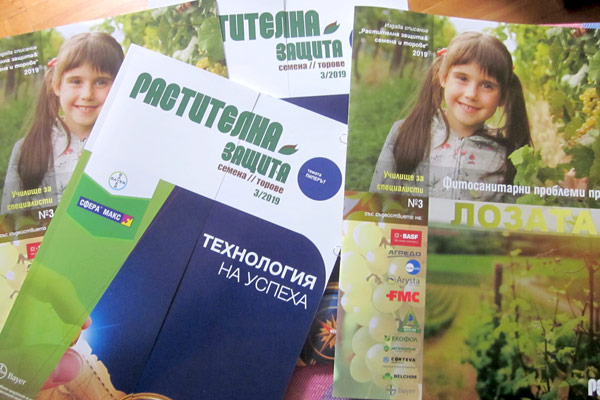
See which topics are current in this issue
For the topic of the April issue of the magazine „Plant Protection” we have chosen pepper of the genus Capsicum, which is a major vegetable crop worldwide. It originates from America, and in the 17th century it was cultivated in Southern and Central Europe as a spice and medicinal remedy.
In Bulgaria, the breeding programme for pepper is aimed at creating higher-yielding varieties, resistant to economically important diseases and pests, with excellent taste qualities determined by the content of dry matter, sugars, acids and vitamin C. For years, targeted studies related to the development of resistant varieties have been carried out at the Maritsa Vegetable Crops Research Institute in Plovdiv. The Institute has many years of experience in breeding for resistance to Verticillium wilt caused by Verticillium dahliae Kleb.
Pepper is sensitive to a large number of pests and diseases. Anthracnose of pepper, for example, is an extremely harmful disease, causing serious losses in yield and product quality. It is caused by fungal pathogens belonging to the genus Colletotrichum. Even the smallest spot that appears as a result of the disease reduces its market value. In addition to the well-known diseases, specialists have recently been fighting new diseases of pepper fruits, such as Phomopsis capsici, identified for the first time in the country in 2007.
Moreover, not all diseases can be treated with pesticides. All viral and mycoplasma diseases of pepper cause up to 100% loss of production. In this group of diseases it is very important to know that control is based mainly on sanitary-hygienic and agrotechnical practices. Only for vector-transmitted viruses is it possible to use insecticides. Viral diseases are considered a limiting factor for pepper production, since many of them are transmitted through seeds, working tools and perennial weed vegetation.
In seed production it is necessary to carry out preventive treatment of seeds to eliminate viruses. In this issue we will acquaint you in detail with the overall prophylaxis at all stages of seed production.
We should also not underestimate sucking insects such as aphids, thrips, whiteflies and leafhoppers, which, in addition to direct damage to plants, can cause indirect losses as vectors of viral and mycoplasma diseases.
Another hazard for pepper grown under field conditions, of course, remains weed control, as weeds extract water and nutrients from the soil 2–3 times faster and thus become the main competitor in the development process of the vegetable crop.
Enjoy your reading!
Here is what else you can expect in this issue
The Topic
S. Masheva – Pepper – a major vegetable crop
R. Rodeva, Z. Stoyanova – Anthracnose of pepper
R. Rodeva, Z. Stoyanova – Attention: New disease of pepper fruits!
V. Radeva/Ivanova et al. – Viral and mycoplasma diseases
G. Pasev et al. – Virus-free seeds
V. Yankova, D. Marinova – Pests as vectors of economically important diseases of pepper
N. Valchev – Possibilities for weed control
V. Todorova – Pepper varieties with increased resistance to Verticillium wilt
Diseases
M. Borovinova – The bacterium Pseudomonas syringae p.v. syringae is a threat to cherries
Pests
I. Lecheva, N. Palagacheva – Weevils – pests of fruit crops
Anti-stress
N. Neshev et al. – Use of biostimulants to overcome herbicide toxicity
Quarantine
I. Ivanova –Pests that cross the border without a passport and without warning
Traffic light
*** – Agropal recommends: Schemes for control of diseases and pests in grapevine
Events
*** Summit Agro: Boldly forward to the important things!
School for Specialists
M. Nakov, B. Nakov – Fungal diseases of grapevine
The magazine „Plant Protection“ & Seeds and Fertilizers bears no responsibility for the information presented in the published advertisements and PR materials. Responsibility for their content lies entirely with the advertisers. The authors of the publications bear responsibility for the information contained in the authored materials.