

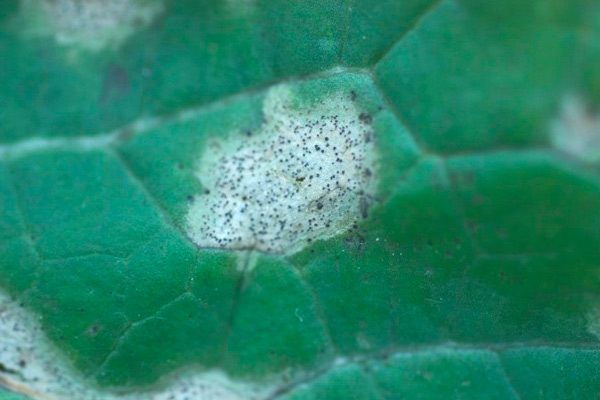
Causal Agent: Leptosphaeria maculans – a fungus
Symptoms: The disease in oilseed rape manifests from seedling emergence up to the phenological phase "6th leaf". Irregular, rounded, greyish-greenish spots with small black dots on them (the pycnidia of the pathogen) form on the lowest leaves. The spots gradually become necrotic and spread to the leaf petiole and stem. Stem infection occurs directly at or just above the soil surface. Phoma also attacks the root collar with the appearance of dark spots, which lead to desiccation and death of the plants. The disease develops in patches within the crop and, under favorable conditions, very quickly spreads across the entire field.
Life Cycle:
The pathogen persists in plant residues and partly in oilseed rape seeds. The development of phoma is favored by rainy and humid weather and an optimal daytime temperature of 22–24 degrees Celsius.
Control:
For disease control, balanced fertilization should be applied and pests on oilseed rape should be combated, as the damage they cause is an entry point for infection. For successful disease control, autumn application of fungicides should be initiated, which will significantly reduce the frequency and severity of infection, as well as the risk of plant frost damage.
Registered Fungicides for Control:
Caramba 60 EC – 120 ml/da; Orius 25 EW/Dynasty 25 EW/Tebu-max 25 EW – 50 ml/da; Pictor SC – 50 ml/da; Folicur 250 EW/Horizon – 50–100 ml/da; Amistar Gold – 100 ml/da; Carrix 240 SL – 70 ml/da; Mirador Forte 160 EC – 100 ml/da; Propulse 250 SE – 100 ml/da; Tilmore 240 EC – 100 ml/da; Toprex 375 SC – 30 ml/da (autumn), 50 ml/da (spring).