

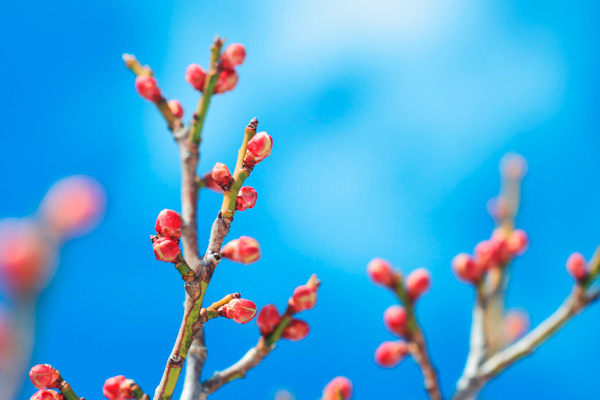
During the third ten-day period of March the calendar spring begins. The average monthly temperature rises from 4-8°C, cloudiness decreases, and the number of sunny days increases. As a result of the warming, the phase of forced dormancy of the fruit species is terminated and, at the same time, the vital activity of a number of pests on them becomes more intensive. The weather in March is very changeable, which requires fruit growers to monitor for suitable days for work in the orchards.
In the mountainous and semi-mountainous regions of the country, where ploughing in the orchards was not carried out in the autumn or at the end of February, it must be done at the beginning of March. By this soil tillage part of the pupae of the cherry fruit fly, the false caterpillars of the stone fruit sawfly, the sour cherry sawfly, the black plum fruit sawfly, and the overwintering forms of the cherry (sour cherry) weevil are destroyed.
With soil tillage in raspberry plantations the larvae of the raspberry gall midge and the earthen chambers where the common raspberry beetle overwinters are destroyed, and in strawberry plantations – the overwintering beetles of the strawberry stem weevil and the strawberry-raspberry weevil. The overwintering forms of the hazelnut weevil, the chestnut weevil and the almond sawfly can also be eliminated through soil tillage.
Ploughing under the fallen leaves helps to reduce the infection from apple and pear scab, grey and brown leaf spots on pear, quince and medlar, cylindrosporiosis on cherry and sour cherry, red leaf spots on plum, gnomoniosis on apricot, etc. In this way the overwintering stock of the species of leaf-mining moths that overwinter in the fallen leaves is also reduced. When ploughing in the leaves, great care must be taken not to damage the root system, which leads to infections with bacterial canker or causal agents of root rot. The depth of ploughing should be determined by the age of the plantation and the type of rootstock.
At the beginning of March sanitary pruning must also be completed, with which infected shoots are removed: from powdery mildew on apple and peach, scab on pear, black rot on fruit trees, cytosporosis, lead (silver) leaf on fruit trees, shot-hole on stone fruits. Damaged branches from longhorn beetles, wood-borers, goat moth, apple clearwing moth, apple twig borer are also cut out. After sanitary pruning, the wounds are coated with white latex paint to which Champion or Funguran is added. It is also very good to use special pastes that accelerate wound healing and thus protect against additional infections from bacteria and fungi. After sanitary pruning, all cut branches and twigs are removed from the orchard and destroyed by burning so that they do not serve as a source of infection.
Before bud break in apple orchards, moisture-charging irrigation is carried out, through which the discharge (release) of the overwintering spores of scab can be accelerated and completed in a shorter period.
Winter spraying in the southern regions of the country is usually carried out towards the end of February, and in the other regions during the first half of March. It is directed against the overwintering stock of: eggs of the European red mite, brown mite, green apple aphid, rosy apple aphid, apple-plantain aphid, pear aphid, Reaumur pear aphid, black cherry aphid, mealy peach-cane aphid, greenhouse peach aphid, leaf-curling aphid, large peach aphid, small and large plum aphid, small winter moth, large winter moth, rose tortrix, hawthorn leafroller, brown-spotted leafroller; larvae of San Jose scale, yellow oyster shell scale, false San Jose scale, apple mussel scale. Against these pests on apple, pear, cherry, sour cherry, apricot, peach and plum, spraying with Para Zomer – 3% is carried out. For simultaneous control of peach leaf curl, pear and peach scab, shot-hole and brown rot on stone fruits, bacterial canker (blight) on cherry, sour cherry and apricot caused by Pseudomonas syringae, and pockets (blisters) on plum, one of the copper-containing fungicides is added to Para Zomer – Bordeaux mixture – 1%, Bordeaux Mix 20 WP – 500 g/ha, Funguran OH 50 WP – 0.3%, Champion WP – 0.3%, Kocide 2000 WG – Pears – scab, grey leaf spot, early brown rot, bacteriosis, fire blight – 155-680 g/ha; Apricots – shot-hole, early brown rot – 185-280 g/ha; Peaches, Nectarines – shot-hole, scab, bacteriosis – 155-285 g/ha.
In March, shaking of apple trees must begin to determine the mass emergence from winter shelters of the apple blossom weevil, and at a density above 4-6 beetles per tree, spraying with Deka EC, Desha EC, Dena EC, Poleci, Decis – 30-50 ml/ha should be carried out. In apple at the “mouse ear” stage, the first pre-bloom spraying against scab and powdery mildew is carried out with one of the following fungicides or fungicide mixtures: Bordeaux mixture 1% + Bayfidan 250 EC – powdery mildew 0.015%, Champion WP – 0.3% + Bayfidan 250 EC – 0.015%, Funguran OH 50 WP – 0.3% + Bayfidan 250 EC – 0.015%. Cultivars resistant to scab should be sprayed only with Bayfidan 250 EC – 0.015%. Golden Delicious is sensitive to russeting of the fruits, and copper preparations increase russeting, which requires the selection of other fungicides. Suitable is Captan 50 WP – 0.2%, which can be successfully used for pre-bloom sprays on Golden Delicious, as well as on other cultivars. For pre-bloom sprays in apple, all fungicides authorised for use against scab and powdery mildew are recommended, but bearing in mind that frequent use of systemic products leads to the development of resistance in Venturia inaequalis, it is necessary to reduce their use by applying them only for bloom and post-bloom sprays. For scab and powdery mildew in apple, the following products can also be used: Bellis – powdery mildew – 80 g/ha; Cozavet DF – 750 g/ha, Kumulus – powdery mildew – (0.6-0.9%), scab – 750 g/ha; Dicofor 250 EC/15 ml/ha, Indar 5 EW – 100 ml/ha; Caramat 2.5 EW – 200 ml/ha.
The second pre-bloom spraying against scab and powdery mildew on apple is carried out at the “pink bud” stage – a phenophase that usually occurs at the end of March or the beginning of April. The same fungicides or fungicide mixtures as in the first spray are used. At a high density of apple sawfly – 2-3 sawflies per 100 shaken shoots – Decis 2.5 EC – 0.03% or Meteor – 60-90 ml/100 litres of water is added to the fungicide solution; these are also effective against leafrollers and winter moths.
Pre-bloom spraying in pear is aimed at scab, pear psylla, pear lace bug and pear fruit sawfly. Among the listed pests, it is almost annually necessary to spray against the common pear psylla. Against scab one of the following fungicides is used: Bordeaux mixture – 1%, Funguran OH 50 WP – 0.3%, Champion WP – 0.3%, Captan 80 WG – 0.2%, Dithane M-45 – 200 g/ha, Bordeaux Mix 20 WP – 375-500 g/ha. At high density – 2-3% rosettes with colonies of the common pear psylla – one of the following insecticides is added to the fungicide solution: Vaztak New 100 EC – 0.02%, Decis 2.5 EC – 0.03%, Masai WP – 25 g/ha, Proteus O-TEC – 0.05 – 0.06% (valid until 14.06.2019), Sumi Alpha 5 EC/Sumicidin 5 EC/Oasis 5 EC – 0.02%, Sineis 480 SC – 30-43.7 ml/ha.
In cherry and sour cherry in March, at bud swelling and before bud break, in most fruit-growing regions of the country spraying is carried out, which is aimed at brown rot, bacterial canker (blight) and shot-hole. One of the copper-containing fungicides is used – Bordeaux mixture – 1%, Kocide 101 WP – 0.4%, Funguran OH – 0.4%, Champion WP – 0.4%. During this period, shaking is carried out to determine the density of the sour cherry (cherry) weevil and, when 3-5 beetles per tree are recorded, spraying with Meteor (15.7 g/l) SC – 0.06-0.09% is carried out.
At the pink bud stage, plum orchards are sprayed against plum fruit sawfly at a density of 3-5 sawflies on average per tree, established by shaking. Decis 2.5 EC – 0.05% or Sumi Alpha 5 EC/Sumicidin 5 EC/Oasis 5 EC – 0.02% are used. If this spray is omitted, or at very high density of the sawfly, control of this pest can also be carried out immediately after flowering, when 70% of the petals have turned brown but have not fallen. This spraying is carried out when 5% damaged ovaries are recorded.
In the warmer regions of the country, where apricots bloom in March, pre-bloom and bloom spraying against brown rot and shot-hole must be carried out. The pre-bloom spray is also aimed against the peach twig borer (before the caterpillars bore into the shoots), as well as against weevils. Against fungal diseases one of the following fungicides is used – Delan 700 WG – 0.05%, Chorus 50 WG – 0.045%-0.05% – curative, with 100 l/ha spray solution, Thiram 80 WG – 0.3%, Systhane 20 EW – 25-30 ml/ha, Systhane Ecozome EW – 65-200 ml/ha, Signum WG – 30 g/ha, Topsin M 70 WG – 0.12% (120 g/ha).
For control of the peach twig borer and weevils one of the following insecticides is used: Vaztak New 100 EC – 0.015%, Rapax – 100-200 ml/ha, Decis 100 EC – 7.5-17.5 ml/ha, Sumi Alpha 5 EC/Sumicidin 5 EC/Oasis 5 EC – 0.02%, Sineis 480 SC – 20 ml/ha, Coragen 20 SC – 16-30 ml/ha, Dursban 4 EC – 150-187 ml/ha. The economic threshold of harmfulness for weevils is 3 beetles per tree. In a wet spring and prolonged flowering, two bloom sprays must be carried out.
Before bud break in peach, spraying is carried out against leaf curl. In this period the most suitable fungicides are Captan 80 WG – 250 g/ha or Score 250 EC – 0.02%. At high density of peach twig borer, one of the insecticides listed for apricot is added to the fungicide solution.
In strawberry plantations, dry leaves are collected and burned in order to reduce the overwintering infection from the causal agents of white leaf spot and violet-brown leaf spot. In raspberry plantations, canes that are infected with didymella, coniothyrium or are attacked by raspberry agrilus, raspberry cane midge or raspberry clearwing moth are cut out and burned.