The invasive species brown marmorated stink bug Halyomorpha halys Stål originates from Asia – China, Japan, Korea and Taiwan. It was first detected in the USA, in Pennsylvania in 1990. By 2013 the bug was already established in 41 states in the USA. Since 1993 in many ports of Canada H. halys has been intercepted in consignments from China, Japan, Korea and the USA. In 2010 it was established in the province of Ontario. Later it was established in New Zealand and Australia, parts of South America, and in the southern part of Africa. In Europe it was officially reported for the first time in the canton of Zurich (Switzerland) in 2007. According to CABI, in Europe it occurs in Austria, Germany, Greece, Georgia, Italy, Spain, Slovakia, Serbia, Slovenia, Russia, Turkey, Croatia, France, the Czech Republic. It was first reported in Bulgaria by Assoc. Prof. Dr. Nikolay Simov. He discovered it in Sofia, in Knyazhevska Garden in September 2016. (publication in “Ecologica Montenegrina”).
Host plants
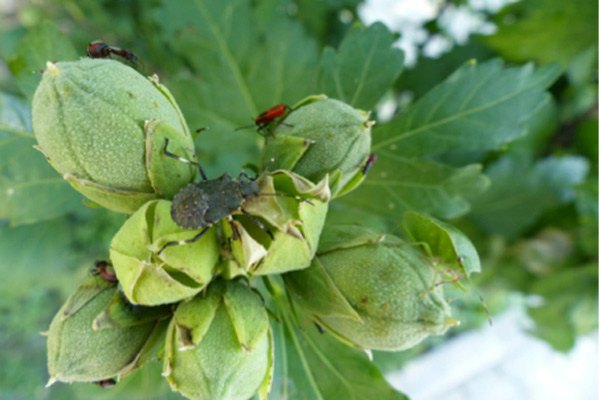
More than 100 plant species have been reported as hosts of the brown marmorated stink bug. Among tree species it attacks cherries, peaches, plums, pears, apples, vineyards, walnuts, hazelnut, tree of heaven, catalpa, paulownia, cercis. Among agricultural crops it attacks maize, soybean, tomatoes, pepper, okra, eggplant and others. In Europe, the list of host plants includes 51 species from 32 families, including exotic species.
Description
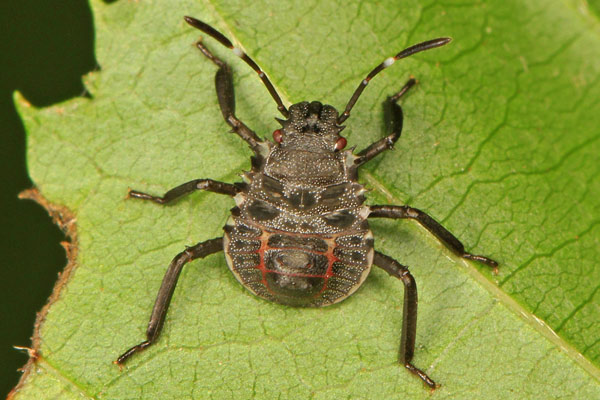
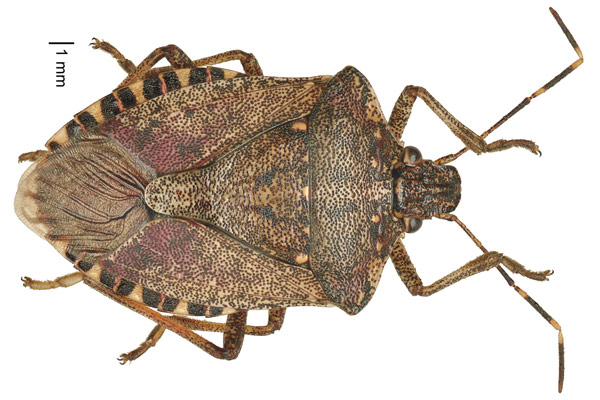
The brown marmorated stink bug varies in size (12–17 mm in length and 7–10 mm in width) and colour (brownish marmorated dorsum with dense speckling). The eggs are smooth, light-coloured, 1.3 by 1.6 mm, laid in clusters of 20–30. First instar nymphs are black to reddish-orange in colour. There are 5 nymphal instars.
Biology
In southern China the brown marmorated stink bug has 5 generations, in the mid-Atlantic region of the USA – 2 generations, and in Switzerland – 1. Overwintering diapausing adults appear depending on temperature from the beginning of March to April. The number of generations depends on temperatures. For one generation at 30oC, 32–35 days are required. It has been established that first instar nymphs remain aggregated around the eggs, but older nymphs move relatively quickly (third and fifth instar nymphs on herbaceous vegetation covered 1.3 to 2.6 m in 30 minutes). The damage is similar to that caused by other stink bugs from the family Pentatomidae. When feeding on fruits such as peaches, apricots and apples they cause depressions, deformations, and in case of later attack towards the end of the growing season – corky spots. Feeding may also cause abortion and death of fruit sets and seeds. Similar damage is caused on tomatoes and peppers.
When searching for overwintering sites the bug may enter dwellings, warehouses, hide under suitcases, clothes, construction materials and others.
Control
It is necessary to use traps to determine the presence of the pest and subsequently apply insecticides for control. In the USA, neonicotinoids and pyrethroids are used for control. In Georgia insecticides with the active substance bifenthrin have been used successfully. Recent studies in the USA have shown a very good effect from the use of “attract-and-kill” traps. Losses caused by the brown marmorated stink bug have been reduced by 2 to 7 times. In Italy, in trials in nectarine and apple orchards, very good results were obtained by using hail protection nets.