

Bursaphelenchus xylophilus (Steiner & Buhrer, 1934) Nickle, 1970 belongs to the genus Bursaphelenchus, family Parasitaphelenchidae. The genus includes over 100 nematode species, widely distributed throughout the world (Vicente et al., 2011; Hunt, 2008 and Kanzaki, 2008). Most of them occur on coniferous tree species, mainly of the genus Pinus, as well as on some broadleaf trees. A characteristic feature is their relationship with certain groups of insects and fungi. Most of their vectors are insects from the families Scolytidae, Cerambycidae and Curculionidae. They are mycophagous or plant parasites, as well as a combination of both types. They represent a potential risk to cultivated plants, especially conifers.
Two representatives of this genus act as virulent plant pathogens: the well-known Bursaphelenchus xylophilus (Steiner & Buhrer, 1934) Nickle, 1970 – the pine wood nematode (PWN) and Bursaphelenchus cocophilus (Cobb, 1919) Baujard, 1989.
Bursaphelenchus xylophilus is one of the most harmful and dangerous species. It is the causal agent of a disease characterized by rapid mass wilting and mortality of coniferous trees, with species of the genus Pinus being the most susceptible.
It originates from North America, from where it was introduced to the southern Japanese island of Kyushu at the beginning of the 20th century with infested wood (Nickle et al., 1981; Mamiya, 1983; Appleby, 1984). The fact that native American coniferous trees are the most resistant, whereas Japanese species are susceptible, supports the hypothesis regarding its origin. From Japan, it subsequently spread to other Asian countries (Li et al., 1983), China (in 1982), Korea and Taiwan (in 1985).
In Europe, the disease was first detected and reported in 1999 in mainland Portugal (Mota et al., 1999), and later in 2009 – on the island of Madeira. In 2008, 2010 and 2012, limited outbreaks were also detected on the territory of Spain near the border with Portugal.
The pine wood nematode is an extremely aggressive invasive species, posing a threat to coniferous forests in East Asia and Southern Europe (Mota and Vieira, 2008). Losses caused by the attack have a tremendous negative economic impact on the timber industry and natural forest resources. Since the beginning of the 1980s, annual losses due to the damage in Japan have amounted to 2.5 million m³ of timber. The results of an economic assessment show that an uncontrolled invasion of the pest will lead to major economic consequences for the coniferous timber industry in the European Union. From the time of its detection in Portugal until 2030, 10.6% of the EU territory is expected to be affected by its invasion. The losses of coniferous timber after 22 years would amount to 22 million euro (Soliman, 2012), which in turn is 3.2% of the total value of coniferous tree species in the EU that are susceptible to the pine wood nematode.
Given the facts about its global impact and the threat of its incursion into new territories through its natural vectors – beetles of the genus Monochamus, and in addition the continuously developing global trade, it is ranked among the first 100 invasive species of global significance. In the legislation of more than 40 countries it is a quarantine pest, which includes the entire European Union. It is also included in the A2 list (pests with limited distribution in the region) of the European and Mediterranean Plant Protection Organization (EPPO).
The main hosts of the pine wood nematode are species of the genus Pinus, with particularly susceptible species being Pinus sylvestris, Pinus nigra, Pinus thunbergii, Pinus densiflora, Pinus luchuensis, Pinus pinaster, Pinus radiata, Pinus lambertiana and Pinus echinata. As secondary hosts, representatives of the order Coniferales; Picea A. Dietr, Pseudotsuga Carr (Malek and Appleby, 1984) and Abies Mill., Cedrus Trew, Larix Mill. and Tsuga Carr are reported. A list with an extended range of hosts has been published by Evans et al. (1996).
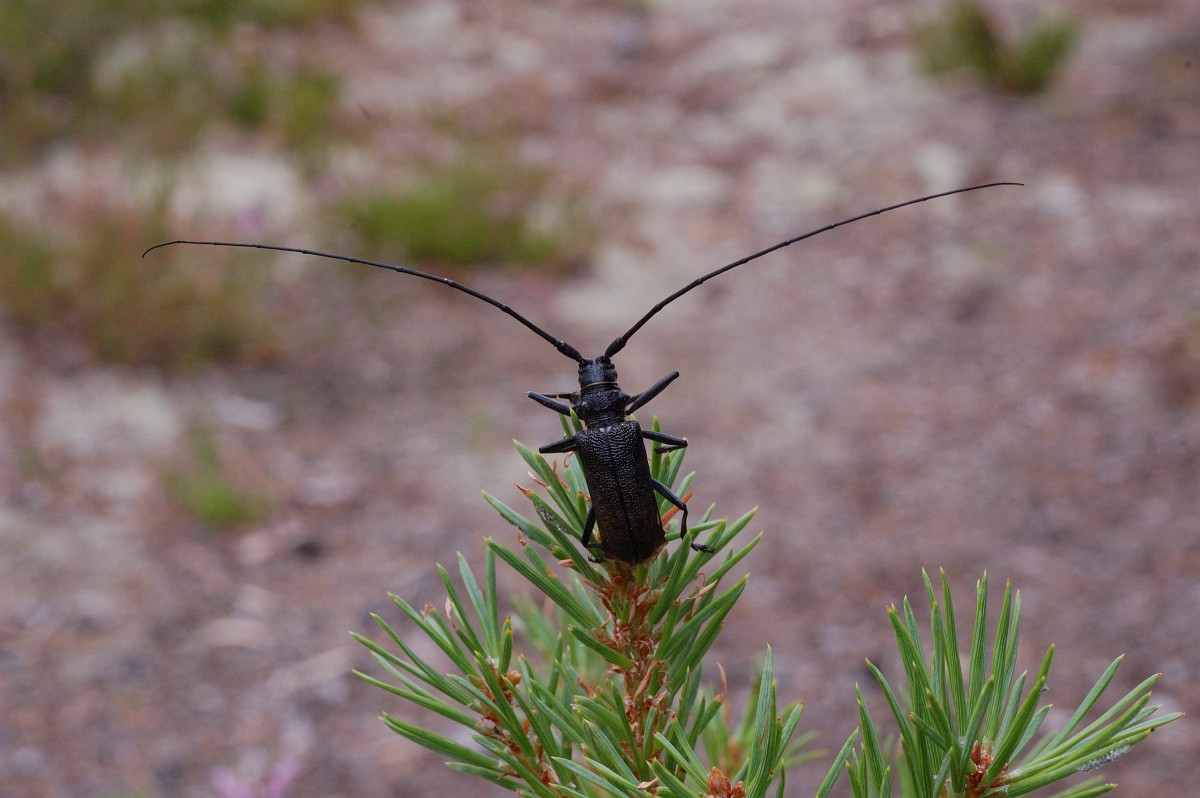
The life cycle of this group of nematodes represents an exception compared to the typical cycle of other plant nematodes. It is complex, with an intermediate host – longhorn beetles of the family Cerambycidae, genus Monochamus (Dejean 1821). They act as vectors for transmission from symptomatic and diseased pine trees to new and healthy ones during oviposition or feeding (Akbulut and Stamps, 2012). A single adult beetle can carry about 0.3 million nematodes in the fourth larval stage and can fly a maximum distance of approximately 2.5 km. Initially, scientists maintained the hypothesis that the insects themselves were the cause of pine wilting, but at a later stage it became clear that they are merely the carriers (Iwasaki and Morimoto, 1971).
In their developmental cycle, nematodes of this genus pass through four larval stages (J1, J2, J3 and J4) before becoming adults. The pine wood nematode has two developmental cycles – a direct one on fungal hyphae in the wood and an indirect one in an intermediate host (Vicente et al., 2011). The indirect cycle develops under unfavourable conditions, when additional resistant, lipid-rich daughter larvae are formed, which tolerate the transmission process more easily. They are localized in the tracheae of the pupae of young beetles, which transport them to healthy wood during their feeding.
In spring, the insects lay their eggs on weakened trees of the g. Pinus and the nematodes penetrate into the decaying wood. During the reproduction period of approximately 28–30 days under favourable conditions at around 20 °C, female nematodes lay between 80–150 eggs in pine wood. The life cycle of the nematodes is completed from egg to adult within 3 to 12 days depending on the temperature. At temperatures above 33 °C and below 10 °C they do not reproduce (Mamiya, 1984, 2004).
The relationship between Bursaphelenchus species and the vector may be more or less specific (Ryss, Vieira, Mota, Kulinich, 2005). For example, nematode species of the xylophilus group are associated mainly with species of Monochamus (Cerambycidae), whereas other nematode species belonging to the morphological groups sexdentati, egersi or eremus can most often be transmitted by bark beetle species of the subfamily Scolytinae (Curculionidae) (Braasch, Burgermeister, Gu, 2009; Ryss et al. 2005). In terms of feeding habits, nematodes of the genus Bursaphelenchus are mycophagous – they feed on fungal hyphae of the genus Ceratocystis and the genus Botrytis. They are specialized to reproduce, live and feed in pine wood at a depth of 1 mm beneath the bark. They show a preference for the epithelial cells of the resin canals and the tissues around the galleries of the longhorn beetle larvae.
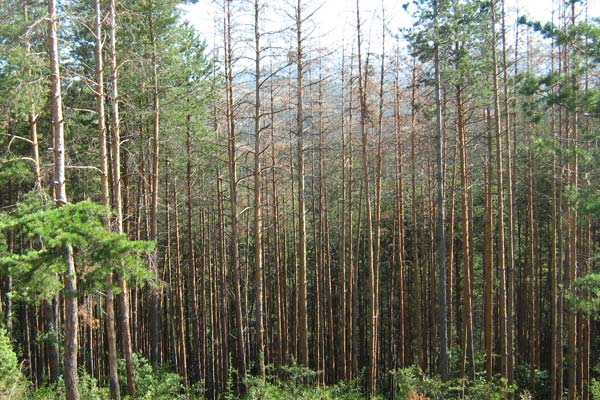
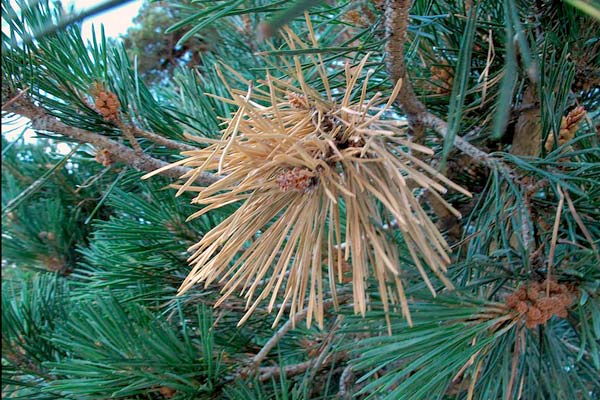
The disease develops rapidly – within a short period of time the affected pine trees reduce and subsequently cease resin exudation. Transpiration is severely reduced, as a result of which their needles turn yellow and wilt. This usually occurs within the first 30–40 days after infection. The plants gradually acquire a tile-red colour and die at the end of summer–beginning of autumn. Usually the plants begin to dry from the top. Even after complete mortality of the trees, nematode density increases. An extremely characteristic symptom is the greying of the wood.
Human activity and vectors play a key role in the spread of the pest worldwide and in Europe. The main risk factor is the continuously increasing global trade. The highest-risk pathway for the spread of the pest is considered to be trade in round wood with bark, bark from infested trees, untreated or poorly treated wood packaging material (WPM), as well as through wood chips, sawdust and bonsai plants. Other factors that should not be underestimated are the presence of vectors – beetles of the genus Monochamus, host plants, as well as favourable climatic conditions. There has been significant progress in studying the relationship existing between the vector, the pine wood nematode, the host trees and the environmental factors that lead to pine mortality in all countries and especially in Portugal. Monochamus galloprovincialis is the only known vector of the pine wood nematode in the infested areas of Portugal and Spain. Countries that meet these conditions have a potential risk for the introduction and spread of the pest.
Bulgaria, with its geographical location in combination with its climatic conditions, is a vulnerable zone for the introduction and spread of B. xylophilus. The suitable temperature, the presence of the vector – species of the genus Monochamus and the fact that 30% of the territory is covered by forests, of which 70% are coniferous species susceptible to the pine wood nematode, make our country a high-risk area. The pest is included in Annex 1, Part A, Chapter II of Ordinance No. 8 of 27 February 2015 on phytosanitary control (State Gazette No. 19 of 13.03.2015).
In the period 1993–2003, a study was carried out with the aim of clarifying the species composition of the genus Bursahelenchus, pathogenicity, development conditions and the presence of Bursahelenchus xylophilus in the country. Experts from the Central Laboratory for Plant Quarantine (CLPQ), the Forest Protection Station, Sofia, scientists from the Bulgarian Academy of Sciences, international organizations and researchers such as McNamara and Dr. Helena Braasch took an active part in these studies. Forest stands in the Balkan Mountains, the Rhodope Mountains, Osogovo Mountain and Vitosha were surveyed. The species B. sexdentati, B. mucronatus and B. boreali were detected. (Choleva & Samuleyan, 1996, Choleva et al., 2002). Bursahelenchus xylophilus was not detected.
Bulgaria, as an EU Member State, reports annually to the European Commission on the status of this pest on its territory. The control is carried out in implementation of the Monitoring Programme for quarantine pests on forest species since 2003, which is approved by the Minister of Agriculture, Forests and Food. The programme includes various objects of control – risk zones, ports, international transport routes, forest plots, roads near forests, wood-processing enterprises, nurseries, parks and green areas. The methods used are: visual inspections, installation of Galloprotect 2D type pheromone traps to establish the presence of the vector–carrier, and sampling of wood. The locations where the vector has been detected are mapped and during the next growing season a planned survey is carried out from these locations. Samples are taken in order to confirm or reject the presence of infestation. The collected samples are sent for analysis to the Central Laboratory for Plant Quarantine (CLPQ).
In 2017, experts from CLPQ for the first time detected and identified the species Bursaphelenchus xylophilus in a sample from WPM imported from Taiwan. The sample was taken and sent by border inspectors from the Port of Varna West. Species identification was performed using the main classical methods based on morphological characteristics. The initial diagnosis was confirmed by a Real-time PCR molecular test. The morphological identification was also confirmed by Prof. Gerrit Karssen, nematologist–taxonomist at the Nematology Department of the Dutch Reference Laboratory, Wageningen.
Up to this moment, the pest Bursaphelenchus xylophilus has not been detected on the territory of Bulgaria.