Pests of root vegetable crops – carrots
Author(s): проф. д-р Стойка Машева, ИЗК "Марица" Пловдив; гл.ас. д-р Дима Маркова; проф. д-р Винелина Янкова, ИЗК “Марица” в Пловдив
Date: 12.01.2019
10682

Diseases
Bacterial soft rot (Erwinia carotovora pv. carotovora)
Symptoms
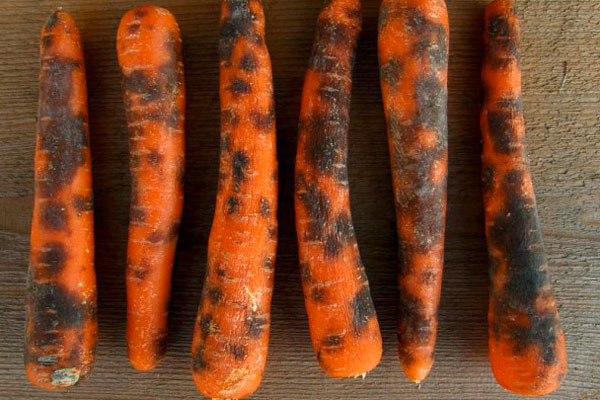
This disease occurs only when the soil is overmoistened or storage conditions are poor. In poorly drained areas or during wet periods, bacterial rot may also appear in the field. Characteristic watery, foul-smelling rotted spots appear on the roots. Losses due to bacteria causing soft rot usually occur after other storage diseases have been controlled. The bacterium survives in infected plant residues left in the field. It penetrates through wounds. Hot and humid weather with abundant rainfall favors the occurrence of the disease.
Control
Careful handling and sorting of the harvest before placing it in storage facilities are the only ways to reduce the problem; Planting on raised beds in poorly drained areas can also reduce bacterial infections; Introduction of a 2–3-year crop rotation; Control of nematodes and insects that are vectors of the bacteria for penetration into plant tissues; Removal of the first diseased plants and their destruction outside the crop; Removal of plant residues at the end of the vegetation; Prolonged irrigation of mature carrots in warm weather should be avoided.
Black rot (Stemphylium radicinum)
Symptoms
When infected seed is sown, a large part of it germinates but does not emerge. Seedlings that emerge develop damping-off. On the leaves of already grown plants, necrotic dark brown to black spots of irregular shape appear. On roots, the damage manifests itself during storage. Round to irregular, slightly sunken spots covered with a greenish-black coating of the fungal sporulation are observed. The pathogen is preserved as spores in plant residues and seeds. Favorable conditions for infection are a temperature of 28oC and high relative air humidity.
Control
Sowing of certified, disease-free seed; introduction of a 3–4-year crop rotation without host plants; Harvested roots should be stored at a temperature of 2oC.
Sclerotinia rot (Sclerotinia sclerotiorum)
Symptoms
In the field, the early signs of the disease are watery spots at the base of the leaves, which in conditions of high humidity become covered with abundant, fluffy white mycelium. Soon black sclerotia are formed in it. During storage of the produce, soft watery spots covered with white mycelium and black sclerotia are observed on the roots.
Control
Introduction of crop rotation without hosts of the disease; Weed control; Sowing on raised beds; Optimal stand density; Balanced fertilization; Optimal irrigation rates; Disinfection of storage facilities before placing the produce in storage; Prior removal of infected roots. Treatment with plant protection products upon appearance: Bordeaux mixture 20 WP 375–500 g/da; Contans WG 200 g/da; Switch 62.5 WG 80 g/da.
Violet root rot of carrots (Rhizoctoniа violaceae)
Symptoms
This disease has characteristic, unique symptoms. First, the leaves turn yellow, and the plants lag behind in their growth. Later, as the disease progresses, the plants wilt and dry up. When pulled out, it is found that the roots of these plants have rotted, and on the roots spots with adhering soil can be observed, covered with violet mold and small black sclerotia.
Control
Avoid sowing carrots on infested areas; Introduction of crop rotation including cereal crops; Growing on well-drained soils; Balanced nutrition; Optimal stand density; Strict prophylaxis to limit the spread of the disease through agricultural equipment.
Black leaf spot (Alternaria dauci)
Symptoms
The first symptoms appear as greenish-brown watery spots on the leaves. The spots enlarge, become brown to black, bordered by a yellow halo. Older leaves are more susceptible to infection. When about 40% of the leaf surface is affected, the leaf scorches and dies. Spots on petioles are elongated and common. They can quickly cause the death of entire leaves. The fungus is present on the seeds as spores and in the seeds as mycelium and/or spores. The pathogen prefers moderate to warm conditions and prolonged persistence of water droplets on the leaves. It is preserved in the soil on plant residues, but dies when the residue decomposes.
Control
Introduction of a 3–4-year crop rotation; Disinfection of seeds with hot water (50°C for 20 minutes); Deep ploughing-in of plant residues at the end of the vegetation; Storage of roots at a temperature of 0–1°C; Avoiding injury to roots during lifting and transport. Treatment with plant protection products upon appearance in the field: Bordeaux mixture 20 WP 375–500 g/da; Dithane DG 200 g/da; Dithane M-45 200 g/da; Difcor 250 SC 50 ml/da; Zoxis 250 SC 80–100 ml/da; Ortiva Top 100 ml/da; Sankozeb 80 WP 200 g/da; Signum 60 g/da; Switch 62.5 WG 80 g/da.
Leaf blight (Cercospora carrotae)
Symptoms
The first signs appear on the edges of leaf segments as small, round, chlorotic spots. Later they darken. In wet weather their center becomes lighter, and a dark halo appears around it. Under heavy attack, the leaf mass scorches. Spots on stems are elongated, with a clearly pronounced light center surrounded by a dark halo. On the flowering parts the symptoms are similar. In the case of early infection, they die before forming seeds. With later infection of the flowers, the pathogen can penetrate the seeds. At high air humidity, the spots are covered with a sporulating coating. It attacks mainly young leaves; older leaves are difficult to infect. Until the next vegetation season, the fungus is preserved in the seeds and in plant residues in the soil. High relative air humidity and a temperature of about 28oC are favorable for development of the disease.
Control
Introduction of a 2–3-year crop rotation; Optimal stand density; Sowing of certified, treated seeds; Preventive treatment of seed production fields with plant protection products. Upon appearance of the disease and with frequent showers, treatment with: Bordeaux mixture 20 WP 375–500 g/da.
Powdery mildew (Erysiphe umbelliferarum)
Symptoms
On the leaves, small, irregularly rounded, chlorotic spots are formed, which become covered with a greyish-white coating of fungal spores. Later they increase and cover a large part of the leaf mass and the stems. Small black dots – the cleistothecia of the fungus – appear on them. Under heavy attack, the leaf mass scorches and the resulting produce is unfit for consumption. Until the next vegetation season, the pathogen is preserved as cleistothecia and spores on plant residues. Mass development of the disease is observed at high relative air humidity.
Control
For sowing, high, well-ventilated sites should be selected; Optimal stand density; At the appearance of the first symptoms, treat with plant protection products: Difcor 250 SC 50 ml/da; Zoxis 250 SC 80–100 ml/da; Signum 60 g/da; Sulphur WG 300–400 g/da; Thiovit Jet 80 WG 300–400 g/da.
Pests
Aphids
On carrots occur Dysaphis crataegi Kalt., Semiaphis dauci F. and Myzus persicae Sulz. Aphids are sucking pests that feed on plant sap. They tend to gather in large groups on the leaves. They cause deformation of leaves and petioles, inhibit the growth and development of plants, and at high population density the plant may die. During feeding, aphids secrete a sticky excretion called honeydew. It is an ideal medium for the development of sooty fungi, which contaminate leaves and slow down photosynthesis. Aphids are vectors of certain viral diseases.
Control:
Destruction of weed vegetation. Treatments can be carried out with the products Karate Express WG/Ninja/Forza 40–50 g/da; Deca EC/Desha EC/Dena EC/Poleci/Decis 30 ml/da.
Carrot fly (Psila rosea F.)
The most dangerous pest of carrots is the carrot fly. It also damages parsnip, parsley and celery. It develops two generations per year and overwinters as a pupa in the soil or as a larva in unharvested roots stored in clamps. The flight of the flies begins during apple blossom. Flies of the second generation fly in August. The larvae develop on the roots until late autumn. The second generation of flies causes major damage to carrots. Plants attacked by carrot fly show leaf discoloration from red-violet to yellow and subsequently dry out; the roots are misshapen, rot, become tasteless, bitter and unfit for consumption.
Control:
Deep ploughing and weed control. Observance of crop rotation. Carrot sowing should be carried out at a greater distance from the areas where the crop was grown the previous year. Earlier sowing is preferable. Soils for carrot sowing should be lighter. Thinning of the stand, as dense stands are more heavily damaged. When mass flight of the carrot fly is established, chemical spraying with the insecticide Altacor 35 WG 10–12 g/da can also be applied.
Swallowtail butterflies (Papilio machaon L. and Papilio podalirius L.)
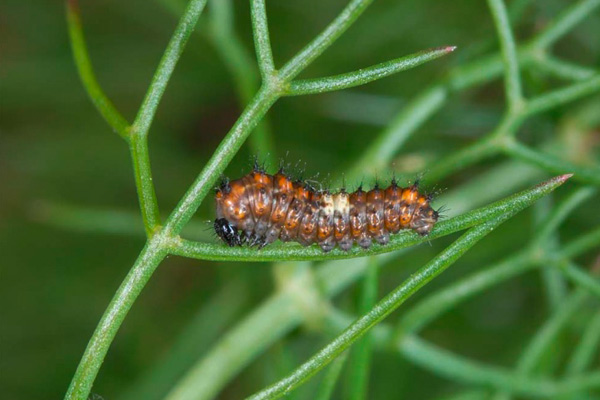
The larvae of the well-known beautiful butterflies, known as swallowtails, cause damage. They gnaw the leaves, often completely destroying the leaf mass. Usually single specimens are encountered, more rarely they occur in high numbers. They develop two generations per year. They overwinter as pupae. The first generation of butterflies appears in April and May, the second generation flies in July–August.
Control:
Treatment can be carried out with broad-spectrum insecticides such as Karate Express WG/Ninja/Forza 40–50 g/da; Deca EC/Desha EC/Dena EC/Poleci/Decis 30 ml/da.
Wireworms (fam. Elateridae)
These pests are typical polyphagous species. They have a three- to five-year development cycle. The larvae cause damage by boring tunnels in the roots. Through these tunnels, disease pathogens enter. The roots rot. The quality of the produce deteriorates. Such roots have no market value and do not withstand long storage. Often the damaged plants lag in development, wilt and die.
Control:
Use of areas free from the pest. Maintenance of optimal water and nutrient regime. Destruction of weed vegetation. For pest control, the product Ercole GR 1000–1500 g/da can be used as localized soil application at sowing.
Root-knot nematodes (Meloidogyne spp.)
They damage the roots of plants (carrots, radish). During feeding they secrete enzymes, as a result of which giant cells are formed, providing their nourishment. Galls are formed on the roots. The plants lag in development, turn yellow and, under heavy infestation, dry out.
Control:
Crop rotation. Soil cultivation and weed control. Timely sowing helps earlier development of the root system and makes plants more tolerant. Treatment with the product Vydate 10 G at a rate of 2.5 kg/da can be carried out.
For the diseases and pests that create problems in radish, radishes, beetroot for salad and parsnip, read issue 10/2018 of the journal “Rastitelna Zashtita” (Plant Protection).