

![MultipartFile resource [file_data]](/assets/img/articles/прогноза-май-2024.jpg)
During most days of the first ten-day period of May, agrometeorological conditions will be determined by unstable weather with frequent rainfall, which will create conditions for increasing the infectious background of fungal diseases. Vegetative processes in agricultural crops will proceed at moderate rates at temperatures close to climatic norms.
The rainfall in the second half of April in most of the field areas, between 30-50 l/m2, contributed to overcoming the soil moisture deficit in autumn crops, with the exception of some places in Northwestern Bulgaria. The forecasted rainfall until mid-May will maintain relatively good moisture reserves in the 50 cm soil layer, above 75% of FC (Field Capacity). During the first ten-day period, wheat crops will undergo the heading phase – beginning and mass. Rapeseed will be in bloom.
More suitable conditions for carrying out seasonal agrotechnical activities and plant protection sprays during the first ten-day period will be in the middle of the period, when relatively dry weather is forecasted.
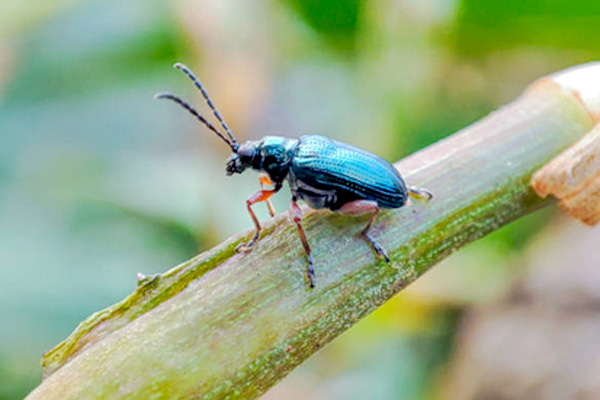
The common cereal leaf beetle seriously threatens wheat yields
During the period, winter cereal crops should be inspected for the presence and density of the harmful cereal bug and the common cereal leaf beetle.

On grapevines, damage to the flower clusters is caused by the caterpillars of the first generation of the grape berry moth. Upon reaching the economic damage threshold (EDT), which is 6-8 caterpillars per 100 clusters for wine varieties and 4-6 caterpillars per 100 clusters for dessert varieties, timely treatment is mandatory.
After the unstable weather until mid-month, a change in agrometeorological conditions is expected in the second half of May. An increase in average daily temperatures and an acceleration of vegetative processes in autumn crops and sown spring crops are forecasted. During this period, leaf formation will occur in sunflower and corn.
The expected rainfall at the end of May will ensure the increased moisture requirements of winter cereals in the soil. During this period, wheat will be in the milky ripeness stage. For sunflower crops sown within the agrotechnical deadline, inflorescence formation will be observed. In May, the possibility of hailstorms and the risk of damage to agricultural crops remain. For perennial crops and vegetable crops affected by hail, treatment with copper-containing fungicides is recommended to limit the risk of secondary infections with pathogens.
More suitable conditions for conducting plant protection sprays against a number of diseases – early brown rot, shot hole, scab on pome fruit species, downy mildews on vegetable crops and grapevines, fusarium head blight on wheat – will be available at the end of the first ten-day period, at the beginning and end of the second, and during most days of the third ten-day period of May.
Source NIMH