

The decisions that determine the establishment and yield of common winter wheat
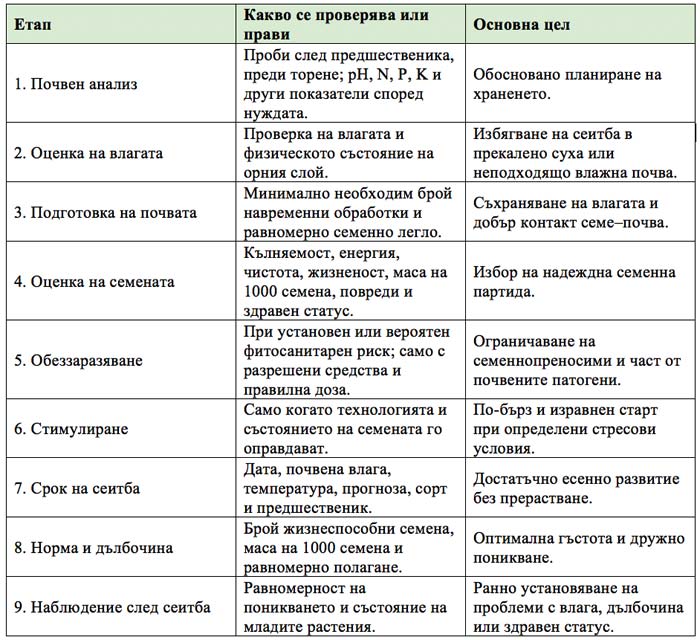
High and stable yields in common winter wheat do not begin with the first spring top-dressing. A significant part of the potential of the future crop is determined even before sowing – through knowledge of the soil, moisture conservation, the creation of a suitable seedbed, the choice of the right timing and the use of quality and healthy seed material. When these decisions are coordinated with one another, the plants are given the opportunity to emerge uniformly, to develop a good root system and to enter winter in an appropriate growth stage.
Soil analysis – the starting point for rational fertilization
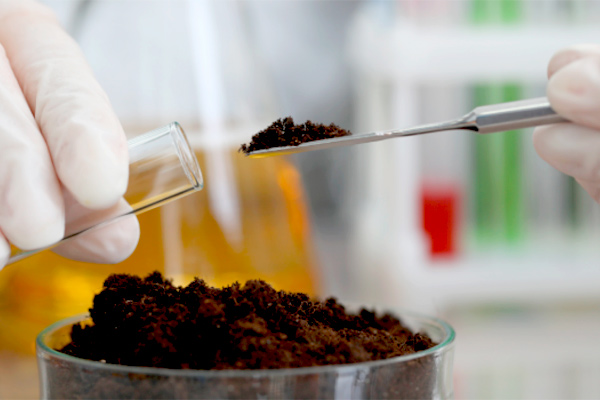
One of the most frequently underestimated steps before sowing is to establish what the soil actually has available. Fertilizing by habit or according to the previous year's scheme carries two risks – applying unnecessarily large amounts of a given nutrient or leaving a shortage of another that limits development as early as autumn. Soil analysis allows the nutrient regime to be planned for the specific field rather than for a conventional „average“ soil.
It is most appropriate to take samples after harvesting the preceding crop and before the main and pre-sowing fertilization. For autumn crops, this usually means the period from late summer to early autumn, so that sufficient time remains for laboratory analysis and adjustment of the fertilization programme. In field crops, sampling from the arable layer, approximately 0–30 cm, is often used, but the exact depth must be consistent with the laboratory's methodology and the purpose of the analysis. Mineral nitrogen requires particular attention because its content can change relatively quickly under the influence of moisture, temperature, the preceding crop and microbiological processes.
No less important than the timing is the method of sampling. A single sample from a random location cannot reliably represent a large or heterogeneous field. Good practice is to form a composite sample from multiple sub-samples taken from a relatively homogeneous area. Zones with different relief, soil type, fertilization history or visibly different development of the preceding crop are better investigated separately. It is the representative sample that turns the laboratory result into a useful decision-making tool.
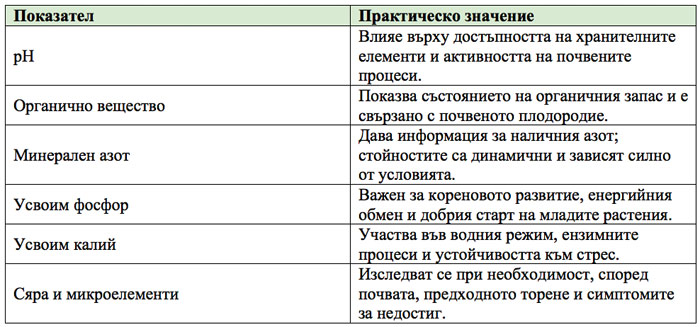
It is important that the results be interpreted comprehensively. The same laboratory value does not always mean the same degree of nutrient supply in different soils. Soil reaction, texture, organic matter, moisture, the preceding crop and the expected yield level determine the extent to which nutrients will be available to the plants. Therefore, soil analysis is a basis for decision-making, not merely a set of numbers.
Soil moisture and soil preparation – the conditions for uniform emergence
Even the best-balanced fertilization will not ensure a good start if the seeds land in a dry, excessively loose or heavily compacted seedbed. Water is necessary for the swelling and germination of the seeds, but also for the movement and uptake of nutrients. With insufficient moisture, emergence is delayed and becomes uneven, and the plants begin their autumn development under different conditions.
After harvesting the preceding crop, the main task is to create a sowing layer that allows the seeds to be placed at a relatively uniform depth and to have good contact with the soil. The preparation must distribute plant residues, limit weeds and preserve as much of the available moisture as possible. The goal is not to carry out a certain number of tillage operations, but to achieve a suitable physical condition of the soil with as few unnecessary passes as possible.
In a dry autumn, an excessive number of tillage operations can further dry out the surface layer. In waterlogged soil, the opposite risk is compaction, smearing of the structure and the formation of clods, especially when working with heavy machinery. Therefore, the choice of tillage and the timing of its implementation must depend on the texture, the preceding crop, plant residues and the current moisture level.
In practice, a good seedbed is relatively firm at the base and finer in the surface layer. If the entire layer is too loose, the seeds may end up at different depths and their contact with the moist soil may be poor. Under certain dry conditions, appropriate consolidation after sowing can improve seed–soil contact, but any such operation must be consistent with soil moisture.
The sowing date determines how much time the plants will have for autumn development. After emergence, wheat must form a viable root system, leaf mass and an appropriate number of tillers without overgrowing. This is precisely why the date influences yield not only through the sowing date itself, but through the condition in which the crop enters winter and starts spring vegetation.
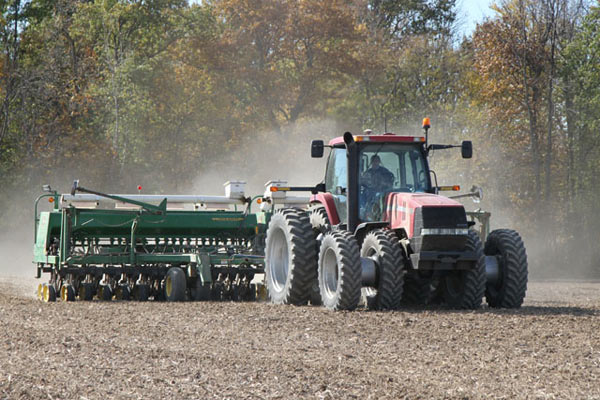
For common winter wheat, the current Guide for Integrated Production of Cereal Crops indicates as a reference 25 September–10 October for the foothill part of Southern Bulgaria and 1–20 October for the plains. The desired development by the end of autumn vegetation is indicated as the formation of approximately 2–3 tillers per plant (Ministry of Agriculture and Food, 2024). Our unpublished data show that under the conditions of Southern Bulgaria, sowing carried out until the beginning of November is not associated with a risk of insufficient plant development in autumn.
However, the calendar should not be followed mechanically. The same date can be very suitable in a wet and moderately warm autumn and unfavourable in a dry year. When determining the specific timing, soil moisture, temperature, the precipitation forecast, the condition of the seedbed, the preceding crop and the characteristics of the variety must all be assessed simultaneously.
Too early sowing in a prolonged warm autumn can lead to excessive tillering and accumulation of above-ground mass. The longer stay of the plants in the field also increases the period during which they can be exposed to certain pests and diseases. With too late sowing, the problem is the opposite – less time for root formation and tillering, which can reduce productive density. Field studies show that severe delay in sowing can reduce yield, and a moderate increase in seeding rate compensates only part of the loss and does not replace the correct timing (Jarecki, 2024).
Seed material quality – more than laboratory germination
Quality seed material is one of the most reliable prerequisites for uniform crop establishment. Laboratory germination is important, but by itself it does not fully describe the behaviour of seeds in the field. It is advisable to also take into account germination energy, vigour, purity, thousand-seed weight, the presence of mechanical damage and the health status of the lot.
This distinction is important because laboratory conditions are close to optimal, while in the field the seeds may encounter limited moisture, lower temperature or temporary drought. Seeds with good vigour and high physiological activity generally have a greater chance of giving rapid and uniform emergence under such fluctuations.
Hence the practical conclusion: high germination is necessary, but the vigour and health of the seeds determine the extent to which that germination will be realized in the field.
When can pre-sowing stimulation give a better start?
Pre-sowing stimulation, often referred to by the term seed priming, includes technologies in which part of the physiological processes preceding germination are activated.
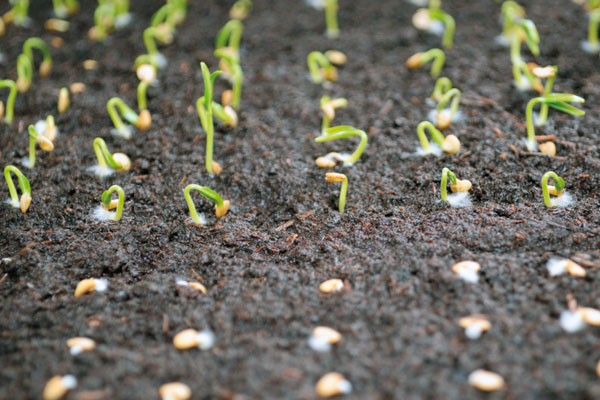
In classical approaches, the seed absorbs a controlled amount of water or solution, metabolic processes begin, but the treatment is terminated before the appearance of the radicle. After appropriate drying, the seeds are sown.
The main goal is that after landing in moist soil, the seeds transition more quickly and more uniformly to germination. Scientific reviews show that priming can improve the speed and uniformity of germination and increase vigour under certain stress conditions (Paparella et al., 2015). In practice, this can be of interest in later sowing, lower temperatures or conditions in which initial development is expected to be difficult.
However, stimulation is not a universal solution. It cannot compensate for low germination, severe mechanical damage, heavy infection, lack of soil moisture or a poorly prepared seedbed. It makes the most sense with quality seeds, when the goal is to support their start. When using stimulant and fungicidal products, their compatibility must be checked, as inappropriate combining, excessive moistening or prolonged storage of already treated seeds can reduce the positive effect.
Seed-borne pathogens – a risk that can remain invisible
The healthy external appearance of the grain does not guarantee that it is free from pathogens. Disease causal agents can be found on the surface, under the seed coats or in the internal tissues of the seed. This is particularly important because infected seed can simultaneously give a weaker plant and introduce primary infectious material into the new field.
In wheat, representatives of the genera Fusarium and Microdochium, as well as Bipolaris sorokiniana, are significant. The classical seed-borne causal agents also include species of the genus Tilletia, causing common bunt, and Ustilago tritici, the causal agent of loose smut. Depending on the pathogen, the consequences can include reduced germination, rotting of seeds and seedlings, root and basal rots, blotching and uneven emergence.
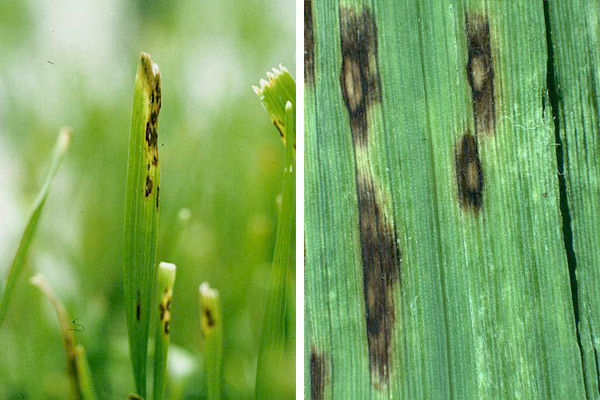
A well-studied example is Bipolaris sorokiniana, which can be transmitted with the seeds and is associated with black point of the grain, common root rot and spot blotch. Infected seeds can have lower quality and germination and serve as a source of primary infection (Al-Sadi, 2021).
Seed treatment – early protection, but not an end in itself
Seed treatment is one of the earliest plant protection measures in the production cycle. The goal is to reduce the infection found on or in the seed, and with certain products to provide protection also against some soil pathogens during germination and initial development. This is precisely when the young seedling is particularly vulnerable and an early infection can lead to thinning of the crop even before the problem becomes visible.
The choice of method must be consistent with the probable or established pathogen, its location in the seed and the health status of the lot. Modern approaches include chemical fungicides, biological agents and physical methods, but their effectiveness is not equal against all causal agents. Therefore, an approach according to the real risk is more reasonable than mechanical treatment without information about the seed lot (Moumni et al., 2023).
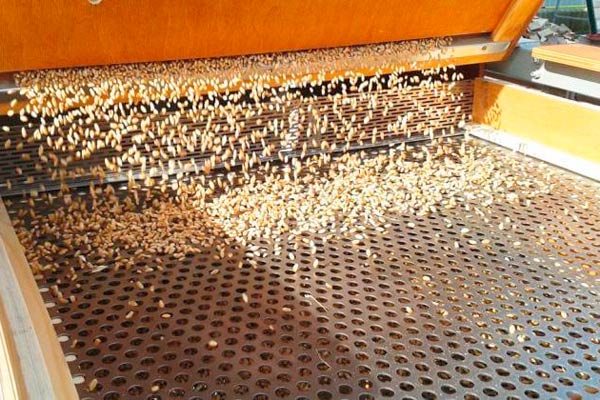
In practical treatment, the correct dose, uniform coverage and compliance with technological requirements are decisive. Insufficient coverage leaves part of the seeds unprotected, while excessive or inappropriate treatment can adversely affect germination and beneficial microorganisms associated with the seed. Therefore, only products approved for the respective crop and purpose should be used, in accordance with the label and current requirements. Seed treatment is part of integrated protection, but it cannot replace healthy seed material, crop rotation, a good seedbed and the right timing.
Seeding rate and depth – the final touch before emergence
Once the seeds and the timing have been chosen, one more important decision remains – how many seeds to sow. The seeding rate is best not determined only as kilograms per decare, because two lots with different thousand-seed weight can give a different number of plants at the same weight quantity. A more accurate approach is to start from the desired density and the number of viable seeds.
The calculation takes into account the thousand-seed weight, laboratory germination, purity, expected field losses, the variety, the sowing date and the condition of the soil. With moderately delayed sowing, an adjustment of the rate is sometimes made, but increasing it has limits and cannot compensate for severe delay or a poor seedbed. Equally important is that the seeds be placed uniformly at an appropriate depth, so that they have access to moisture without hindering emergence.