

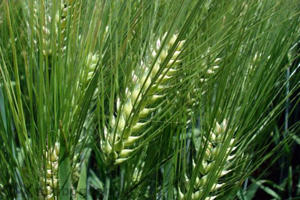
During the first days of August, the agrometeorological conditions in Western Bulgaria remained unstable. This further hindered the wheat harvest and worsened grain quality. By the end of the month, the wheat harvest had still not concluded in the higher areas of the Kyustendil, Pernik, and Sofia provinces. In mid-August, the atmosphere stabilized, temperatures rose, and in different parts of the country the maximums reached between 33-38°C.
During the second half of August, part of the spring crops concluded their development. The sunflower harvest and the sowing of rapeseed began. In Southern Bulgaria, in areas with less rainfall during the season, the harvest of early hybrid corn also started.
WHEAT AND BARLEY
The unstable agrometeorological conditions worsened grain quality, and in late-harvested crops, the appearance of fungal pathogens from the genus Alternaria was noted (Vidin, Vratsa, Pernik, Sofia-province, Stara Zagora, Targovishte, etc.). The rainfall during the summer months provoked secondary weed infestation of areas cleared after the harvest of cereal crops and rapeseed. In the provinces of Blagoevgrad, Vratsa, Lom, Razgrad, and Ruse, a campaign for treating stubble fields with total herbicides is underway, with priority given to areas intended for re-sowing with cereals. To date, approximately 114 thousand decares have been treated. During surveys conducted in August on stubble fields, field margins, and roadside strips, a trend of gradation in the development of the common vole was observed.
Due to heavy weed infestation and the presence of fresh vegetation, the recorded population density of the pest is around and above the Economic Threshold (ET in autumn: 2 active colonies/decare). In stubble fields from winter crops and rapeseed, in the provinces of Pleven, Razgrad, Ruse, and Stara Zagora, the recorded vole density ranges from individual burrows to 2 active colonies/decare. Up to 3 active colonies/decare were recorded in the provinces of: Burgas, Varna, Vratsa, Dobrich, Kyustendil, and Lovech. In the provinces of Pernik and Targovishte, the recorded density is 2-7 active colonies/decare. In the Shumen province, a density of 2-18 active colonies/decare was recorded. If favorable climatic conditions continue in the autumn of 2014, a mass multiplication of voles is expected in Northern Bulgaria and the fields in the western part of the country. In Southern Bulgaria, in the regions of Plovdiv, Stara Zagora, Yambol, and Burgas provinces, an increase in the numbers of the common vole and the Eastern Mediterranean house mouse is also expected. Surveys to monitor the development dynamics of murine rodents continue. The trend in the development of murine rodents is: an increase in numbers, harmful activity, and expansion of their range.