

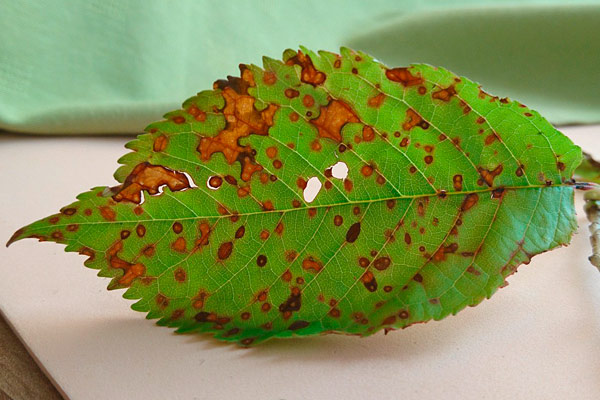
Shot-hole disease in stone fruit species may be caused not only by the bacterium – Pseudomonas syringae p.v. syringae, but also by the fungus Stigmina carpophylla (Coryneum beijerinckii)
Symptoms:
Small purplish-red spots appear on the leaves, in the centre of which the tissue becomes necrotic and falls out. In cases of severe infection, the spots merge; a light yellowish halo appears around them when the causal agent is a bacterium, or a reddish-violet border when the causal agent is a fungus. On the fruits the spots are dark; as the fruit ripens they become sunken and may adhere to the stone.
The bacterium survives in the infected plant parts, in the fallen leaves and in the soil. Infection occurs through wounds, buds and leaf scars, through stomata and the cuticle. The spores are dispersed by rain, wind and insects. For spore germination, water droplets are required, therefore a strong infection wave follows prolonged rainfall.
Life cycle
The fungal causal agent overwinters as mycelium in the infected twigs. It multiplies during mild winters and in the dormant period, forming conidia which are a source of infection.
The bacterial causal agents overwinter in the infected plant parts, as well as in the fallen leaves and in the soil.
Infection by shot-hole disease occurs through wounds, through stomata or through the cuticle.
Spores and bacteria are spread by rain, wind or insects.
Control:
In autumn it is mandatory to prune out the infected parts of the tree, and the fallen leaves must be deeply incorporated into the soil by ploughing. In autumn (at 70–80% leaf fall) and in early spring, spray with 1% Bordeaux mixture.
To control the disease, the following treatments are necessary:
- First spraying - at the phenological stage “pink bud”;
- Second spraying - after flowering;
- Third spraying - 7 days after the second.
Registered fungicides for control:
Captan 80 WG (valid until: 31.07.2021) – 150–180 g/da, Bordo Mix 20 WP – 375–500 g/da, Kocide 2000 WG – 155–285 g/da – for peach and nectarine, for apricot – 185–280 g/da, and Funguran OH 50 WP – 150–250 g/da, Champion 50 WP/ Champ 50 WP/ Macc 50 WP – 300 g/da, Vitra 50 WP/ Kuprohay 50 WP – 150 g/da; Merpan 80 WG (valid until 31.07.2021)