

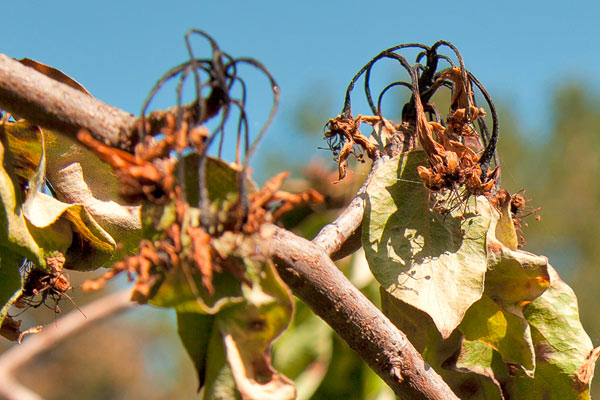
This is a bacterial disease that affects all above-ground parts of pome fruit species – pear, apple, quince, medlar. Infected trees are recognized by the characteristic hook-shaped young shoots, bent from the tip downwards and dried, branches with dried, blackened leaves and fruits that remain on the trees and do not fall. The bacterium causing the disease survives the winter in the infected branches and therefore the affected plant parts must be cut 50–70 cm below the boundary between diseased and healthy tissue and must be burned outside the orchard. When the infection is established, it is necessary:
- Cutting of the affected parts of the trees 50–70 cm below the boundary between diseased and healthy tissue and burning them outside the orchard;
- Heavily infected trees are uprooted and also burned;
- After each cut, the cutting tools must be disinfected with a 10% solution of bleach or formalin;
- After completion of pruning, a treatment with a copper-containing fungicide must be carried out.
The causal agent of fire blight is a bacterium. It overwinters in the infected branches, penetrates the plant through wounds and cracks, through stomata and flowers, and is spread by insects, bees, birds and humans during operations – for example, during pruning.
For better control of the disease, when 70–80% of the leaf mass has fallen, it is necessary to spray the peach trees with contact or systemic fungicides: Dithane M 45 – 0.03%, Dithane DG – 0.3%, Score 250 EC – 0.02%, Thiram 80 WG – 0.3%, Shavit F 72 WDG – 0.2%, Champion 50 WP – 0.3%.