

In a large part of the cereal crops in the country, especially those in Southern Bulgaria and the high fields of Northern Bulgaria, an expanding spread of winter-spring weed species and ephemerals is observed, which emerge mainly in autumn – sheep’s fescue, wild oat-grass, ryegrass, blackgrass, windgrass, couch grass, as well as broadleaf species such as corn poppy, cornflower and others, which are found throughout Bulgaria. These weeds are one of the main threats and compete with winter wheat at the beginning of its development, which has a negative effect on the stand density of the crops. Therefore, in cases where it is known that there is a large reserve of viable seeds in the soil from the above-mentioned species and heavy weed infestation of wheat crops is expected, chemical control must start already in the autumn with an appropriate product.
It is important to note that the economic threshold of harmfulness varies in individual cases, because it depends on many factors such as the biological characteristics of the variety, sowing date, soil and climatic conditions, type and degree of weed infestation, density and phytosanitary condition of the crop, etc. Persistent grass weeds such as wild oat-grass, fescue and ryegrass are controlled extremely successfully already in autumn with the new product of Bayer – Atlantis Flex + Biopower
The trials conducted during the 2017-2018 farming year fully confirm this. The most appropriate time for controlling these weeds is before they overgrow. The conducted trials show the high level of efficacy of Atlantis Flex against difficult-to-control grass weeds and the practical recommendations of the specialists from Bayer.
How does ATLANTIS FLEX perform against some of the most widespread weeds?
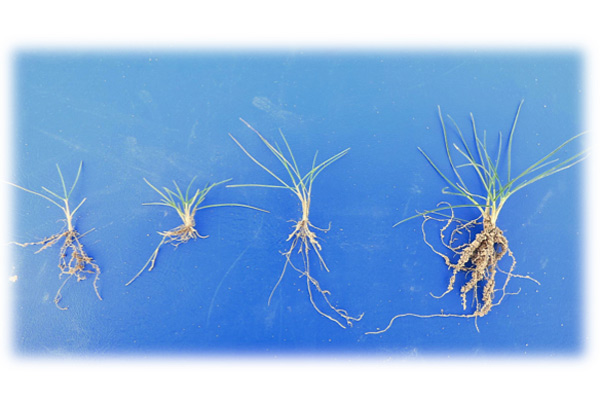
SHEEP’S FESCUE is one of the most persistent weeds occurring in certain regions of Bulgaria. Due to the structure of its leaves, sheep’s fescue is difficult to catch with graminicidal herbicides. Its leaf blade is permanently folded, needle-shaped and its diameter reaches only up to 1 mm. The leaf sheaths are smooth and hairless. A very important condition for achieving an optimal effect is that the weeds are treated at the optimum growth stage – before tillering. The conducted trial shows excellent control of the weed, with the treatment carried out in autumn. Due to the specificity of the leaf blade, combining Atlantis Flex with the adjuvant Biopower is mandatory in order to achieve maximum effect against this persistent weed.
DOSE USED: Atlantis Flex 25 g/da + Biopower 100 ml/da autumn application.
After 35 days, the effect of Atlantis Flex + Biopower, compared with an alternative product on the market and with the untreated control, is 20% better. The root system of the fescue treated with Atlantis Flex is much less developed, with the weeds gradually dying off compared to the root system of the fescue treated with the alternative product. After 92 days, 80% control of fescue is recorded. The weed in the control is already strongly developed.
RYEGRASS – a grass weed, frequently encountered in the fields of Bulgaria. Fifteen days after treatment with Atlantis Flex there is already a clearly expressed yellowing of the main leaf and the beginning of weed dieback.
DOSE USED: Atlantis Flex 25 g/da + Biopower 100 ml/da autumn application – efficacy against the weed.
After 92 days, the weed is 100% destroyed. In the control, the ryegrass has tillered strongly.
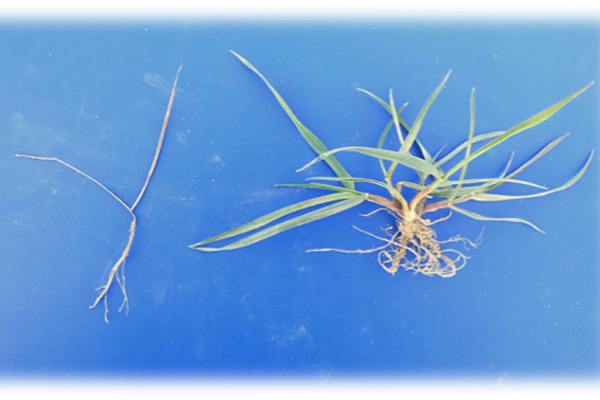
WILD OAT-GRASS – another extremely difficult weed to control, due to the numerous hairs on its leaf blade. In this particular trial it was treated in spring, although here too it is recommended that control be carried out already in autumn at a dose of 25 g + 100 ml Biopower if the weed has emerged. To demonstrate the capabilities of Atlantis Flex, we carried out the treatment in spring at an overgrown stage of the wild oat-grass – between tillering and stem elongation. Twenty-two days later we can see the difference between the treated and untreated weeds.
DOSE USED: Atlantis Flex 30 g/da + Biopower 100 ml/da spring application – efficacy against wild oat-grass.
The treated wild oat-grass gradually dies, while that in the control sets seed and continues its development.
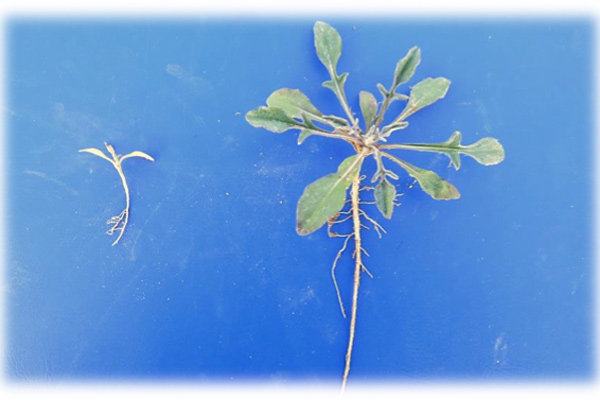
For broadleaf weeds, especially those emerging in autumn, Atlantis Flex showed excellent results against POPPY AND CORNFLOWER. Cornflower was treated in autumn. The weed in the control has formed a rosette, while the treated cornflower is 90% controlled. The poppy is strongly suppressed and dies.
DOSE USED: 30 g/da + adjuvant Biopower 100 ml/da
In addition to its exceptionally comprehensive action against difficult-to-control weeds, like every Bayer product, Atlantis Flex is extremely tolerant to the crop thanks to the built-in safener technology. This allows the product to be used in a very wide application window from the 2–3 leaf stage up to stem elongation of the wheat.
Another advantage of the product is that it can be tank-mixed with fungicides, insecticides and foliar fertilizers. Trials in Bulgaria show that in practice Atlantis Flex can also be applied with a lower spray volume (down to 10 l/da) without this affecting its efficacy.
Are you looking for reliable control of the most persistent weeds in cereals? Now is the time for timely protection of your crops, which will ensure clean fields and healthy plants in spring!
Atlantis Flex from Bayer is a herbicide distinguished by its complexity and its ability to control difficult grass weeds such as wild oat-grass, fescue, ryegrass, and even broadleaf weeds such as poppy and cornflower!
With ATLANTIS FLEX, applied in the early growth stages of cereal crops, you reduce the risk of weed infestation and preserve the high yield potential of the crop!
For cleaner fields in autumn and higher yields – choose ATLANTIS FLEX – an innovative herbicide technology from BAYER!
PR material