

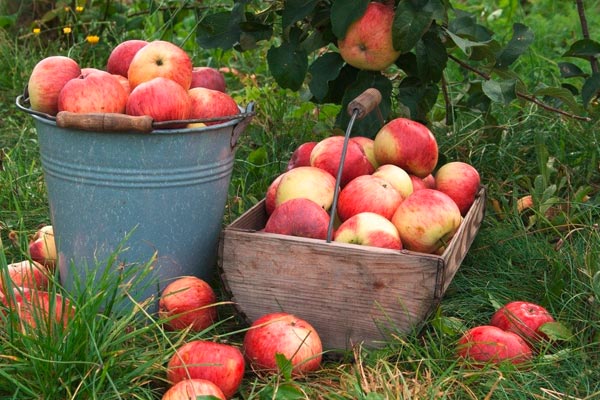
Temperatures in September decrease and usually the maximums do not exceed 25°C. The foliage of the trees continues to photosynthesize actively and ensures the nutrition of the fruits (for autumn and winter cultivars), the differentiation of the fruit buds and the deposition of reserve nutrients. During this month, for most fruit species it is not necessary to carry out treatments, but although fewer, they are still needed.
In apple orchards, spraying is carried out against late scab infections and the causal agents of fruit rot during storage from fungi of the genera Monilinia, Penicillium, Botritis, Alternaria, Botryosphaeria, etc. Damage from the codling moth also continues.
Apple cultivars whose fruits will be harvested in the second half of September should be sprayed with insecticides with a short pre‑harvest interval.
For late‑ripening pear cultivars control against fruit moths (codling, oriental and pear moth) and the causal agents of fruit rot must be continued. The insecticides and fungicides indicated for apple are used.
The fruits of the quince cultivars grown in our country are highly susceptible to late brown rot, grey mould and soft rot, which are particularly harmful in periods of frequent rainfall during fruit ripening and later during storage. This necessitates spraying against these pathogens. To protect the fruits from infestation by codling moth and oriental fruit moth, an insecticide is also added to the fungicidal solution.
Information on the plant protection products required for spraying during this period can be found in issue 8/9 2018 of the journal “Plant Protection”.