

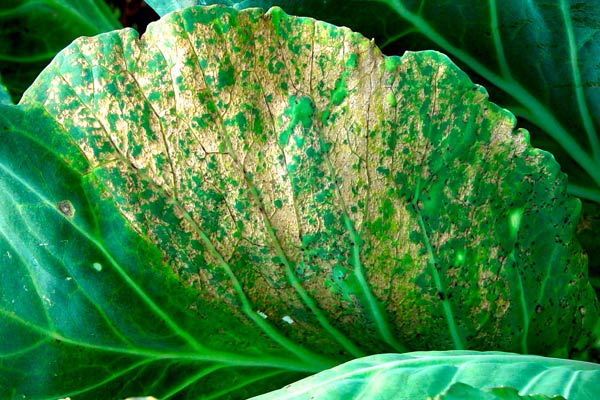
The disease is widespread in regions with a cooler climate. In our country it causes more severe damage to seedlings for early production and in autumn to late cabbage. The first symptoms appear on the seedling plants as sunken spots, which on the lower side are covered with a loose whitish coating of fungal spores. Later the coating disappears and the spots scorch. Under severe attack, young plants may die. In adult plants the outer leaves of the heads are attacked first. Numerous ashy-grey spots, merging with one another, appear on them. Sometimes deeper-lying leaves may also be attacked, which leads to rapid rotting of the entire heads. The pathogen attacks the flower stalks, fruit peduncles and pods, and from there the seeds. The fungus survives until the next vegetation period as oospores in plant residues. It also overwinters in the heads from seed production stands. These are probably the primary sources of infection. It is also preserved in the seedbeds. Infection with the disease is massive at a temperature of 16ºC, and at 20 - 24°C the pathogen develops in the tissues of the host.
Control
Control measures are carried out under favourable conditions and after the appearance of the disease with Bordeaux Mix 20 WP – 500 g/ha, Infinito SC – 160 ml/ha or Ridomil Gold R WP – 500 g/ha.