

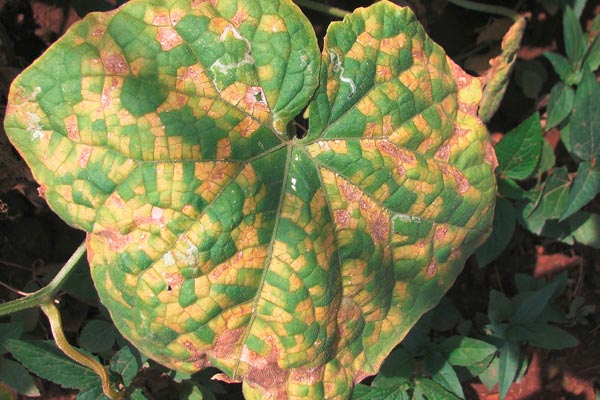
This is the disease of greatest economic importance in cucumber cultivation. On the upper side of the leaves, yellowish spots of irregular shape are formed, delimited by the veins. In humid weather they are watery, and their lower surface is covered with a loose grey‑violet coating formed by the sporulation of the fungus. Later, the spots enlarge, merge and the entire leaf scorches. The first spots usually appear on the lowest leaves, but within a short time the greater part of them can be affected. It is of greater significance in cucumbers grown in greenhouses with polyethylene covering, where humidity is higher. The fungus survives as oospores in the soil. With prolonged continuous cultivation of cucumbers, especially in polyethylene greenhouses, a large amount of inoculum accumulates in the soil. Then the disease may develop very early and cause major losses. High relative air humidity is favourable for its mass development. A favourable condition is the morning dew that forms on the plants in unheated cultivation facilities due to the difference between day and night temperatures. With night heating that does not allow dew formation, the probability of downy mildew infection is negligible. When favourable conditions for development of the fungus are present and the first spots appear, treatments with PPP must be carried out immediately. Inadequate actions at such a moment can be fatal and the losses – substantial.
Control
Removal of plant residues from the previous vegetation; cultivation of resistant varieties. Regular ventilation of greenhouses. Balanced plant nutrition. Maintenance of an optimal temperature and humidity regime. Dew formation on the leaves must not be allowed. Preventive treatments with PPP.
In the presence of critical periods, treatment with registered PPP: Bordeaux mix 20 WP 375–500 g/ha; Verita WG 0.15%; Galben 8M 65 0.25%; Dithane DG 200 g/ha; Dithane M‑45 200 g/ha; Equation Pro 0.04%; Infinito SC 120–160 ml/ha; Curzate M DF 0.3%; Curzate R DF 0.25%; Melody Compact 49 WG 150–185 g/ha; Polyram DF 180–200 g/ha; Ridomil Gold MZ 68 WG 0.25%; Ridomil Gold 500 g/ha; Sancozeb 80 WP 200 g/ha; Champion WP 0.15%.