

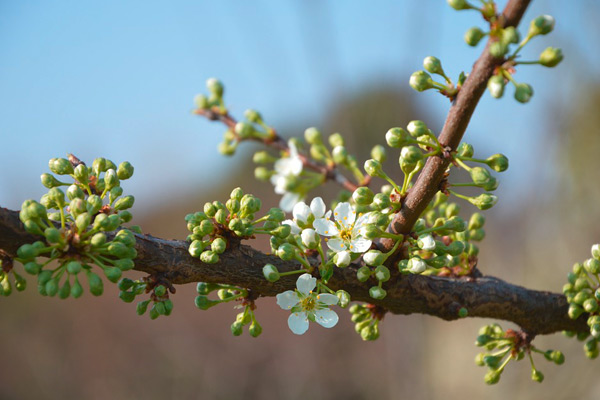
In the third ten-day period of March, the calendar spring begins. The average monthly temperature rises from 4-8°C, cloudiness decreases, and the number of sunny days increases. As a result of the warming, the phase of enforced dormancy of the fruit species is terminated, and at the same time the vital activity of a number of pests on them is activated. The weather in March is very changeable, which requires fruit growers to monitor for suitable days for work in the orchards.
Many of the overwintering forms of dangerous pests of fruit trees spend the winter in the soil, and in the fallen leaves the disease pathogens are “lurking”, ready to attack. Therefore, cultivated and cleaned orchards are a guarantee for reducing the risk of pests. If winter spraying has not been carried out so far, it should not be omitted, because it destroys mites, aphids and scale insects.
Pre-bloom sprayings begin in March. The first is at the “mouse ear” stage in apple – against powdery mildew and scab with a fungicide, and the second – again against the same diseases, but with the inclusion of an insecticide against the apple sawfly. In pear – against scab, pear sawfly, pear psylla and stink bug. In sweet cherry and sour cherry – against brown rot, shot-hole disease, fire blight, cherry/sour cherry weevil. Plums – plum sawfly. Apricot – brown rot, shot-hole disease, peach twig borer. Peach – leaf curl, peach twig borer.
The pre-bloom sprayings of fruit trees are a responsible measure that should not be omitted. They mark the beginning of chemical control, and this beginning determines the phytosanitary status in the orchard throughout the entire season.
For chemical control in the orchard and vegetable garden – for the timing of treatments and suitable products, read issue 2/2018 of the journal “Plant Protection”.