

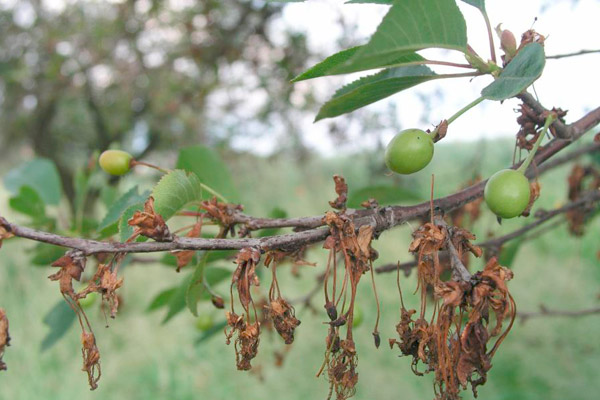
Causal agent: Monilinia laxa – fungus
Hosts: apricot, sour cherry, cherry, plum, peach
Symptoms:
The manifestation of blossom blight (early brown rot) begins as necrotic spots on the petals and subsequently encompasses the entire flowers – a “blight” form of the blossoms, shoots and leaves, which dry out.
The young fruit turn brown, the fruits rot, become mummified, and under conditions of high relative air humidity and moderate temperatures they are covered with grey, fine, powdery tufts of the sporulation of the fungus.
The affected plant parts do not fall, but remain in the tree canopy until the following spring.
On infected scaffold branches, cankers and lesions, as well as gummosis, are observed.
With priority, blossom blight (early brown rot) attacks apricot, sour cherry and the plum cultivar „Stanley“.
Life cycle
The causal agent overwinters as mycelium in infected shoots and in mummified fruits remaining on the trees.
Infections are caused by conidia, which are formed in spring under moist conditions and are dispersed by wind, rain and insects.
The disease is more severe at high relative air humidity.
Mass fruit rot is favoured by fruit cracking as a result of excessive soil moisture, pest damage and mechanical injuries from hail.
Control:
To control the disease, it is necessary to carry out:
- Pre-bloom spraying – at the „flower bud” phenophase;
- Bloom spraying – at the beginning of flowering;
- Post-bloom spraying – after petal fall;
- Fourth spraying – in wet and cool weather during the flowering period and in case of high infection pressure – 8-10 days after the third treatment.
Registered fungicides for control: Captan 80 WG – 150-180 g/da, Bordeaux Mix 20 WP – 375-500 g/da, Kocide 2000 WG – 185-280 g/da, Funguran OH 50 WP – 150-250 g/da, Champion WP, Champ WP, Macc 50 WP – 300 g/da, Vitra 50 WP, Cuprohy 50 WP – 150 g/da, Delan 700 WDG in peaches – 50 g/da, Difcor 250 EC – 20 ml/da, Caramat 2.5 EW – 300 ml/da, Prolectus 50 WG in peach and nectarine – 80 g/da, Signum WG in peaches – 30 g/da, Systhane 20 EW – 25-30 ml/100 l water (12.5-30 ml/da), Chorus 50 WG – 0.045% (45 g/da).