

The article was updated on 22.09.2021.
The disease is caused by the fungus Botrytis cinerea, which, under suitable climatic conditions, can cause serious yield losses.
Bunches that escape infection during flowering may become infected around and during harvest.
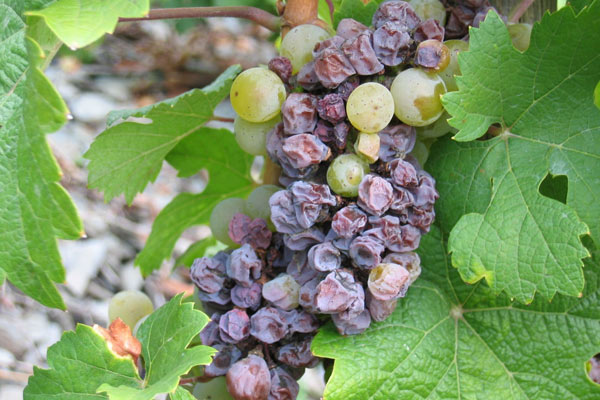
Although grey mould attacks the buds, young shoots, and leaves of grapevine plantations, the most typical damage caused by the disease is observed on the berries in the period around their ripening. When infection occurs, pale brown spots appear on the berries, on which the skin peels off easily. The disease rapidly affects the entire bunch and spreads to neighbouring bunches. In wet weather, the affected plant parts become abundantly covered with grey mould. As the grapes ripen, the spread and intensity of grey mould attack increases. Grey mould also develops rapidly if the plants have previously been attacked by grape moths, in the presence of powdery mildew infection (oidium), hail damage, birds, etc.
Life cycle
The fungus overwinters in mummified berries, dead tissues and other organic residues in the vineyards. In spring it develops from small, dark and hard structures (sclerotia). At that time it forms conidiospores, by which it spreads throughout the entire vegetation period. After flowering is completed, the fungus infects the dead parts of the inflorescences. Once it penetrates the berries, the pathogen may remain dormant until the sugar content of the fruit increases and the acids are reduced to levels that enable its growth.
Pest control strategy
At berry softening and veraison, spraying is carried out with one of the registered fungicides.
Authorized plant protection products
Banjo - 100-150 ml/ha; Geox WG - 50 g/ha; Zenbi (former Zenbai) - 150 ml/ha; Cabrio Top – 0.2% (120 g/ha); Cantus - 100 g/ha; Carbicure SP - 500 g/ha; Kenja - 150 ml/ha; Krayor - 150 ml/ha; Mevalon - 160-400 ml/ha; Metomofor F - 100-150 g/ha; Polyversum WP - 10-30 g/ha; Switch 62.5 WG - 100 g/ha; Taegro WP – 18.5-37.0 g/ha.