

The intense rainfall and hailstorms that occurred in early July in some places in the Danube Plain, in the central and northeastern regions of the country (Pleven, Lovech, Targovishte, Razgrad, Ruse) caused significant damage to the ripe wheat and barley crops (lodging of the crops and grain shattering) and winter rapeseed, and destroyed hundreds of decares of vegetable crops.
Greenhouse production
Main pests for the period
Late blight (Phytophthora infestans)
Early blight (brown leaf spots) (Alternaria porri f. sp. solani)
Leaf mold (Fulvia fulva)
Gray mold (Botrytis cynerea)
Downy mildew (cucurbit downy mildew) (Pseudoperonospora cubensis)
Powdery mildew on cucumber (Podosphaera xanthii)
Powdery mildew on pepper (Leveilula taurica syn. Oidiopsis taurica)
Tomato leaf miner (Tuta absoluta)
Greenhouse whitefly (Trialeurodes vaporariorum)
Cotton aphid (Aphis gossypii)
Thrips (Thrips tabaci, Franklinella occidentalis)
Two-spotted spider mite (Tetranychus urticae)
During this period harvesting is intensive, therefore plant protection products with short pre-harvest intervals must be selected.
Tomatoes, cucumbers, peppers
Late blight (Phytophthora infestans)
The risk of attack by this disease persists in the presence of high air humidity. Symptoms are water-soaked spots of irregular shape on the oldest leaves, covered on the underside with a sparse whitish growth – the sporulation of the fungus. Later they turn brown and dry up. Under severe attack the entire leaf mass may die. The spots on leaf and fruit petioles are dry, dark brown, and on the stem they are large and water-soaked and encircle it completely. On the fruits the spots are brown, rough, with a radiating structure. At high air humidity a sparse whitish sporulation appears on them. Green fruits are usually attacked.
Pest control strategy
Maintaining an optimal temperature and humidity regime. Dew drops should not be allowed to remain on the plants. During “critical periods” preventive treatments with plant protection products should be carried out.
Authorised plant protection products
valbon – 180-200 g/da; verita WG – 0.15%; winker WG – 200 g/da; Equation Pro – 0.04%; Karial Star – 60 ml/da; Consento SC – 200 ml/da; Corsate 60 WG – 20-30 g/da; Quadris 25 SC – 0.075%; Lieto – 40-45 g/da; Manfil 75 WG – 210 g/da; Melody Compact 49 WG – 185 g/da; Pencozeb 80 WP – 200 g/da; Pencozeb 75 WG – 210 g/da; Pergado MZ 27 WG – 500 g/da; Polyram DF – 0.2%; Revus 250 SC – 0.05%; Ridomil Gold R WG – 500 g/da; Sancozeb 80 WP – 200 g/da; Sinstar – 70-80 ml/da; Fortuna Globe – 200 g/da;
Downy mildew (cucurbit downy mildew) (Pseudoperonospora cubensis)
This disease is important in cucumber cultivation throughout the entire vegetation period. On the upper leaf surface yellowish spots of irregular shape appear, delimited by the veins. In wet weather they are water-soaked, and their lower surface is covered with a sparse grey-violet growth of the fungus sporulation. Later the spots enlarge, merge and the entire leaf scorches. The disease can encompass the entire plant in a short time and severely reduce yield.
Pest control strategy.
Maintaining an optimal temperature and humidity regime. Formation of dew on the leaves should not be allowed.
Authorised plant protection products:
Flash – 0.3%; Verita WG – 0.15%; Equation Pro – 0.04%; Infinito SC – 120-160 ml/da; Corsate 60 WG – 20-30 g/da; Kocide 2000 WG – 100-155 g/da; Quadris 25 SC – 0.075%; Polyram DF – 180-200 g/da;
Field production
Main pests for the period
Diseases
Tomatoes, peppers, potatoes
Late blight in tomatoes and potatoes (Phytophthora infestans)
Phytophthora fruit rot of tomato (Phytophthora nicotianae var. parasitica)
Early blight (brown leaf spots) in tomatoes, peppers and potatoes (Alternaria porri f. sp. solani)
Phytophthora blight of pepper (Phytophthora capsici)
Stolbur (Phytoplasma)
Bacterial speck and spot in tomatoes and peppers (Pseudomonas syringae pv. tomato, Xanthomonas vesicatoria, X. gardneri)
Cucumbers, watermelons, melons
Downy mildew (cucurbit downy mildew) (Pseudoperonospora cubensis)
Powdery mildew (Podosphaera xanthii, Erysiphe cichoracearum)
Angular leaf spot (Pseudomonas syringae pv. lachrymans)
Other vegetables
Downy mildew of cabbage (Peronospora parasitica)
Downy mildew of onion (Peronospora destructor)
Pests
Tomatoes, peppers, eggplant
Leafhopper (Hyalesthes obsoletus)
Cotton bollworm (Helicoverpa armigera)
Cabbage
Cabbage bug (Eurydema ornata)
Cabbage flea beetles (Phyllotreta sp.)
Cabbage moth (Mamestra (Baratra) brassicae)
White cabbage butterflies (Pieris spp.)
Diamondback moth (Plutella maculipennis)
Potatoes
Colorado potato beetle (Leptinotarsa decemlineata)
Potato tuber moth (Phthorimea operculella)
Beans
Bean weevil (Acanthoscelides obtectus)
Diseases
Phytophthora blight of pepper (Phytophthora capsici)
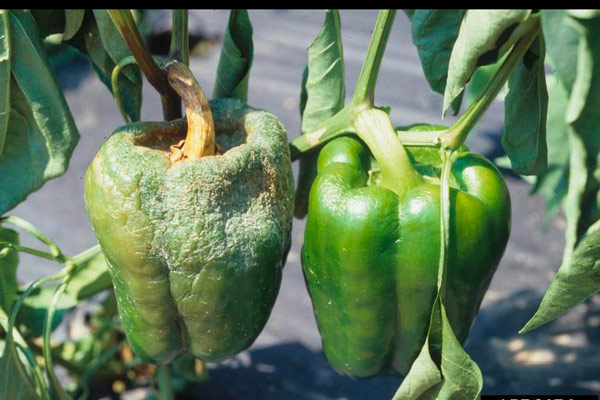
In pepper crops single plants or small groups appear that wilt and soon die. Root system rot and a dark sunken lesion in the collar region are observed. Such plants are usually found in low spots that are flooded by irrigation water, which subsequently spreads the infection throughout the entire crop. Under heavy rainfall during this period, aboveground plant parts are also attacked. At the base of the branches, lesions of dead tissue appear, encircling them like a ring and the part of the plant above the lesion dries out. In fruits the pathogen penetrates through the peduncle, reaches the pericarp and causes its decay. Only the skin remains of the affected peppers, giving them a parchment-like appearance.
Pest control strategy
It includes a system of agrotechnical measures – levelling of the fields; introduction of a 3–4 year crop rotation; growing pepper on high flat beds; not using irrigation water from contaminated sources; upon appearance of the first diseased plants, the spots should be destroyed by irrigation with a 2% solution of ammonium nitrate or copper sulphate. Treatment of crops with plant protection products.
Authorised plant protection products:
Ridomil Gold R WG 500 g/da; Ridomil Gold MZ 68 WG 0.25%.
Cucumbers, watermelons, melons
Downy mildew (cucurbit downy mildew) (Pseudoperonospora cubensis)
On the upper leaf surface yellowish spots of irregular shape appear, delimited by the veins. In wet weather they are water-soaked, and the lower surface is covered with a sparse grey-violet growth of the fungus sporulation. Later the spots enlarge, merge and the entire leaf scorches. The first spots usually appear on the lowest leaves, but within a short time they can encompass the entire plant.
Pest control strategy.
Regular monitoring of crops. Preventive treatments with plant protection products under favourable conditions for the disease.
Authorised plant protection products:
Aliette Flash – 0.3%; Bordeaux Mix 20 WP – 375-500 g/da; Verita WG – 0.15%; Galben 8M 65 – 0.25%; Dithane DG – 200 g/da; Dithane M-45 – 200 g/da; Equation Pro – 0.04%; Infinito SC – 120-160 ml/da; Corsate M DF – 0.3%; Corsate R DF – 0.25%; Kocide 2000 WG – 100-155 g/da; Quadris 25 SC – 0.075%; Mancozeb 80 WP – 0.25%; Melody Compact 49 WG – 150-185 g/da; Polyram DF – 180-200 g/da; Ridomil Gold MZ 68 WG – 0.25%; Ridomil Gold R WG – 500 g/da; Sancozeb 80 WP – 200 g/da; Timorex 66 EC – 0.5%; Champion WP / Macc 50 WP / Champ WP – 0.15%.
Downy mildew of cabbage (Peronospora parasitica)
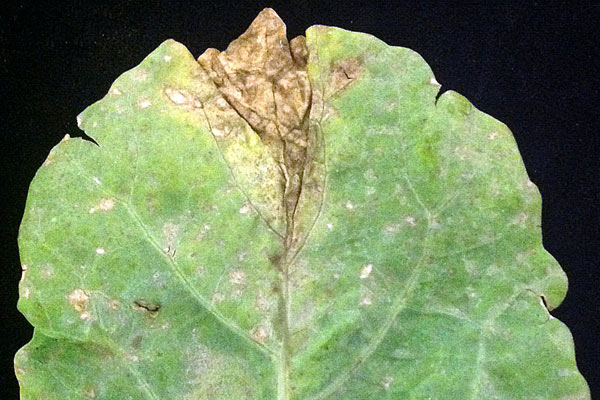
The disease causes more serious damage in seedlings for early production and in late crops. It is particularly dangerous for seed production. The first symptoms are sunken spots on the leaves, which on the underside are covered with a whitish to ash-grey coating with numerous spores. Later the coating disappears and the spots scorch. In adult plants, the outer leaves of the heads are attacked first. In seed production crops the pathogen attacks both the vegetative parts and the flower stalks, fruit pedicels and pods, from where it passes onto the seeds and infects them.
Pest control strategy
Seedlings and crops should be regularly monitored for early detection of the first symptoms. In seedlings preventive treatments with plant protection products are carried out; in early crops a single treatment after the appearance of the first spots is sufficient. In seed crops control must be more intensive.
Due to the presence of a waxy coating on cabbage leaves, an adjuvant should be added to the spray solutions.
Authorised plant protection products:
Bordeaux Mix 50 WP – 375-500 g/da; Infinito SC – 160 ml/da; Ridomil Gold R WG – 500 g/da.
Pests
Tomatoes, peppers, eggplant
Cabbage moth (Mamestra (Baratra) brassicae).
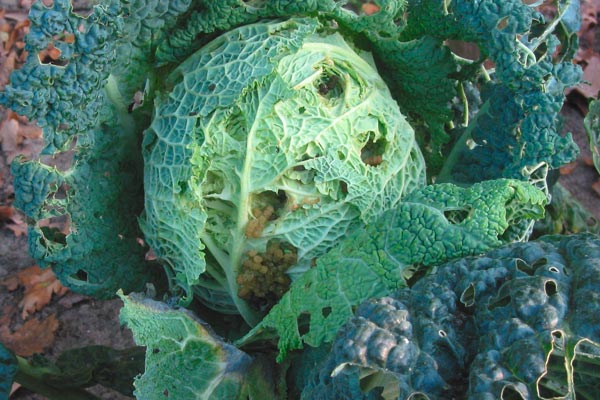
Caterpillars cause feeding damage on leaves and heads. After hatching they live on the underside of leaves, later they eat the leaves leaving only the thick veins and then enter the head. Damaged heads have an unpleasant odour.
Pest control strategy
Regular monitoring of the fields.
Authorised plant protection products.
Avant 150 EC 17 ml/da; Altacor WG 8-10 g/da; Dursban 4 EC 100 ml/da; Confidor Energy 80 ml/da; Ranner 240 SC 40 ml/da; Ampligo 150 ZC 40 ml/da; Supersect Mega 25 ml/da; Sumi Alpha 5 EC 25 ml/da; Nexide 015 CS 40 ml/da; Karate Zeon 15 ml/da; Fury 10 EC 10 ml/da; Decis 2.5 EC 50-70 ml/da; Dipel 2x100 g/da.
Potato tuber moth (Phthorimea operculella).
A dangerous pest that attacks leaves, stems and tubers of plants. In addition to potatoes, it also damages tomatoes, eggplant and some weed species. In potato tubers it bores galleries under the epidermis. The skin above the damage dries and sinks. Caterpillars also bore zigzag-shaped galleries of varying depth in the tubers, filled with excreta. On the leaves they feed near the main vein and mine them. Severely attacked leaves wilt and dry. Caterpillars leave such damaged leaves and penetrate into the stem, boring galleries directed downwards.
Pest control strategy.
Regular monitoring of the fields. Treatments with insecticides against the Colorado potato beetle are also effective against adults of the potato tuber moth.
Authorised plant protection products.
Coragen 20 SC 12.5-17.5 ml/da.