

The relatively dry weather in July allows the fruits of some fruit species and grape varieties to ripen within a short period, but also requires that plant protection treatments be carried out during the cooler hours of the day. In addition to spraying with plant protection products, in order to reduce pest population density in the orchard, it is of great importance that fallen fruits be collected and removed from the orchard.
Pome fruit species
Key pests for the period
Apple and pear scab Venturia inaequalis; Venturia pirina
Powdery mildew on apple Podosphaera leucotricha
Fall webworm Hyphantria cunea
Coddling moth Laspeyresia pomonella = Cydia pomonella
Round leafminer moth Cemiostoma scitella = Leucoptera malifoliella
San Jose scale Quadraspidiotus perniciosus
Aphids fam. Aphididae
European red mite Panonychus ulmi
Apple and pear scab
On developed fruits the spots are irregularly rounded, have a dark coating in the centre and a grey halo forms around them. The spots are often mottled with dark and light zones. Later the coating disappears and corky tissue becomes visible. Severely attacked fruits usually become deformed, crack and often drop prematurely. On fully developed fruits, before ripening, many small, barely noticeable spots are formed which, during storage, enlarge into large scab lesions.
Pest control strategy:
Depending on humidity and the level of infection, treatments continue until the end of the phenophase “fruit growth”.
Authorised plant protection products:
Apple:
anthracol 70 WG - 0.2%; delan 700 WDG 0.035% + 0.02% discus DF; delan 700 WDG – 0.05%; ditan DG - 200 g/da; ditan M-45 - 200 g/da; difcor 250 SC - 15 ml/da; difo 25 EC / shardif 25 EC / difenzon 25 EC - 20 ml/da; captan 80 WG - 150-180 g/da; luna experience - 20-75 ml/da; manfil 75 WG - 320 g/da; merpan 80 WDG - 0.1% + ardent 50 SC - 0.015%; polyram DF - 0.2%; sankozeb 80 WP - 200 g/da; sylit 40 SC - 160 ml/da; scab 80 WG - 188 g/da; score 250 EC - 0.02%; strobe DF / discus DF - 0.02%; strobe DF + delan 700 WDG - 0.02% + 0.035%; thiovit jet 80 WG - 600 g/da; thiram 80 WG - 0.3%; faban - 120 ml/da; faban - 120 ml/da; flint max 75 WG - 0.02%; fontelis SC - 75 ml/da; chorus 50 WG - 0.03% (preventive) 0.05% (curative); shavit F 72 WDG – 0.2%.
Pear:
ditan DG - 200 g/da; ditan M-45 - 200 g/da; difcor 250 SC - 15 ml/da; captan 80 WG - 150-180 g/da; luna experience - 20-75 ml/da; manfil 75 WG - 320 g/da; merpan 80 WDG - 0.1% + ardent 50 SC - 0.015%; polyram DF - 200 g/da; sankozeb 80 WP - 200 g/da; scab 80 WG - 188 g/da; thiovit jet 80 WG - 600 g/da; faban - 120 ml/da;
Round leafminer moth
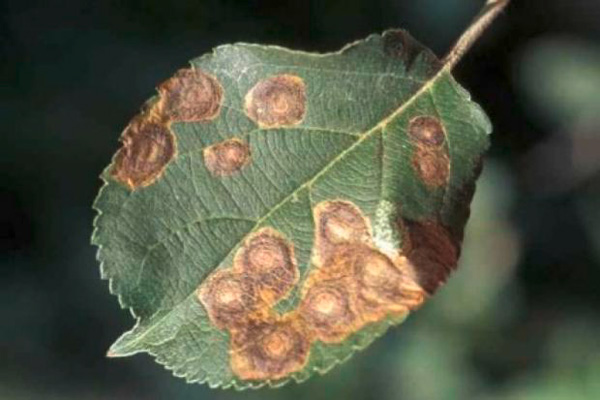
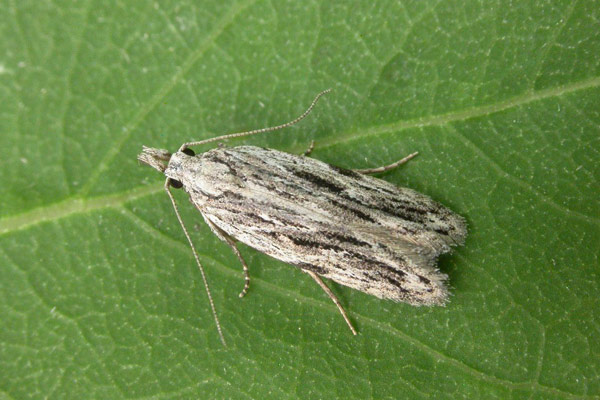
During the month, the development of the second generation is completed and the flight of the moths of the third summer generation begins. With each subsequent generation, the number of mines on the leaves becomes increasingly large. The mines are round, initially as small as a dot and gradually expand spirally as brown spots. They are clearly visible on both sides of the leaf, especially when viewed against transmitted light. At high population density, two or more mines merge into common spots.
Pest control strategy:
Chemical control is carried out at an ETL: 2-3 eggs and mines per leaf.
Authorised plant protection products:
AFICAR 100 EC - 30 ml/da; BI-58 – 0.15%; vaztak nov 100 EC - 0.015%; deka EC / desha EC / dena EC - 50–70 ml/da; dimilin 25 WP – 0.05%; dukat 25 EC – 30 ml/da; dursban 4 EC – 0.015%; efcimetrin 10 EC / ciper 10 EC - 30 ml/da; calypso 480 SC – 0.02%; karate express WG / ninja / forza – 60-100 g/da; mospilan 20 SG – 20 g/da; nexcid 015 CS – 0.04%; sumi alpha 5 EC / sumicidin 5 EC – 0.02%; supersect mega / supersect extra – 0.03%; ciklon 10 EC - 30 ml/da; ciperfor 100 EC - 30 ml/da; sherpa 100 EC - 30 ml/da.
Stone fruit species
Key pests for the period
Powdery mildew on peach Sphaerotheca pannosa
Late brown rot Monilinia fructigena
Cherry leaf spot (cylindrosporiosis) on sweet and sour cherry Blumeriella jappii
Rust on plum Tranzschelia pruni
Plum fruit moth Laspeyresia funebrana = Grapholita (Aspila) funebrana
Oriental fruit moth Grapholitha molesta
Peach twig borer Anarsia lineatella
Slugworm on cherry Caliroa cerasi (lymacina)
Rust on plum
On the upper side of the leaves numerous small, angular, yellow or reddish spots are observed. On the underside the spots are covered with powdery heaps of spores. Severely attacked leaves turn yellow and drop prematurely. In heavily infested trees the fruits ripen prematurely, remain small and with reduced sugar content, and the trees themselves are highly susceptible to winter injury.
Pest control strategy:
Treatment is carried out at the appearance of the first spots on the leaves. Under heavy attack, one or two additional sprays are applied at twenty-day intervals.
Authorised plant protection product:
SIGNUM - 45 g/da
Plum fruit moth
During the month, the flight, egg laying, hatching and harmful activity of the caterpillars of the second generation of the pest continues. The hatched caterpillar bores into the fruit immediately next to the place where the egg was laid. Around the stone, in the fleshy part of the fruit, it forms a gallery filled with excrement and frass. Damaged fruits show signs of premature ripening and drop.
Pest control strategy:
Chemical treatment is carried out at an ETL for the second generation: 1.5-2% fresh entries in the fruits;
Authorised plant protection products:
vaztak nov 100 EC – 0.0125%; decis 2.5 EC – 0.05%; decis 100 EC - 7.5-17.5 ml/da; dimilin 25 WP - 0.04%; dursban 4 EC - 150-200 ml/da; eforia 045 ZC - 150 ml/da; coragen 20 SC - 16–30 ml/da; pyrinex 48 EC – 0.15%; runner 240 SC - 0.03%; sumi alpha
5 EC / sumicidin 5 EC – 0.02%.
Peach twig borer
In July the development of the second generation of the pest takes place. The caterpillars of this generation damage both shoots and fruits. Attacked shoots wilt, their apical part dries together with the leaves, and their growth stops. On the fruits they feed by boring a short tunnel in the fleshy part. The damage resembles that caused by fruit moths.
Pest control strategy:
Treatment is carried out at an ETL - 3% fruits damaged by caterpillars.
Authorised plant protection products:
vaztak nov 100 EC – 0.015%; deka EC / desha EC / dena EC - 50-70 ml/da; decis 100 EC - 8.75–12.25 ml/da; dursban 4 EC - 150-200 ml/da; coragen 20 SC - 16–30 ml/da; luzindo 40 WG – 0.025%; meteor - 90 ml/100 l water; rapax SBS europa - 100-200 ml/da; sineis 480 SC - 20 ml/da; sumi alpha 5 EC / sumicidin 5 EC – 0.02%.