

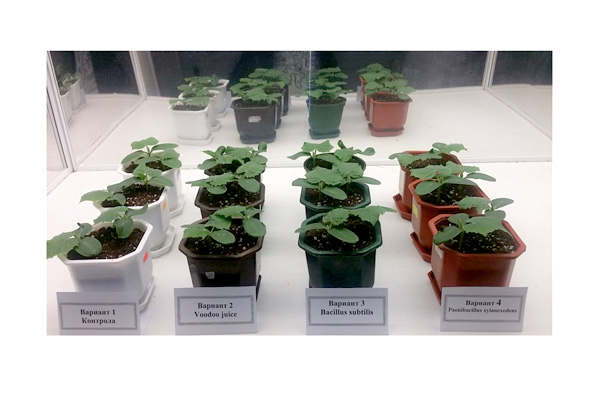
The application of plant biostimulants is an important part of intensive agriculture. An increasing number of farmers are effectively using biostimulants during specific crop growth stages to stimulate growth, the efficiency of mineral nutrition, tolerance to stress factors, as well as to improve the quality of crop production.
Along with protein hydrolysates, humic and fulvic acids, seaweed extracts, etc., microbial biostimulants also belong to the group of biostimulants. They contain beneficial microorganisms and their metabolites. The idea for the development of microbial biostimulants is borrowed from and motivated by the natural ability of organisms to form long-term and diverse relationships in the environment. Plants coexist and interact with the microorganisms associated with them throughout their entire life cycle.
Positive effects of biostimulants on various agricultural crops are confirmed not only in scientific studies, but also in production and demonstration trials. The following microbial biostimulants registered in our country have been tested in these trials.
AminoT is a biostimulant developed from selected fungal strains of the species Trichoderma harzianum and amino acids, which enhances photosynthesis, yield and fruit quality, as well as tolerance to drought, frost and other adverse abiotic factors. It can be applied both foliar and soil-applied to fruit trees, citrus, vegetables, flowers and ornamental shrubs, while in vineyards it is applied only to the soil.
Baikal EM1-U is a biological product containing strains of the species: Lactobacillus casei, Lactococcus lactis, Rhodopseudomonas palustris, Saccharomyces cerevisiae, which can be used both for pre-sowing soil treatment and for seed and tuber (potato) treatment, as well as for foliar application during the vegetation period. Its use improves microbiological processes in the soil and creates an opportunity to increase yield.
Slavol-S is a bacterial inoculant that ensures faster seed germination and contributes to the development of a strong root system, nourishes and stimulates plant growth. It contains soil bacteria Bacillus megaterium and Azotobacter chroococum. It can be applied to the soil and for seed treatment.
Tarantula is a liquid microbial fertilizer containing a complex of microorganisms and minerals (Bacillus sp., Paenibacillus polymixa, Arthrobacter globiformis, N, P, K, Ca, Mg, Na, Fe, Cu, Zn). It can be applied foliar (by spraying) or to the soil to increase yields, to increase protein and oil content in seeds, it improves mineral nutrition of plants, and enhances tolerance to abiotic and biotic stress. It can also be used as an additive to nutrient solutions for hydroponics. It may also be used for seed treatment (maize, winter cereals).
BIO-EDNO (liquid concentrate) is a bacterial inoculant containing nitrogen-fixing bacteria (Azotobacter vinelandii, Clostridium pasteurianum), which increase nitrogen fixation in the soil and soil fertility. It is used for pre-sowing soil treatment.
Biolife concentrate is a soil inoculant for restoring soil microflora, especially in degraded and exhausted soils, and for stimulating plant development. It contains representatives of the genera: Bacillus, Corynebacterium, Pseudomonas, Arthrobacter, Flavobacterium, Rhodococcus, Azotobacter and Streptomyces.
Plantagra is a biological product based on beneficial microorganisms that improves product quality and increases the number of flowers in ornamental crops. It is applied foliar by spraying (spray) or to the soil by addition to nutrient solutions for fertilization in tomato, potato, maize, sunflower and flowers.
Rizo-Vam Basic is a preparation containing the arbuscular mycorrhizal fungus Glomulus intraradices immobilized on a solid carrier. Owing to the symbiosis between the mycorrhizal fungus and the root system, the uptake of nutrients is increased, and tolerance to stress is also enhanced. The preparation is applied to the soil in cereal, forage, fruit, row, vegetable and ornamental crops.
At the Agricultural University of Plovdiv and in other research centres in our country, the physiological and agronomic effects of various microbial biostimulants are being studied. The research is carried out under controlled conditions, with different crops and products and with the use of modern scientific equipment.
Team – Microbial biostimulants
Assoc. Prof. Lyubka Koleva, PhD,
Chief Assist. Prof. Veselin Petrov, PhD,
Gergana Angelova,
Nevin Amin,
Ivelina Daradjanska,
Prof. Yordanka Kartalska, PhD,
Prof. Andon Vasilev, PhD
from the Agricultural University of Plovdiv
You can read the full text in issue 4/2017 of the special supplement “BIOSTIMULANTS FOR AGRICULTURAL CROPS”, which is distributed together with the main print edition of the journal "Plant Protection".