

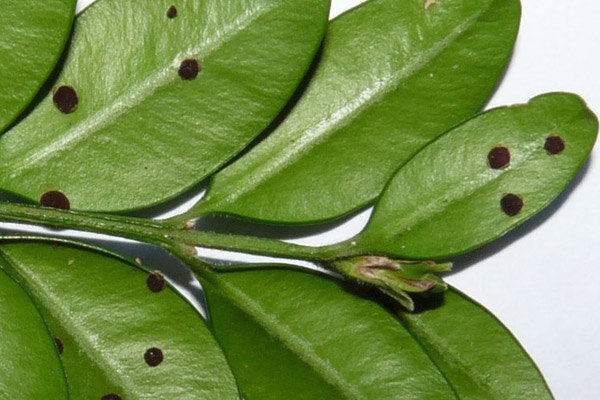
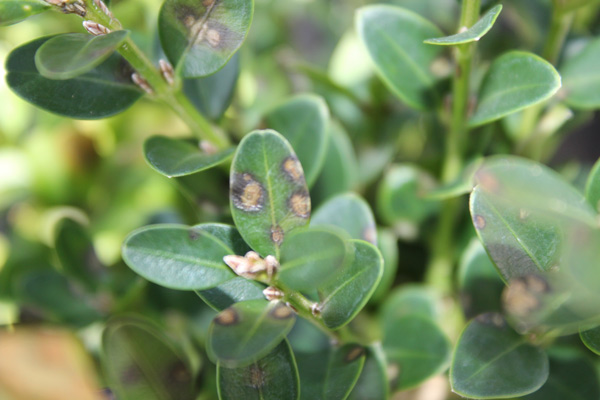
In recent years, farmers have been concerned about the occurrence and spread of diseases, mainly on ornamental shrubs, some leafy vegetables and herbs (for dishes and preserves). The monitoring carried out shows that disease causal agents have appeared which are still unknown in practice and for which the literature information is insufficient. In the period 2015-2016, studies were conducted on vegetation severely affected by diseases.
Rust /Puccinia boxis/
Light brown and or dark brown sori are formed on the leaves. After the epidermis ruptures, a powdery mass of urediniospores and teliospores is exposed. In cases of severe infection, premature leaf fall occurs. The telia are flat, slightly swollen, and the teliospores are club-shaped, light to dark brown, with slight thickening towards the apex. They are constricted at the septa and are formed on long sporophores.
Leaf spots /Phyllosticta boxina/
Light brown spots are formed on the leaves, which become bleached in the centre and are speckled with black dots, the pycnidia of the fungus.
Control:
- Heavily affected branches should be removed in order to ensure aeration inside the shrubs.
- For preventive control of rust, spraying with sulphur-containing products should be carried out. In the presence of both diseases, sulphur-containing fungicides may be mixed with Topsin M - 0.1%, or Dithane M 45 - 0.2%.