

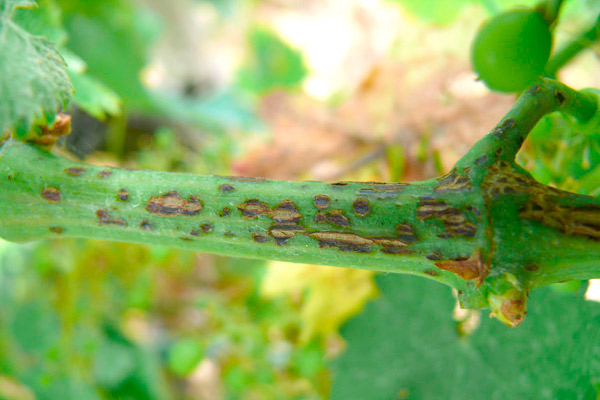
In the presence of increased rainfall and rising daytime temperatures in the period from bud swelling to the second and third leaf, the development of the disease excoriose (Phomopsis cane and leaf spot) on the vine is observed.
The causal agent of excoriose in grapevine is the fungus Phomopsis viticola Sacc., which mainly attacks the green parts of the vine, but symptoms also appear on one-year-old and perennial wood. The fungal pathogen survives in the buds as mycelium and in the shoots as pycnidia (small black dots measuring 0.5–1 mm), where it overwinters.
The disease attacks the buds at the base of the shoot and they fail to develop properly. The shoots are weak, with shortened internodes, and the leaves are small, deformed, with necrotic spots. At the base of the shoots, small dark spots develop, which later merge, lighten and acquire an elliptical shape. At the site of damage, the bark cracks, and the shoots break due to wind and the weight of the clusters. Infected inflorescences dry out before flowering. The most characteristic symptoms appear at the end of the vegetation period, when the bark of infected shoots turns white, cracks and begins to peel. On the clusters, excoriose develops on the rachis before flowering, causing drying.
Strategy for pest control:
Planting material for propagation must be taken only from healthy vines. Parts of the vine attacked by excoriose must be cut out and burned, and the tools used for pruning must be disinfected. Pruning of the vines should be carried out early, before sap flow.
Authorised plant protection products:
VERITA WG – 200 g/ha (0.2%). Applied from the “bud burst” stage to the “second leaves unfolded” stage. Spray volume: 40–100 l/ha. Maximum number of applications per vegetation: 3. Interval between treatments: 10 days.
DELAN 700 WDG – 0.05% (50 g/ha); KUMULUS DF – 750 g/ha; MIKAL FLASH 300 g/ha (0.3%). Applied at the “rosette” phenological stage. Spray volume: 30–100 l/ha. Maximum number of applications per vegetation: 1.
MOMENTUM EXTRA WG 300 g/ha. Applied from the “beginning of bud swelling” stage to the “fourth leaf unfolded” stage. Maximum number of applications: 3, interval between applications: 12–14 days. Spray volume: 40–100 l/ha. Note: During drying to raisins, residual quantities are concentrated.
PASODOBLE 70 WG 200 g/ha
PENCOZEB 75 WG 210 g/ha. Applied from the “beginning of bud burst” stage to the “berries begin to colour” stage. Maximum number of applications: 4, interval between applications: 7 days. Spray volume: 40–100 l/ha.
SOLOFOL 188 g/ha (for table and wine grape varieties). Applied from the “woolly bud” stage: brown wool clearly visible, to the “second leaves unfolded” stage. Maximum number of applications: 2.
THIOVIT JET 80 WG 1250 g/ha. Applied from the “bud burst” stage: green shoot tips clearly visible, to the “fruit is ready for harvest” stage (BBCH 09–89). Maximum number of applications: 8. Minimum interval between applications: 10 days. Spray volume 20–100 l/ha.
FOLDER 80 WG 187.5 g/ha. Applied at the “beginning of bud burst” stage. Maximum number of applications: 2, interval between applications: 7 days. Spray volume: 30–100 l/ha. Note: Vine leaves from treated plantations must not be consumed.
FOLLOW 80 WG 187.5 g/ha, wine grape varieties. Applied before the appearance of the first symptoms, according to disease forecast. From the crop stage “five leaves unfolded”. Maximum number of applications: 8, interval between applications: 10–14 days. Spray volume: 40–100 l/ha.
FOLLOW 80 WG, FRILLER 80 WG, FLOUST 80 WG – 187.5 g/ha.
For more information on authorised plant protection products against excoriose in grapevine, you can see HERE
See also:
Plant protection practices in fruit crops, grapevine and vegetables in April