

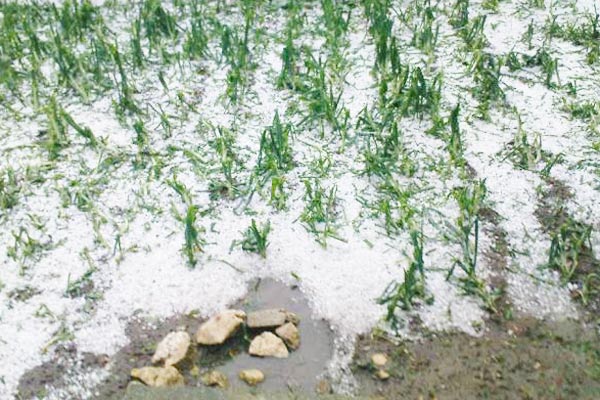
In May, no critical minimum temperatures for agricultural crops are forecast, but they will be low for the season. The risk of hail is high. In case of hail damage, it is advisable that the affected fruit crops be treated with copper-containing fungicides at the first opportunity, in order to accelerate the healing of the wounds and reduce the risk of secondary infections by pathogens.
During the first ten-day period of May, the agrometeorological conditions will be determined by unstable and cool weather. The expected significant precipitation will keep the upper soil layers waterlogged in many places in the field areas, which will hinder the implementation of pre-sowing tillage, delay the sowing of grain maize and some of the thermophilic spring crops – beans, cotton, peanuts, watermelons, melons, etc. During the ten-day period, conditions will be favourable for the development of certain fungal diseases such as downy mildew on grapevine (Plasmopara viticola), blossom blight (Monilia laxa) and shot-hole disease (Stigmina carpophila) in stone fruit species, scab on apple (Venturia inaequalis) and pear (Venturia pirina), fruitlet drop in quince (Monilinia cydoniae), grey mould in strawberry (Botrytis cinerea), etc.
During this period, the vegetation of the winter crops and the sown spring crops will proceed at a slower rate, under below-normal thermal conditions. In wheat and barley in the higher fields, the transition from stem elongation to heading will occur. In the field areas, the predominant stage of the crops will be heading. In some places in the Danube Plain and in Southern Bulgaria, the beginning of flowering will also be observed in the winter cereals.
During most days of the second and third ten-day periods, the development of agricultural crops will take place at temperatures close to the climatic norms. The expected precipitation in the second half of May will maintain a good level of soil moisture reserves in the 50 and 100 cm layers (above 85% of field capacity), and will have a beneficial effect on the winter cereals, in which grain formation and filling will be in progress. At the end of the second ten-day period, in some southern areas, barley will enter the milk ripeness stage earlier than usual. At the end of May, the milk ripeness stage will also be observed in wheat in parts of the Danube Plain and in some places in Southern Bulgaria. During the month, leaf formation will proceed in maize and sunflower. At the end of the third ten-day period, in sunflower crops sown within the agrotechnical time frame, the formation of the inflorescence will be observed.
In May, no critical minimum temperatures for agricultural crops are forecast, but the risk of hail remains. In case of hail damage, it is advisable that the affected fruit crops be treated with copper-containing fungicides at the first opportunity, in order to accelerate the healing of the wounds and reduce the risk of secondary infections by pathogens.
Source: NIMH-BAS