

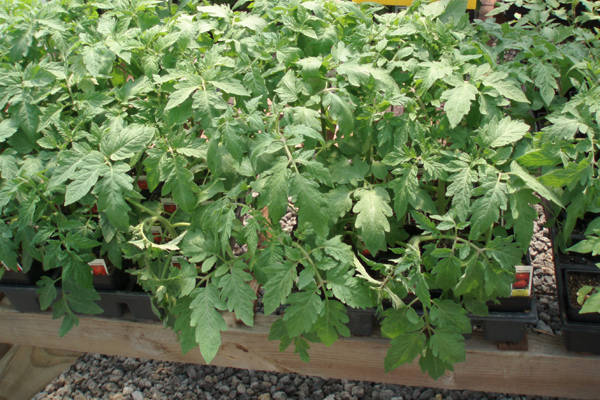
Practices during the period: Care for seedlings for early and medium-early open-field production continues. Plots are prepared for transplanting early tomatoes, peppers, and eggplants at the end of April, and medium-early ones in the first ten days of May. Seeds of late tomatoes and medium-early head cabbage are sown. The necessary agrotechnical practices are applied to ensure optimal conditions for crop development in the protected cultivation facilities. At higher temperatures, to improve the relative air humidity, the paths are frequently moistened, and in glass greenhouses short misting is also carried out. If solar radiation is more intensive, the glass is shaded (whitened) with suitable mixtures.
Plant protection:
- Pre-sowing treatment of tomato and cabbage seeds, if they have not been disinfected. Technological requirements must be observed so as not to destroy seed germination.
- The soil mixtures in the seedbeds must mandatorily be disinfected. Baits against mole crickets are scattered.
- For control of damping-off in seedlings, diseased plants and the healthy plants adjacent to them are removed and destroyed outside the greenhouse, and the soil under them is watered with a fungicidal solution.
- With the last soil tillage, granular insecticides are applied against wireworms when more than 5 pcs/m2 have been established in the preliminary survey. The treatment is also effective against cutworms, mole crickets, leatherjackets, Colorado potato beetle, nematodes, and has a residual effect against sucking pests – aphids, leafhoppers, thrips.
- One week before transplanting, the seedlings are sprayed with fungicides. In tomatoes, early blight (Alternaria), grey mould (Botrytis), powdery mildew, leaf mould are observed, and in cucumbers – powdery mildew, downy mildew, angular leaf spot (bacteriosis).
- Although the pest complex in protected cultivation facilities is the same, due to the higher temperature and low relative air humidity, the harmful activity of thrips and spider mites increases.
- In early crops in the open field there is a risk of occurrence of downy mildews – on brassicas, onions, and early potatoes. Signals from regional services should be monitored and timely control measures should be implemented.
- There is a risk for onion crops from onion fly and leaf miner fly, and for cabbage and radishes – from cabbage fly.
Attention: When spraying brassica and onion crops, an adjuvant must mandatorily be added to the pesticide solution. Caution is required when treating green onions and garlic, radishes, etc., which are offered for fresh consumption early in spring, in order to avoid unwanted and dangerous poisonings with pesticide residues.