

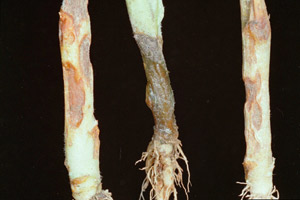
Damping-off is a widespread disease of great economic importance affecting seedlings of all vegetable crops. Two types are distinguished: the so-called false damping-off, resulting from an unfavorable microclimate, and true damping-off, caused by pathogenic soil fungi.
1. False damping-off. It is caused by high temperatures and overheating of the surface soil layer. After pulling out the plant, it is established that the stem is healthy below the damaged area.
2. True damping-off. It is caused by soil fungal pathogens (Pythium, Rhizoctonia, Phytophthora). The first symptoms are subsoil cutting, leading to the death of germinating seeds. After emergence, a wet spot appears at the base of the stem, which expands in a ring, darkens, becomes thinner and the tissue rots. The plants wilt and fall as if cut down, from which the disease takes its name. Initially, individual plants die, then those adjacent to them, and so on, forming spots of various sizes that are foci of infection. The occurrence, development and spread of damping-off are favored by growing conditions – high or low temperatures, high soil moisture or drought, fertilization with high nitrogen rates, high salt concentration, insufficient light, excessive plant density.
The control of damping-off in seedlings is complex: elimination of the primary infection, use of disinfected seeds, sowing in disinfected manure-soil mixtures, ensuring optimal plant density, maintaining an optimal microclimate in the seedling facilities, with the temperature difference between night and day not exceeding 6–8°C. When symptoms appear, irrigation is reduced and the seedlings are covered with a dry mixture. When growing seedlings in outdoor beds, well-drained soils in airy locations should be selected.
In case of occurrence of true damping-off, diseased plants together with the adjacent healthy ones are removed and destroyed, and the patches are irrigated with a 2% solution of copper sulfate or ammonium nitrate. To control the causal agents of the disease, plants are watered with solutions of fungicides registered for this purpose: Proplant 722 SL 0.1% at a working solution rate of 5 l/m²; three applications of Topsin M 70 WP 0.15% for cucumbers and tomatoes in greenhouses: I – 3 days before pricking out at 3 l/m², II – 3 days before transplanting at 50 ml solution per plant, III – 10 days after transplanting at 200 ml solution per plant. For better efficacy against all causal agents of damping-off, combinations of the indicated fungicides are also recommended. When undisinfested manure-soil mixtures are used, before sowing the seeds, their bed is dusted with 3–4 g/m² copper oxychloride or Funguran, and after covering them, it is irrigated with a 0.5% Bordeaux mixture.