

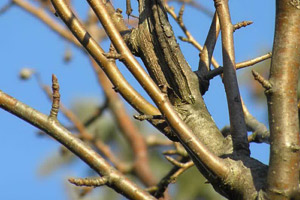
Perform this operation in dry weather during the month of February. Winter spraying must not coincide with winter pruning, since plant protection products are used for spraying, which cause damage if they come into contact with pruning wounds. Calm, windless days are suitable for spraying, as in this way there is no risk that the solution will be carried away by the wind.
When: During the dormant period of the trees.
Objective: To destroy the stages of pests and disease agents that overwinter on their trunks and branches:
- peach leaf curl, shot-hole disease, early brown rot, plum pockets, bacterial blight;
- winter eggs of red fruit mite, aphids, apple and pear psyllids, winter moths, San José scale and other flat scale insects, plum scale insect, codling moth, hawthorn mite, common spider mite and yellow apple mite;
Highlights:
- Winter spraying against pests is necessary only if there is a proven population density above the economic injury threshold. For diseases, however, it is mandatory.
- The best effect from winter spraying is achieved when it is carried out immediately before bud swelling. At that time, the development of the overwintering stages of insects and mites begins. The embryo in the egg is in an advanced stage of development, and the overwintering caterpillars and adult insects leave their winter shelters and move along the branches of the trees.
- The products and your labour will be wasted if you do not spray properly. Thoroughly wet with solution all parts of the branches, twigs and branching points, where pests most often accumulate, as well as the trunk. In other words, “bathe” the entire tree.
Products:
- Against diseases – Bordeaux mixture 1 %, and against peach leaf curl only – in addition to it, the fungicides Funguran OH 50 WP – 0.15 %, Champion – 0.3 %, Dithane DG – 0.3 %, Dithane M-45 – 0.3 % or Thiram 80 WG – 0.3 % may be used.
- Against pests – Parazomer 0.3 %.
If you have pears
At a temperature of 3–5 °C and sunny weather, the pear psylla migrates within the canopy and begins to feed, and at a temperature of 8 °C it begins to lay eggs. This is the moment for spraying. Good efficacy will be obtained from Alfamec 100 EC – 0.0125 % or Sumi Alpha 5 EC – 0.03 %. After the beginning of egg laying, Deltamec 2.5 EC – 0.03 % is recommended.