

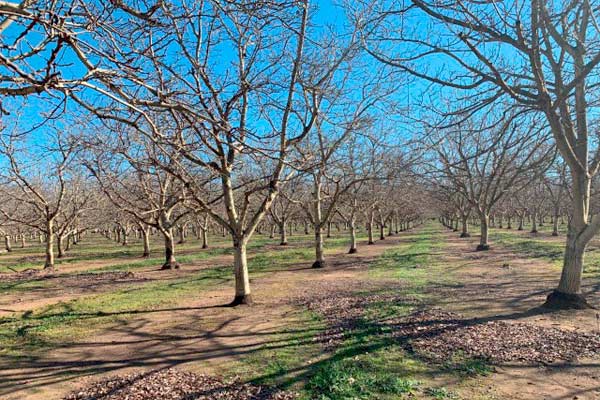
The development of the „National Programme for Pest Control in Permanent Plantations during the Winter Period and Control of the Black Capnodis (Capnodis tenebrionis)“ (the Programme) aims to limit losses and the spread of diseases and pests in the country. The Programme primarily addresses pests that are affected by agrotechnical and chemical control measures applied outside the vegetation period of the plants. Their implementation reduces the overwintering reservoir of pests and disease agents in fruit crops, which ensures normal plant development at the beginning of the vegetation period and reduces the number of vegetation sprayings. In recent years, an expansion of raspberry and strawberry areas in the country and an annual increase in production have been observed. These crops are also grown in a permanent location for years, which is why in 2015, after the Programme was supplemented, pests of raspberries and strawberries that can be controlled by measures outside the active vegetation of the crops were also included. Over the past few years, the trend in the development of the pest black capnodis (Capnodis tenebrionis) has been a gradual expansion of the distribution area and an increase in the number of infested and destroyed plants, respectively in stone fruit and pome fruit plantations, oil-bearing rose and ornamental species of the family Rosaceae. In 2026, the „National Programme for Pest Control in Permanent Plantations during the Winter Period“ was supplemented with measures to limit the spread of the pest black capnodis (Capnodis tenebrionis), and its name was changed to „National Programme for Pest Control in Permanent Plantations during the Winter Period and Control of Black Capnodis (Capnodis tenebrionis)“.
The requirement in the European policy for „sustainable use of pesticides“ guarantees both the production of quality agricultural produce without pesticide residues and a high level of protection of human health and preservation of the environment from the negative impact of pesticides. Autumn-winter sprayings of permanent plantations destroy overwintering forms of pests and also prevent the development of numerous disease agents. In addition to chemical means, agrotechnical and biological methods are used for pest control in permanent plantations during this period.
The current National Programme is intended for specialists – agronomists and agricultural producers and is aimed at diseases and pests whose development can be limited by applying autumn-winter protective measures. The Programme was developed on the grounds of Art. 2 of the Plant Protection Act and Order No. RD 09-656/27.09.2013 of the Minister of Agriculture and Food by a working group comprising employees of the Ministry of Agriculture and Food, the Bulgarian Food Safety Agency, the Regional Food Safety Directorate – Kyustendil, the Regional Food Safety Directorate – Pazardzhik and the Regional Food Safety Directorate – Plovdiv, with the active assistance of the Agricultural University – Plovdiv, and was supplemented in 2015 with the assistance of the Institute of Agriculture – Kyustendil. In 2019, with the assistance of the Institute of Rose and Essential Oil Crops – Kazanlak, the scope of the Programme was expanded, and the oil-bearing rose was added to it. In order to offer solutions for dealing with the problem of the proliferation of the pest black capnodis (Capnodis tenebrionis), by Order No. RD 11-528/24.02.2025 of the Executive Director of the BFSA, the „Guidelines for the Application of Measures for Control of Black Capnodis (Capnodis tenebrionis) in Woody Fruit and Ornamental Species of the Family Rosaceae on the Territory of the Republic of 5 Bulgaria“ were approved.
In the development of the Programme, scientific opinions, data, tables, presentations, photographs, Good Plant Protection Practice in fruit crops, raspberries, strawberries and essential oil crops, materials from EPPO (European and Mediterranean Plant Protection Organization) and others were used.
The National Programme for Pest Control in Permanent Plantations during the Winter Period and Control of Black Capnodis (Capnodis tenebrionis) can be viewed on the BFSA website or HERE