

![MultipartFile resource [file]](/assets/img/articles/заглавна-грозде-дрозофила.jpg)
Drosophila suzukii (Matsumura, 1931) is a pest of growing economic importance that attacks a large number of fruit tree species, berry crops and grapevines.
The species was originally described in the Hawaiian Islands in 1980 (Kaneshiro, 1983). In 2008 it was reported in Spain and California (USA), and in 2009 – in Italy (Cini et al., 2012). From that moment on, D. suzukii has spread very rapidly and within a decade has become established as a major pest of soft-skinned fruits in much of Europe and North America (EPPO, 2025). Its mass reproduction in various regions has a negative impact on fruit production, often leading to losses reaching complete destruction of the harvest.
D. suzukii is a species with broad ecological plasticity, which is why it successfully adapts to climatic conditions – from temperate continental to Mediterranean and even high-altitude zones. D. suzukii has an extremely wide range of hosts – over 90 cultivated and wild plant species, but it prefers fruits with a thin epicarp, on which it causes serious damage by damaging the fruit flesh and allowing the entry of secondary microorganisms leading to rotting processes (Tundagi et al., 2023). This significantly increases the risk of mass spread, creating difficulties in limiting populations. Climatic factors have a significant influence on the development and reproduction of D. suzukii.
Temperature conditions, especially during winter, play a decisive role in the survival of adults (Leach et al., 2019). At the same time, temperature values during the growing season determine larval development and the number of generations within a single season (Wang et al., 2016). At temperatures above 30 °C, a significant reduction in the population and the risk of attack on vineyards is observed (Eben et al., 2018), which indicates that climate change can have both a limiting and a stimulating effect on the spread of the species in different regions.
The biological characteristics of D. suzukii distinguish it from most representatives of the genus Drosophila. Unlike the common fruit fly (D. melanogaster), which prefers overripe or already damaged fruits, D. suzukii lays its eggs in completely healthy fruits (Kienzle et al., 2020). The selection and varietal characteristics of grapevines also influence the degree of attack. Studies show that red wine varieties are more preferred by D. suzukii compared to white ones (Weissinger et al., 2021).
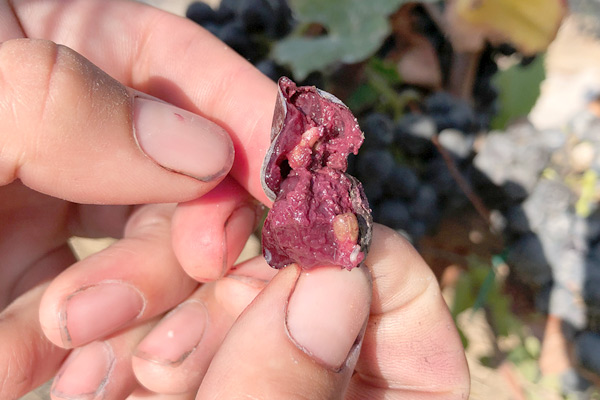
The preference of the species for red-coloured fruits has been confirmed by a number of authors who found a higher degree of attack in varieties with red-purple berry skin compared to those with yellow-green (Poyet et al., 2015). Besides colour, morphological characteristics such as cluster compactness and the tendency to cracking are key factors increasing the risk of attack (Hartman and Kaiser, 2008).
Drosophila suzukii overwinters as an adult insect, which prefers shaded places in forests. The species becomes active when the average daily temperature rises above 10°C. Flies are most active between 20– 25°C, and at 30°C their activity decreases (Kanzawa, 1939). Under suitable conditions it can develop year-round, but it has been established that below 5°C the flies enter winter diapause (EPPO, 2010).
Depending on the climatic conditions of the region, the species develops from 7 to 15 generations. The development of the species passes through complete metamorphosis - egg, larva (3 larval instars), pupa and adult. Initially, females are sexually immature and for their maturation they feed additionally, reaching sexual maturity within 1-2 days. During their feeding, they determine the sugar content in the fruit, and about 14% is necessary for them to lay their eggs in a suitable environment for their development.
In acidic fruits, the larvae cannot complete their development. With their serrated ovipositor, females lay their eggs inside. At low temperatures in autumn, sexually mature females stop laying eggs and continue in the following spring.
To determine the biological characteristics of the species on the territory of Bulgaria, a CLIMEX model was developed, with the help of which maps of the ecoclimatic indices (EI) and the potential number of generations of D. suzukii were created.
These indices make it possible to identify the territories where climatic conditions are favourable for the development and overwintering of the pest. The higher the ecoclimatic index for a given territory, the more favourable the conditions are for the development of the species. At a value of 10, it is assumed that the species could overwinter. The EI values for parts of Northwestern and Central Bulgaria show that the climatic conditions are suitable for the development of the species in the country.
Moreover, even in places with unfavourable conditions for overwintering of D. suzukii, the appearance of temporary populations with the potential to cause significant damage is not excluded (Karadjova et al., 2015). The analysis of the results of the climate model shows that D. suzukii can spread in the country and develop from 3 to 7 generations per year. There are areas where this species can establish permanently and overwinter (Karadjova et al., 2015).
The studies were conducted in 2025 under field conditions in three regions of Southern Bulgaria:
- the village of Brestovitsa, Plovdiv region with the variety „Velika“
- the village of Granit, Stara Zagora region with varieties: „Afrodita“ and „Viktoria“
- the village of Kovachite, Sliven region with varieties: „Muscat Ottonel“, „Hamburg Muscat“ and „Alphonse Lavallée“.
The vines are grafted onto the rootstock Berlandieri × Riparia SO4, in full bearing, grown as mid-trained with Stem Guyot training, and pruning is mixed.
Monitoring of Drosophila suzukii
The occurrence and population dynamics of Drosophila suzukii were monitored with food and pheromone traps placed in the vineyard agroecosystems.
Food traps
For monitoring of D. suzukii, food traps were used containing a mixture of red wine and apple cider vinegar in a ratio of 2:1, placed in plastic containers.
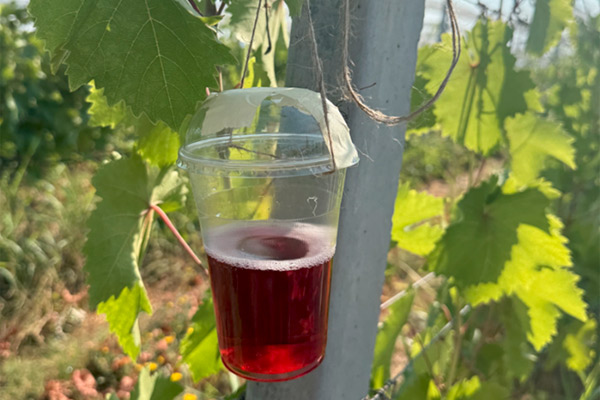
Figure 1: Food trap for monitoring of Drosophila suzukii
The traps are placed around the clusters of the vine plants. The traps were checked at intervals of 10 days, and at each check the food bait was replaced with a freshly prepared mixture.
Pheromone traps
For monitoring of D. suzukii, the pheromone traps PHEROCON® SWD PEEL-PAK™ Broad Spectrum were used in combination with PHEROCON® Red Sticky Canopy Trap and PHEROCON® SWD Dual Panel Sticky Liner, provided by the company Trécé. The traps are placed in the cluster zone, where the highest activity of adults is observed, in order to increase capture efficiency. When necessary, the sticky bottoms and pheromones were replaced according to the manufacturer's instructions. On an experimental area of 0.5 ha, two pheromone traps were placed.
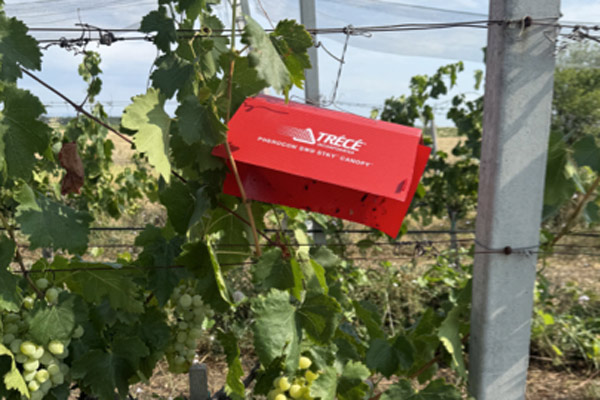
Figure 2: Pheromone trap for monitoring of Drosophila suzukii
The results show widespread distribution of Drosophila suzukii in the surveyed viticultural regions. This trend is an indicator of the high adaptive potential of the species and necessitates increased attention in the monitoring and control of its populations.
The total number of captured adults of Drosophila suzukii shows significant differences between the three studied regions.
The highest abundance was recorded in the village of Brestovitsa – a total of 1564 individuals.
The region is characterised by intensive viticulture and active winemaking activity, as well as the presence of abandoned vineyards in the vicinity.
The variety „Velika“ has large berries, thin skin and high sugar content, conditions that are favourable for oviposition and development of D. Suzukii. According to Cini et al. (2012) and Asplen et al. (2015), varieties with thin skin and juiciness are particularly preferred by the species, which may explain the high density of the pest in this region.
The abundance of D. suzukii in the village of Granit is significantly lower – a total of 84 individuals.
In the village of Granit during the observation period, the neighbouring crops were wheat and lavender, and the vineyards were of the varieties „Afrodita“ and „Viktoria“. Field crops are not suitable food hosts for the species, and the varieties „Afrodita“ and „Viktoria“ have a denser skin and better resistance to cracking, which limits the possibilities for oviposition. Similar results have been reported by Lee et al. (2011), who point out that the absence of suitable hosts leads to a significantly lower population density of the pest.
The abundance of D. suzukii recorded in the village of Kovachite is 145 individuals. In the area, coriander and other field crops were grown in the vicinity, and the varieties are „Muscat Ottonel“, „Hamburg Muscat“ and „Alphonse Lavallée“. These varieties, especially „Alphonse Lavallée“, are characterised by larger and juicier berries, which makes them potentially suitable for the development of the pest. The presence of vineyards with susceptible varieties probably determines the higher abundance compared to the village of Granit, but lower compared to the village of Brestovitsa. A similar relationship between varietal composition and the density of D. suzukii has also been established by Ioriatti et al. (2018), who emphasise the importance of agroecological conditions and variety characteristics. The results obtained confirm that the distribution and density of Drosophila suzukii are closely related both to the presence of suitable hosts and to the varietal characteristics of the vineyards, with varieties with thin skin and high sugar content creating more favourable conditions for the development of the pest.
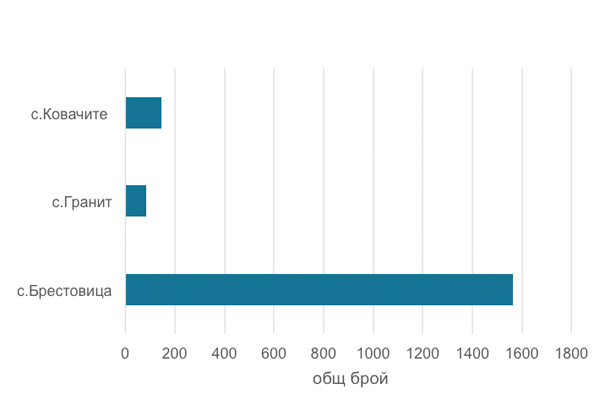
Figure 3: Total number of captured adults of Drosophila suzukii in vineyards in the village of Brestovitsa, the village of Granit and the village of Kovachite in 2025.
Monitoring is a key element of the integrated management of Drosophila suzukii and is of crucial importance for limiting its density. Through regular tracking of the abundance of adults using food and pheromone traps, information is obtained about the occurrence and dynamics of the pest. This allows determining the most appropriate time for applying control measures and reducing losses in the plantations.
References
1. Karadjova, O., Draganova, S., Tomov, R., Ilieva, Zh., Laginova, M., Ivanova, I., Prodanova, S., Rosnev, N., & Chavdarov, L. (2015). National Programme for Phytosanitary Control and Control of Drosophila suzukii.
2. Cini, A., Ioriatti, C., & Anfora, G. (2012). A review of the invasion of Drosophila suzukii in Europe and a draft research agenda for integrated pest management. Bulletin of Insectology, 65(1), 149–160.
3. Eben, A., Espinosa, P. J., Sevilla, F., & Dalmau, E. (2018). Seasonal variation and preference of Drosophila suzukii (Diptera: Drosophilidae) in Spanish vineyards. Journal of Applied Entomology, 142(7), 644–654.
4. EPPO (2010a). Pest alert: Drosophila suzukii. Paris: European and Mediterranean Plant Protection Organization.
5. EPPO (2025). EPPO Global Database: Drosophila suzukii. Paris, France: European and Mediterranean Plant Protection Organization.
6. Hartman, C., & Kaiser, C. (2008). Impact of grape variety characteristics on fruit susceptibility to Drosophila suzukii. Viticulture Science Journal, 6(2), 201–207.
7. Kaneshiro, K. Y. (1983). Drosophila (Sophophora) suzukii (Matsumura) on Oahu. Proceedings of the Hawaiian Entomological Society, 24, 179.
8. Kanzawa, T. (1939). Studies on Drosophila suzukii Matsumura. Yamanashi Agricultural Experiment Station, 49 pp.
9. Kienzle, R., Groß, L. B., Caughman, S., & Rohlfs, M. (2020). Resource use by individual Drosophila suzukii reveals a flexible preference for oviposition into healthy fruits. Scientific Reports, 10, 3132.
10. Leach, H., Moses, J., Hanson, E., Fanning, P., & Isaacs, R. (2019). Rapid population growth of Drosophila suzukii in the absence of crop protection. Journal of Economic Entomology, 112(2), 886–894.
11. Poyet, M., Le Roux, V., Gibert, P., Meirland, A., Prévost, G., Eslin, P., & Chabrerie, O. (2015). The wide potential trophic niche of the invasive Drosophila suzukii: The key of its success? PLoS ONE, 10(11), e0142785.
12. Riedle-Bauer, M., Wiman, N. G., & Fischer, S. (2020). Susceptibility of grape cultivars to Drosophila suzukii and implications for management. Insects, 11(9), 611.
13. Walsh, D. B., Bolda, M. P., Goodhue, R. E., Dreves, A. J., Lee, J., Bruck, D. J., Walton, V. M., O’Neal, S. D., & Zalom, F. G. (2011). Drosophila suzukii (Diptera: Drosophilidae): invasive pest of ripening soft fruit expanding its geographic range and damage potential. Journal of Integrated Pest Management, 2(1), G1–G7.
14. Wang, X. G., Stewart, T. J., Biondi, A., Chavez, B. A., Ingels, C., Caprile, J., Grant, J. A., & Daane, K. M. (2016). Population dynamics and ecology of Drosophila suzukii in temperate climates. Journal of Pest Science, 89(3), 701–712.
15. Weissinger, A., Bahlmann, L., & Vogt, H. (2021). Influence of grape variety on oviposition and infestation behavior of Drosophila suzukii. Vitis, 60(3), 129–136.