

![MultipartFile resource [file_data]](/assets/img/articles/заглавна-мана-картофи.jpg)
Summary
Phytophthora infestans is a highly aggressive oomycete causing potato late blight – one of the most destructive diseases in agriculture. The pathogen has a very short infection cycle, massive sporulation, and can destroy crops within 7–10 days under wet and cool weather. It is characterized by high evolutionary potential, a dual mode of reproduction, and resistance to a number of fungicides. Control relies on a combination of good agronomic practices, fungicides, forecasting models, and resistant varieties.
Potato late blight, caused by the oomycete Phytophthora infestans, is one of the most significant diseases in the history of agriculture. The pathogen is known for its ability to destroy entire crops within days and for its immense impact on society – the most dramatic example being the Irish Famine of 1845–1852, when millions of people died or emigrated as a result of failed potato harvests. The disease appeared in North America in 1843, and only two years later reached Europe, where conditions — cool and wet weather, monoculture potato cultivation, and a lack of resistant varieties — allowed the pathogen to spread at an unprecedented rate (Yuen, 2021; Nowicki et al., 2012).
The ability of Ph. infestans to destroy entire crops within days is due to its extremely short infection cycle. Sporangia are produced en masse on the leaves, spread by wind and rain, and can cause new infections within 3–4 days. Under favorable conditions — high humidity and moderate temperatures — the entire crop can perish within 7–10 days (Nowicki et al., 2012; Arora et al., 2014). This biological characteristic turns the pathogen into an ideal „epidemiological engine“, which in 1845–1852 led to the most severe agricultural catastrophe in European history – the Irish Famine (Yuen, 2021).
The social consequences were so profound that the demographic structure of Ireland remained permanently altered — the population never again reached pre-famine levels (Yuen, 2021).
Ph. infestans is an oomycete belonging to the group of eukaryotic microorganisms related to brown algae, rather than to true fungi (Arora et al., 2014). This characteristic explains why many classical fungicides are ineffective against it. The pathogen reproduces both asexually and sexually, granting it an exceptionally high evolutionary potential. Asexual sporangia are produced en masse on the leaves and can infect new plants within 3–4 days. At lower temperatures, sporangia release motile zoospores, which move in a water film and cause new infections (Nowicki et al., 2012). When both mating types – A1 and A2 – are present, oospores are formed, which survive for years in the soil and serve as primary inoculum in subsequent seasons (Arora et al., 2014; Njoroge et al., 2019).
Since the 1980s, a widespread distribution of the A2 mating type has been observed in many regions, leading to the emergence of more aggressive genotypes, a shorter life cycle, and increased resistance to fungicides. The first symptoms are water-soaked, pale green lesions on the leaves, which quickly darken (Figure 1). A white sporangiophore growth appears on the underside. Stems develop elongated brown lesions and easily break. Under favorable conditions, the entire foliage can die within a week. On tubers, lead-grey lesions develop, forming rust-brown necrosis internally. Often, secondary bacteria cause soft rot in storage (Kromann et al., 2008; Arora et al., 2014; Coomber et al., 2024).
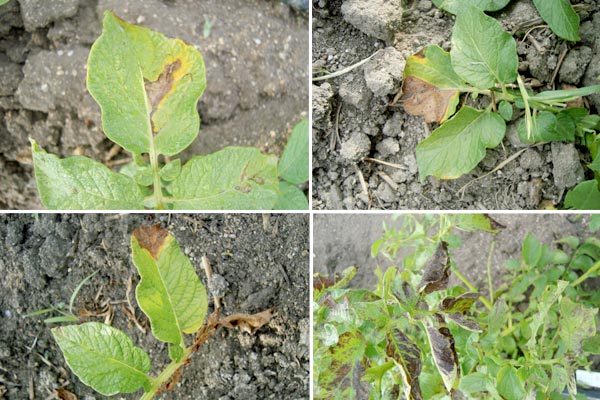
Figure 1. Symptoms of potato late blight
Disease development is highly dependent on humidity, rainfall, and temperatures. Sporulation occurs mainly at night, while light suppresses it (Kim and Mutschler, 2006; Arora et al., 2014).
Numerous forecasting models have been developed – Beaumont, BLITECAST, NegFry – which allow for optimizing fungicide applications and reducing costs (Yuen, 2021).
Integrated disease control measures include:
Agronomic measures
Agronomic practices are the first line of defense and play a key role in reducing primary inoculum. Oospores can survive for years and cause early infections, including on underground stems — a phenomenon observed in Scandinavia (Yuen, 2021). Therefore, it is critically important to: destroy plant debris; avoid growing potatoes in the same location; remove volunteer plants from previous seasons. Short rotations increase the risk of oospore accumulation. A minimum of 3–4 years without potatoes in the same field is recommended (Arora et al., 2014). Good soil drainage — free water is critical for zoospores. Avoid excessive nitrogen fertilization — it stimulates tender, susceptible foliage. Planting certified, healthy seed material (May and Ristaino, 2004).
Chemical measures
Chemical protection remains a key element in disease management, especially in high-humidity regions. Contact fungicides - used early in the season when the risk is lower: dithiocarbamates (mancozeb), chlorothalonil. They prevent infection but do not cure already infected tissues. Systemic and systemic-contact fungicides - used under increased risk or upon the appearance of initial symptoms: phenylamides (metalaxyl), cymoxanil, dimethomorph, mandipropamid, fluazinam, cyazofamid, fosetyl-aluminium (Arora et al., 2014). Metalaxyl is extremely effective, but resistance quickly develops — in some regions, over 60% of isolates are resistant (Arora et al., 2014).
Suitable products for disease control are: RIDOMIL GOLD R WG (metalaxyl-M – 20 g/kg copper oxychloride – 141.9 g/kg) - 500 g/ha, SIVAR GOLD (potassium phosphonates - 255 g/l + azoxystrobin - 62.5 g/l) - 300 ml product/ha, FUNGURAN OH 50 WP (77% copper hydroxide (50% Cu)) - 150 g/ha, CYMbal 45 WG (cymoxanil – 450 g/kg) - 25 g/ha, VITENE TRIPLO R (cymoxanil – 28.5 g/kg fosetyl-aluminium – 300 g/kg Copper – 160 g/kg (present in the form of copper oxychloride)) - 400 - 450 g/ha.
Forecasting models
Models such as Beaumont, BLITECAST, NegFry, and JHULSACAST allow for optimizing spray applications (Yuen, 2021). They use: temperature, humidity, duration of leaf wetness, rainfall. This reduces the number of unnecessary treatments and prevents gaps that could lead to complete crop destruction.
Biological measures
Biological agents have potential, but their field efficacy is limited.
Antagonistic microorganisms: Trichoderma spp., Pseudomonas spp., Bacillus spp. show inhibition of the pathogen under laboratory conditions, but field results are inconsistent (Gupta et al., 2004; Arora et al., 2014).
Late blight remains one of the greatest challenges in potato production. The pathogen is extremely dynamic, evolves rapidly, and overcomes both genetic and chemical barriers. The combination of molecular research, resistant varieties, forecasting systems, and integrated practices is the key to sustainable disease management. Today, Ph. infestans remains a global threat. In many countries, potatoes are a staple food, and the pathogen continues to adapt, develop new races, and overcome the resistance of varieties and fungicides. Its evolutionary potential is so high that even modern genetic studies show: historical isolates from the 19th century already possessed effectors capable of overcoming R genes, which breeders only introduced in the 20th century (Liu et al., 2005; Coomber et al., 2024).
More on the topic:
References
- Arora, R. K., Sharma, S., & Singh, B. P. (2014). Late blight disease of potato and its management. Potato Journal, 41(1), 16.
- Coomber, A., Saville, A., & Ristaino, J.B. (2024). Evolution of Phytophthora infestans on its potato host since the Irish potato famine. Nature Communications, 15, 6488.
- Gupta H, Singh BP and Mohan J (2004) Biocontrol of late blight of potato. Potato J 31: 39-42
- Kim, M. J., and Mutschler, M. A. 2006. Characterization of late blight resistance derived from Solanum pimpinellifolium L3708 against multiple isolates of the pathogen Phytophthora infestans. J. Am. Soc. Hortic. Sci. 131:637-645.
- Kromann P, Taipe A, Andrade-Piedra JL, Munk L and Forbes GA (2008) Pre-emergence infection of potato sprouts by Phytophthora infestans in the highlands tropics of Ecuador. Plant Dis 92: 569-74
- Liu, Z., Bos, J. I. B., Armstrong, M., Whisson, S. C., da Cunha, L., TortoAlalibo, T., Win, J., Avrova, A. O., Wright, F., Birch, P. R. J., and Kamoun, S. 2005. Patterns of diversifying selection in the phytotoxin-like scr74 gene family of Phytophthora infestans. Mol. Biol. Evol. 22:659-672.
- May KJ and Ristaino JB (2004) Identity of the mtDNA haplotype(s) of Phytophthora infestans in historical specimens from the Irish potato famine. Mycol Res 108: 471-79
- Njoroge, A. W., Andersson, B., Lees, A. K., Mutai, C., Forbes, G. A., Yuen, J. E., & Pelle, R. (2019). Genotyping of Phytophthora infestans in eastern Africa reveals a dominating invasive European lineage. Phytopathology, 109(4), 670–680. https://doi.org/10.1094/ PHYTO-07-18-0234-R.
- Nowicki, M., Foolad, M.R., Nowakowska, M., & Kozik, E.U. (2012). Potato and tomato late blight caused by Phytophthora infestans: An overview of pathology and resistance breeding. Plant Disease, 96(1), 4–17.
- Rana RK, Sharma N, Arya S, Singh BP, Kadian MS, Chaturvedi R and Pandey SK (2013) Tackling moisture stress with drought-tolerant potato (Solanum tuberosum) varieties: Perception of Karnataka farmers. Indian J Agric Sci 83(2): 216-22
- Yuen, J. (2021). Pathogens which threaten food security: Phytophthora infestans, the potato late blight pathogen. Food Security, 13, 247–253.
- Yuen, J. E., & Andersson, B. (2013). What is the evidence for sexual reproduction of Phytophthora infestans in Europe? Plant Pathology, 62, 485–491. https://doi.org/10.1111/j.1365-3059.2012.02685.x.